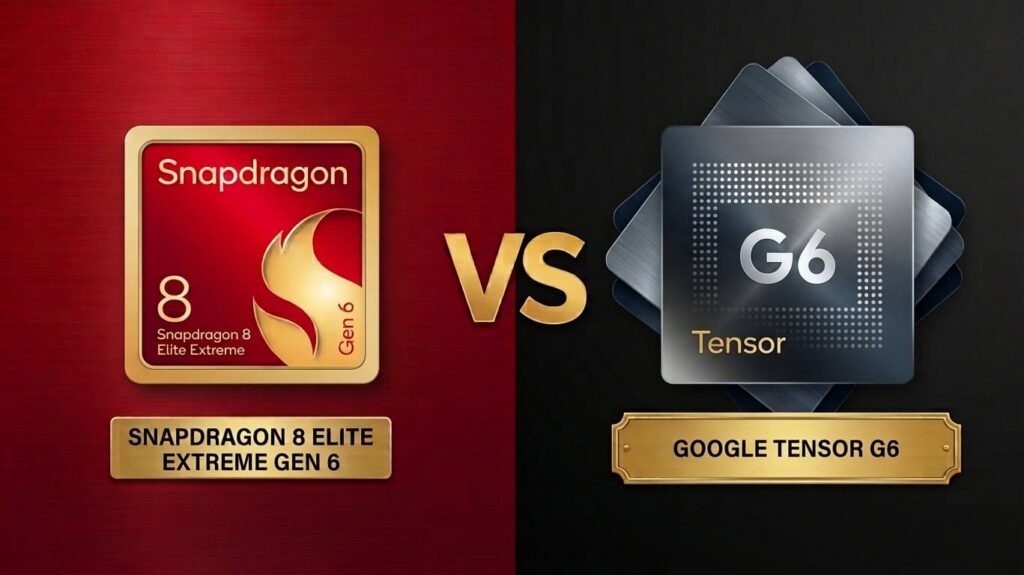

Qualcomm announced its new flagship processors a couple of days ago. The Snapdragon 8 Elite Gen 6 and Snapdragon 8 Elite Extreme Gen 6 are the chips in question. The latter has several advantages over the former, but they’re very similar, and both are made on a 2nm process node from TSMC. With that being said, in this article, we’ll be comparing the Snapdragon 8 Elite Extreme Gen 6 with the Tensor G6 from Google.
As a reminder, we’ve already compared Qualcomm’s latest chips with the MediaTek Dimensity 9600 Pro, Apple A20 Pro, and the Snapdragon 8 Elite Gen 5. Now it’s time to do the same with the best of Google. It’s not exactly a secret that the Tensor G6 is inferior to other top-end mobile chips in the market at the moment, in terms of sheer power. It ranks notably lower on benchmarking tests. Google also doesn’t have a separate facts/specs page for the chip, which is why it required considerable digging to get all the necessary information here. As usual, when it comes to these comparisons, this will be a spec-heavy article. So get ready for that.
| Qualcomm Snapdragon 8 Elite Extreme Gen 6 | Google Tensor G6 | |
| Architecture | 64-bit | 64-bit |
| Process node | 2nm (N2P) | 3nm |
| CPU | – Octa-core – Custom-built Qualcomm Oryon CPU – 2 Prime cores, up to 5.0GHz – 6 performance cores, up to 4.0GHz – 16MB Qualcomm Oryon Flex Cache – 10% improved CPU performance (over Gen 5) – 37% improved CPU power efficiency (over Gen 5) |
– 7-core – Arm cores – 1 Arm C1-Ultra core at 4,11GHz – 4 Arm C1-Pro cores at 3,38GHz – 2 Arm C1-Pro cores at 2,65GHz – Titan M3 security co-processor – 25% faster browsing (over G4) – 20% better power efficiency (over G4) – 8MB L3 cache – 3MB L2 cache – 128KB L1 cache |
| GPU | – Adreno GPU with matrix cores – 35% improved GPU performance (over Gen 5) – 40% improved GPU power efficiency (over Gen 5) – Qualcomm Game Quick Touch 3.0 – Real-time hardware-accelerated Ray Tracing with Lumen Global illumination – API support: Vulkan 1.4, OpenGL ES 3.2, OpenCL 3.0 FP |
– PowerVR CXTP-48-1536 – OpenGL 3.2 |
| Memory | – LPDDR5X/6 up to 5,300MHz – Memory Density: Up to 24GB |
– LPDDR5X – Memory Density: Up to 16GB |
| Storage | UFS 5.0 | UFS 4.1 |
| Wi-Fi | – FastConnect 8800 – Peak download speeds up to 11.6Gbps |
– Wi-Fi 7 |
| 5G Modem | – Qualcomm X105 Modem-RF System – Peak download speeds up to 14.8Gbps – 5G Advanced, 5G mmWave, sub-6GHz, 5G standalone (SA), and non-standalone (NSA) modes, standalone mmWave, and mmWave-sub-6 dual connectivity, FDD, TDD – Uplink up to 4.2Gbps -mmWave: 8 carriers, 2×2 MIMO – Sub-6GHz: 4×6 MIMO – 6nm noode transceiver with 30% lower power consumption – 5th Gen Qualcomm 5G AI processor – Qualcomm 5G PowerSave – Fully integrated NB-NTN and NR-NTN support – 6-antenna (6Rx) support for smartphones – Qualcomm QTM565 mmWave module – Global 5G multi-SIM – 3GPP Release 19 hardware – NB-IoT for extended coverage – Supports all major global 5G bands, from 0.6 to 41GHz |
MediaTek M90 |
| NPU | – 14% improved NPU performance (over Gen 5) | 5th-gen Tensor Processing Unit |
| ISP | – Qualcomm Spectra ISP – Dual Always-Sensing ISPs to support two concurrent always-sensing cameras – Triple 20-bit AI-ISPs – Elite Color Engine with real-time 3D-LUTs – Supports HDR, 16-bit LOFIC, DCG+VS, and DCG Staggered, QDOL, Less Blanking, and Multi-Frame HDR image sensors |
– Dedicated hardware accelerator for video portraits – 4K Portrait Video |
| Bluetooth | – Bluetooth 6.0 – LE Audio – Bluetooth Channel Sounding – Bluetooth High Data Throughput (HDT) |
Bluetooth 6.0 |
| Display | On-device display support: – 4K+@120Hz – QHD+@240Hz Maximum external display support: – HDR, HDR10+, HDR Vivid, Dolby Vision HDR |
Max on-device display support: 3840 x 2400 |
| Location | – Concurrent GPS, Glonass, BeiDou, Galileo, QZSS, NavIC – Triple frequency GNSS – AI-based GNSS Location Gen 3 – Sensor-Assisted Positioning 6.0 – Global pedestrian navigation with sidewalk accuracy – Global freeway lane-level vehicle navigation |
|
| Camera | – Up to 64MP triple camera with Zero Shutter Lag – Up to 108MP single camera with Zero Shutter Lag – Up to 320MP photo capture – Cinema-grade video with APV support – 8k60 video capture – 4k240 ultra HD slow-motion video – 10-bit HEIF: HEIC photo capture – AI video processing |
– Up to 200MP – 8K@30 FPS video capture – Low-light photography boost – Night shot capture up to 4.5x faster – Up to 120x Pro Zoom – Codecs: H.264, H.265, AV1, VP9 |
| USB | USB 3.1 Gen 2 | USB 3.2 |
| Charging | Qualcomm Quick Charge 5 | N/A |
| Audio | – Qualcomm Sound Technology Suite – Qualcomm aptX Adaptive and aptX Lossless audio – Qualcomm Aqstic audio codec – Qualcomm Aqstic smart speaker amplifier – Playback: -108dB – Qualcomm Aqstic Speaker Max – Qualcomm Audio and Voice Communication Suite – Qualcomm Spatial Audio Renderer with head-tracking |
Codecs: AAC, AIFF, CAF, MP3, MP4, WAV |
| AI | – Advanced agentic AI with deeper contextual understanding – Significantly enhanced on device AI performance – 30B+ parameters MoE (Mixture of Experts) models 50% larger shared memory – 20% improved AI performance per-watt (over Gen 5) |
50% on-device AI boost |
| Power Savings | Up to 37% improved CPU power efficiency (over Gen 5) | Up to 20% better power efficiency (over G5) |
Which OEMs/phones (will) use them?
As many of you know by now, Google’s Tensor chips are exclusive to the company’s Pixel devices. The Google Pixel 11, Pixel 11 Pro, Pixel 11 Pro XL, and Pixel 11 Pro Fold already utilize the Tensor G6 chip. Those devices were announced back in August. There is a chance that the Pixel 11a will end up using the Tensor G6, but based on last year’s model, the Tensor G5 is the more probable choice for Google. There’s a good chance these four devices will be the only ones that end up using the Tensor G6 chip.
What about the Snapdragon 8 Elite Extreme Gen 6? Well, both that chip and its sibling will be used by a ton of devices over the next year or so. Qualcomm confirmed that devices from HONOR, iQOO, Motorola, OnePlus, OPPO, Redmi, RedMagic, Vivo, and Xiaomi will be amongst those to utilize this chip. We also know that the OnePlus 16 will utilize it, and the newly announced Xiaomi 18 Pro and Xiaomi 18 Pro Max already use the Snapdragon 8 Elite Gen 6 series. The Motorola Signature 27 was also announced, and it uses the Snapdragon 8 Elite Extreme Gen 6.
The post Snapdragon 8 Elite Extreme Gen 6 vs Google Tensor G6 Comparison appeared first on Android Headlines.