MoMo Productions/Getty Images
- Middle-income Americans are increasingly taking on multiple jobs, surpassing lower-income earners.
- The share of multiple jobholders with a college degree has risen, and more women have multiple jobs.
- It paints a picture of traditionally more affluent and stable Americans seeking out a second income.
America’s middle class is always hustling — and now, they’re side hustling.
The share of Americans with more than one job has been steadily rising for the last several years, and is still hovering at elevated levels. But the population holding multiple jobs looks different from before the pandemic, with a growing cohort of more traditionally stable Americans now seeking multiple income streams.
The second job is no longer just a survival tactic for the lowest earners, or a nice income boost for the highest earners — it’s increasingly showing up for college-educated, middle-income Americans and the women of the workforce, who seem to be seeking out an extra buffer of stability and income.
An analysis from the Richmond Federal Reserve found that before the pandemic, the share of multiple jobholders across income groups was similar: low-, middle-, and high-earners worked multiple jobs in roughly equal proportion.
In the past few years, that’s changed. Middle-income earners are much more likely to hold multiple jobs than their lower-earning counterparts, and sit just barely below their higher-earning peers.
At the same time, college-educated workers have increasingly been creeping into the multiple jobholder workforce. In the 1990s, they made up around 35% of those holding multiple jobs; by 2024, they made up over half, according to the Richmond Fed analysis.
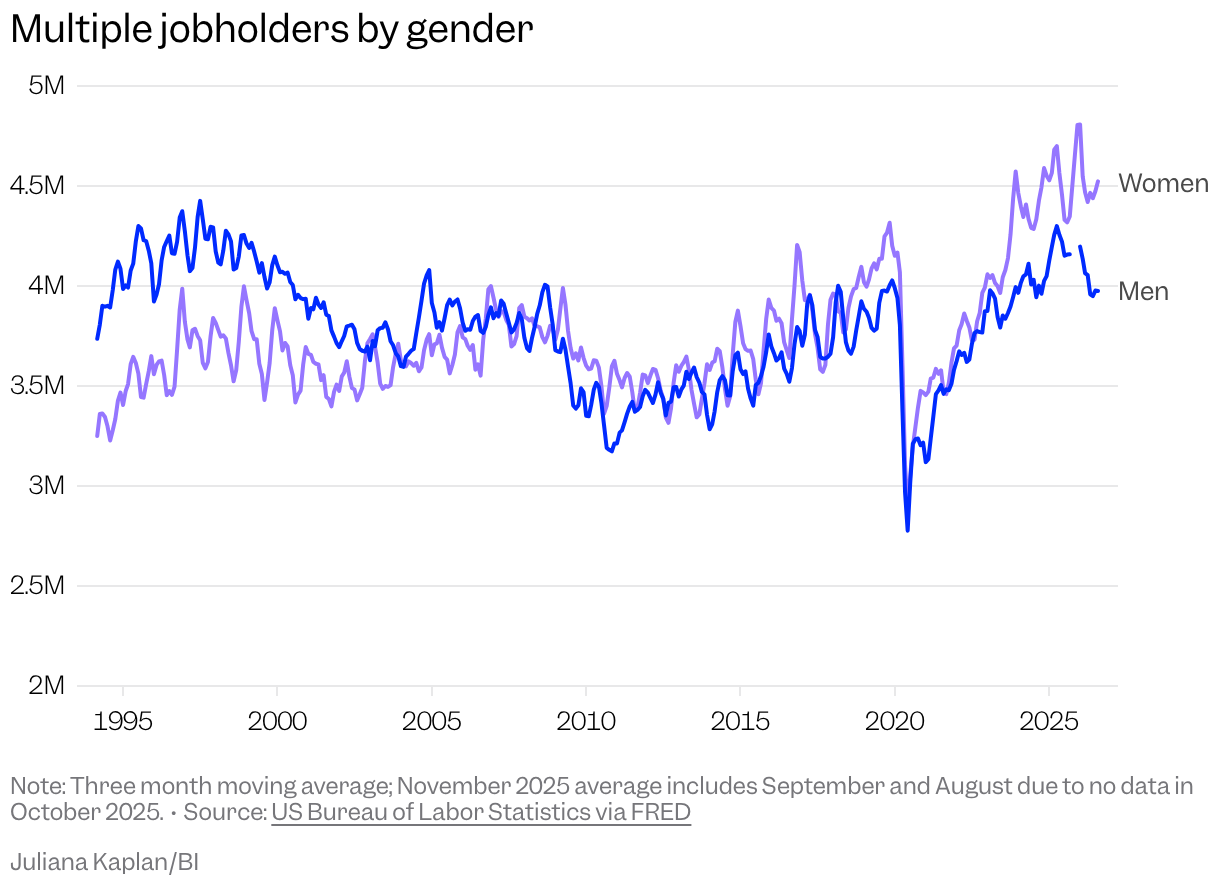
Simultaneously, the number of women holding multiple jobs has increased in the last few years, according to the Bureau of Labor Statistics’s latest employment data. The gender gap in multiple jobholding has widened, meaning that more women — especially those aged 20 to 24 — are working in several roles. That tracks with a labor force where women have outnumbered men with college degrees, and younger women in some areas earn more than their male counterparts.
Taken together, the data indicate that more educated and traditionally more affluent Americans feel an urge to bring in multiple income streams. Side hustles are increasingly prevalent across the economy: The share of Americans holding down a side hustle has increased from 19% in 2017 to 27% in 2025, per a Bankrate survey. Official measures of multiple jobholding also often fail to completely capture the number of workers participating in gig work, since BLS’s rate measures workers who hold at least one traditional wage job.
And that might show how workers feel about their prospects. Women have been shedding jobs in the past months, and the white-collar world has been shaken by layoffs attributed to AI. Taking a new job is risky — workers say it’ll cost more than ever to lure them away from their roles — so an additional job might offer more reassurance. For college-educated workers, middle-income earners, and women, a side hustle might be a buffer against an increasingly unsteady labor market.