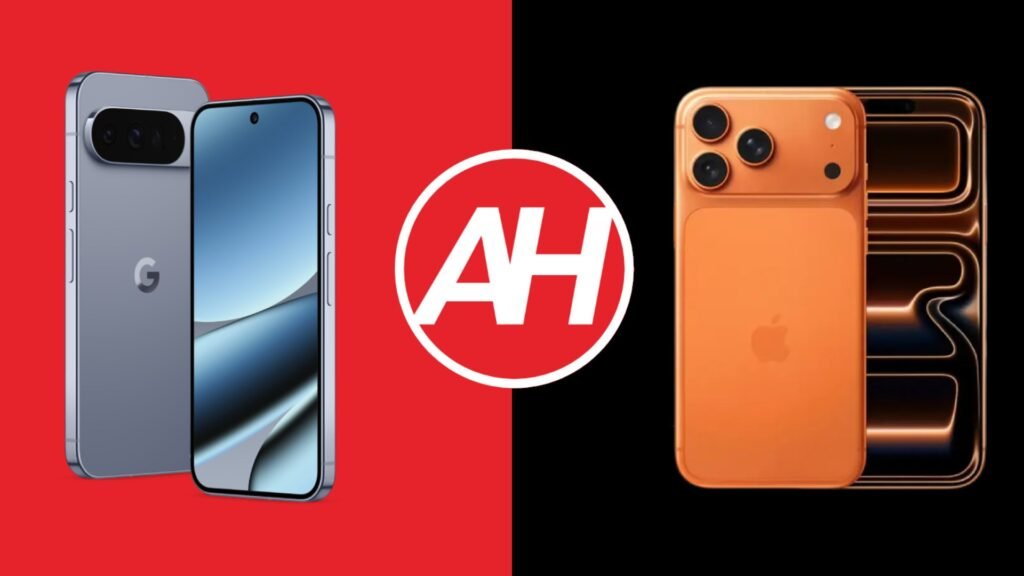

Both Google and Apple announced very compelling large-format flagships as part of their latest flagship smartphone series. We’re here to compare those two devices. We’ll be comparing the Google Pixel 10 Pro XL vs Apple iPhone 17 Pro Max. These two phones have been on the market for a while now, and they’re actually very different. They are both large and have some similarities, but for the most part, they’re very different.
As we usually do, we will first list the specs of both smartphones. Following that, we’ll compare their designs, displays, performance, battery life, cameras, and audio. Their spec sheets are different as well, but so are their designs, their camera performance, and so on. So, let’s get into it, shall we?
Specs

Google Pixel 10 Pro XL

Apple iPhone 17 Pro Max
| Google Pixel 10 Pro XL | Apple iPhone 17 Pro Max | |
|---|---|---|
| Dimensions | 162.8 x 76.6 x 8.5mm | 163.4 x 78 x 8.8 mm |
| Weight | 232 grams | 233 grams |
| Display | 6.8-inch Super Actual LTPO OLED display | 6.9-inch LTPO Super Retina XDR OLED |
| Refresh rate | Smooth Display (1-120Hz) | 1-120Hz (adaptive) |
| Resolution | 2992 x 1344 | 2868 x 1320 |
| Chipset | Google Tensor G5 | Apple A19 Pro |
| RAM | 16GB (LPDDR5X) | 12GB |
| Storage | 256GB/512GB/1TB (UFS 4.0) | 256GB/512GB/1TB/2TB |
| Main camera | 50MP (f/1.68 aperture, 1/1.3-inch sensor size, 82-degree FoV) | 48MP (1/1.28 aperture, 1.22um pixel size, sensor-shift OIS, dual pixel PDAF) |
| Ultra-wide camera | 48MP (f/1.7 aperture, 1/2.55-inch sensor size, 123-degree FoV) | 48MP (f/2.2 aperture, 1/2.55-inch sensor size, 120-degree FoV, 0.7um pixel size, PDAF) |
| Telephoto camera | N/A | N/A |
| Periscope telephoto camera | 48MP (f/2.8 aperture, 1/2.55-inch sensor size, 5x optical zoom, 22-degree FoV) | 48MP (f/2.8 aperture, 1/2.55-inch sensor size, PDAF, 3D sensor-shift OIS, 4x optical zoom) |
| Selfie camera | 42MP (f/2.2 aperture, 103-degree FoV) | 18MP (f/1.9 aperture, OIS) |
| Battery size | 5,200mAh | 4,832mAh (nano SIM) / 5,088mAh (eSIM only) |
| Charging | 30W wired, 25W Qi2 wireless (charger not included) | 40W wired, 25W MagSafe wireless, 4.5W reverse wired (charger not included) |
| Colors | Moonstone, Jade, Porcelain, Obsidian | Silver, Cosmic Orange, Deep Blue |
Google Pixel 10 Pro XL vs Apple iPhone 17 Pro Max: Design
The moment you lay your eyes on these two phones, you’ll see a bunch of differences. That is true regardless of whether you’re looking at them from the front or the back. They do have similar corner curvature and shape, and they also both include flat frames. The Pixel 10 Pro XL has a flat display with a centered display camera hole up top, with thin and uniform bezels. The iPhone 17 Pro Max includes a flat display with a pill-shaped cutout at the top, the so-called Dynamic Island. This phone also has thin and uniform bezels.
The Google Pixel 10 Pro XL includes a power/lock button on the right-hand side, with the volume up and down keys below it. The iPhone 17 Pro Max, on the flip side, has a power/lock button on the right-hand side, along with the Camera Control key. Its volume rocker buttons are on the left side, along with an Action Key. So, yes, the iPhone 17 Pro Max has two extra buttons in comparison.
They both include flat backplates, though the iPhone 17 Pro Max’s has more flair due to a two-tone design. The Pixel 10 Pro XL includes a horizontal camera bar, which protrudes on the back. The iPhone 17 Pro Max has a camera bar as well, an even bigger one, with three of its cameras grouped in the top-left corner, contrary to the Pixel’s horizontal layout, which is more spread out.
Both phones are slippery in the hand, while they have the same weight (there’s a 1-gram difference). The Pixel 10 Pro XL is slightly narrower, while they’re almost identical in terms of height and thickness. Both smartphones are IP68 certified for water and dust resistance.
Google Pixel 10 Pro XL vs Apple iPhone 17 Pro Max: Display
The Google Pixel 10 Pro XL has a 6.8-inch LTPO OLED display with a refresh rate of up to 120Hz. That display is flat, and it supports HDR10+ content. The peak brightness here is 3,300 nits. The screen-to-body ratio is at 88%, while the resolution is 2992 x 1344 pixels. You’re getting a 20:9 display aspect ratio here, while the Gorilla Glass Victus 2 from Corning protects the display.

The iPhone 17 Pro Max, on the other hand, has a 6.9-inch LTPO Super Retina XDR OLED display. That panel is also flat, and it has a refresh rate of up to 120Hz. HDR10 and Dolby Vision are supported, while the peak brightness is 3,000 nits. The phone offers a screen-to-body ratio of around 91%. When it comes to resolution, it’s 2868 x 1320 pixels here, along with a 19.5:9 display aspect ratio. The Ceramic Shield 2 protects the panel.
Both of these displays are great, actually. They’re not only vivid and sharp, but they have great viewing angles. The touch response is also very good, while they do get bright enough regardless of where you use them. Neither panel has high-frequency PWM dimming like the competing flagships, so if you have sensitive eyes, take note of that. The display protection is also good on both.
Google Pixel 10 Pro XL vs Apple iPhone 17 Pro Max: Performance
Google’s Tensor G5 processor fuels the Google Pixel 10 Pro XL. That is a 3nm chip made by TSMC. It’s paired with 16GB of LPDDR5X RAM and UFS 4.0 flash storage here. The storage is not expandable, but you can choose between 256GB, 512GB, and 1TB options here, so choose carefully.
The iPhone 17 Pro Max, on the flip side, is fueled by the Apple A19 Pro processor. That’s also a 3nm chip, and it’s paired with 12GB of RAM here, along with NVMe storage. Apple’s flagship does not support storage expansion either, but you can choose between 256GB, 512GB, 1TB, and 2TB storage options here.
When it comes to actual performance, Apple’s flagship does pack more punch. Its processor is notably more powerful, though both smartphones offer great performance. During day-to-day use, they’re both very snappy and responsive. They’re great for multitasking and basically whatever else you can think of. The iPhone 17 Pro Max does have the edge in the gaming department, though. That’s honestly not something you’ll notice unless you’re playing the most demanding games out there.
Google Pixel 10 Pro XL vs Apple iPhone 17 Pro Max: Battery
The Google Pixel 10 Pro XL includes a 5,200mAh battery on the inside. The iPhone 17 Pro Max, on the other hand, comes in two battery versions. Its eSIM-only model includes a 5,088mAh battery, which is available in the US. The nano SIM model has a 4,823mAh battery on the inside. Neither company opted to utilize silicon-carbon technology; though, they both use Li-Ion batteries.
Apple’s iPhones usually have smaller batteries than their Android counterparts, though that doesn’t have to mean they have worse battery life. These battery capacities are not that far apart, and do note that we’ve used the eSIM version of the iPhone 17 Pro Max. In comparison, Apple’s iPhone is much better in terms of battery life. Getting over 2-3 hours of extra screen-on time is doable, which is a considerable difference. Your mileage may vary, though, of course.
The Pixel 10 Pro XL supports 45W wired, 25W wireless (Qi2), reverse wired, and bypass charging. The iPhone 17 Pro Max, on the other hand, supports 40W wired, 25W wireless, and 4.5W reverse wired charging. The Pixel 10 Pro XL can be fully charged in around an hour and 20 minutes. The same goes for the iPhone 17 Pro Max, while its nano SIM variant can get there in around an hour and 10 minutes. Do note that neither phone comes with a charger in the box.
Google Pixel 10 Pro XL vs Apple iPhone 17 Pro Max: Cameras
There are three cameras included on the back of the Pixel 10 Pro XL. There is a 50-megapixel main camera with an f/1.7 aperture, 1/1.31-inch sensor size, dual pixel PDAF, and OIS. The second camera is a 48-megapixel ultrawide unit with an f/1.7 aperture, 1/2.55-inch sensor size, dual pixel PDAF, and a 123-degree FoV. The last camera is a 48-megapixel unit with an f/2.8 aperture, 1/2.55-inch sensor size, dual pixel PDAF, and OIS. This is a periscope telephoto unit with a 5x optical zoom.

The iPhone 17 Pro Max, on the other hand, includes three rear cameras as well. A 48-megapixel main camera has an f/1.8 aperture, 1/1.28-inch sensor size, dual pixel PDAF, and sensor-shift OIS. A 48-megapixel ultrawide camera is also included with an f/2.2 aperture, 1/2.55-inch sensor size, PDAF, and a 120-degree FoV. The last camera is a 48-megapixel periscope telephoto unit with an f/2.8 aperture, 1/1.28-inch sensor size, dual pixel PDAF, and sensor-shift OIS.
Both of these phones do a great job in terms of capturing photos. They’re not the best in the market in general, but they’re great. The Pixel 10 Pro XL tends to take more contrasty shots, while the iPhone 17 Pro Max is closer to real-life. They both offer a great level of detail and excellent dynamic range. They are also very capable in low light. The performance of their periscope telephoto and ultrawide cameras is also comparable in terms of quality. The iPhone 17 Pro Max handles video recording better, though.
Audio
You’ll find stereo speakers on both of these smartphones. The ones on the Pixel 10 Pro XL are a bit louder in comparison. The difference is not that big, though, and one could argue the iPhone 17 Pro Max offers a slightly better audio output in general.
When it comes to the audio jack, neither phone has it. They both support audio connectivity via their Type-C ports, however. If you prefer wireless connectivity, however, Bluetooth 6.0 is supported by both phones.
The post Phone Comparisons: Google Pixel 10 Pro XL vs Apple iPhone 17 Pro Max appeared first on Android Headlines.