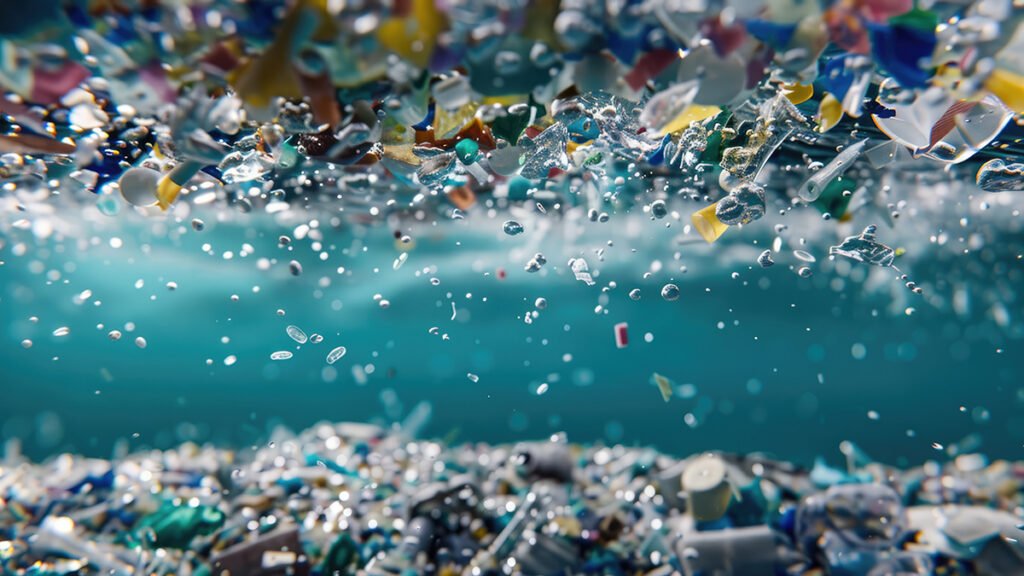
Microplastics have infiltrated all parts of the ocean, with particles identified in sea spray above and the abyssal plain below. This month, Eos is taking a look at researchers using innovative techniques, fresh datasets, and old-fashioned fieldwork to track these tiny invaders and help inform policies to better control them at global, regional, and municipal levels.
In “Tracking Microplastics Above and Below the Waves,” scientist-authors Salvador Reynoso-Cruces and Harry Alvarez-Ospina detail the movement of marine microplastics (MPs) around the celebrated Caribbean coast of Cozumel, Mexico. Their research follows plastics, wafted on winds, that eventually infiltrate the ocean—and, crucially, how some MPs make their way back to the atmosphere. Reynoso-Cruces and Alvarez-Ospina investigated this understudied pathway to reveal “when the ocean acts as a source of airborne MPs, what types of plastic are most likely to be exchanged, and how local breezes and currents shape where the particles end up.”
While Reynoso-Cruces and Alvarez-Ospina mostly stick to the sunlit zone, their fellow scientist-authors Shiye Zhao, Luisa Galgani, and Karin Kvale dive deep into the water column in “Measuring Microplastics in Every Ocean Layer.” As micro- and nanoplastics descend, they not only introduce toxins to delicate biota; they can also disrupt the density of falling organic particles and, as a result, the ocean’s carbon transport. Zhao and his coauthors are making critical inroads where “consistent sampling and analysis methodologies for subsurface plastics do not currently exist.”
The ubiquity of plastics in our everyday lives can make plastic pathways to aquatic ecosystems legion in number. Tire particles are infiltrating estuaries. Nanoplastics from high-mountain trekking gear are accumulating in remote Himalayan lakes. Decrepit ordnance from World War II is polluting the Baltic Sea.
With a more robust understanding of where microplastics are coming from, where they’re going, and how they’re getting there, scientists are helping policymakers put the microplastic invasion in perspective.
—Caryl-Sue Micalizio, Editor in Chief
Citation: Micalizio, C.-S. (2026), Millions of invaders are attacking the ocean, and the ocean is losing, Eos, 107, https://doi.org/10.1029/2026EO260211. Published on 1 July 2026.
Text © 2026. AGU. CC BY-NC-ND 3.0
Except where otherwise noted, images are subject to copyright. Any reuse without express permission from the copyright owner is prohibited.