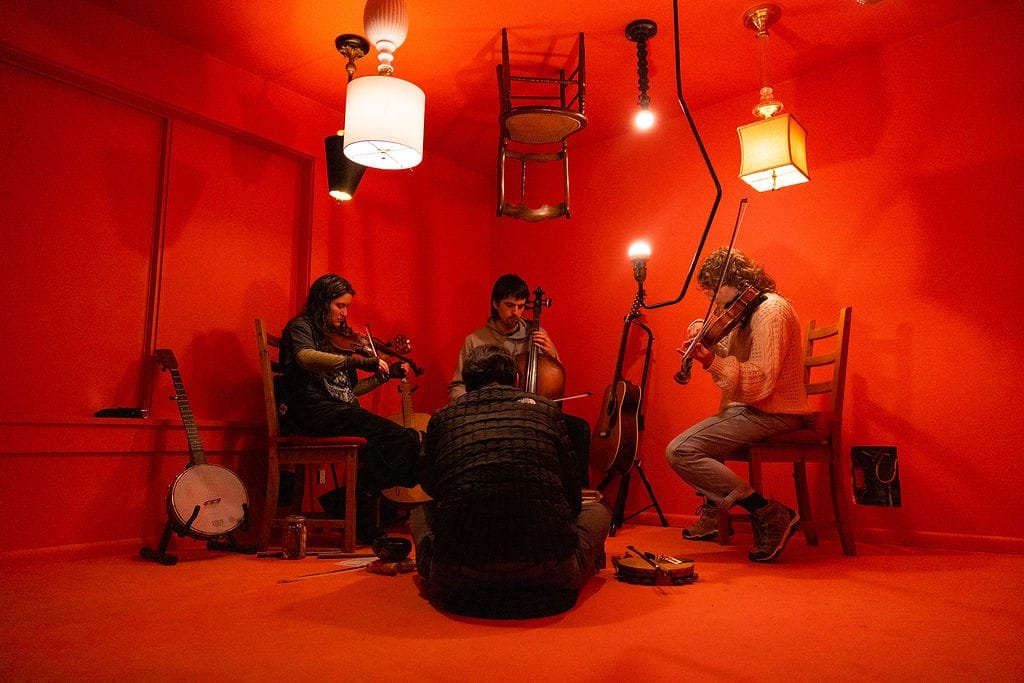
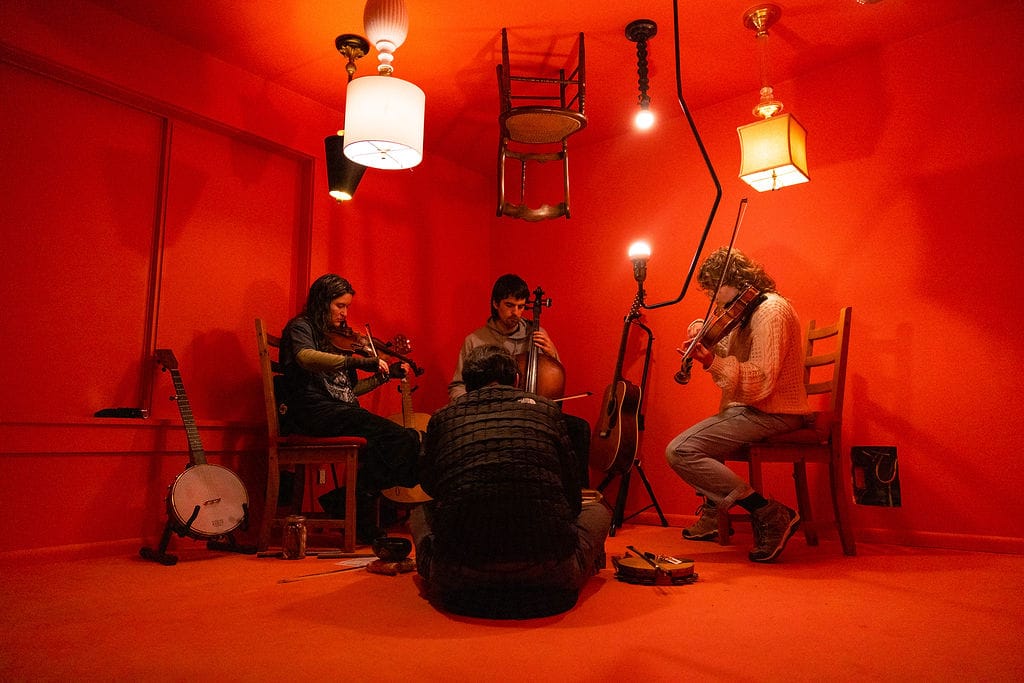
SEATTLE — As the sun sank on a cold day in late February, a steady stream of visitors crossed a stranger’s lawn and filed through the front door of a small bungalow in Seattle’s Greenwood neighborhood. Inside, a topsy-turvy living room was drenched in a fresh coat of bright red paint. Upside-down chairs sprouted from the ceiling, and thrift-store lamps dangled, their shades nearly grazing the heads of guests who, clutching plastic cups of Two-Buck Chuck, tapped their feet to the swell of cello, guitar, and melodica coming from somewhere within the crowd. A hand-painted statement written in black across the crimson wall laid out the terms of this heady bacchanal: The house had only a few days left to live. Five artists were giving it a last hurrah.
Once Removed, conceived by gallerists Zoë Hensley and Sammy Skidmore, invites artists to temporarily transform vacant houses slated for demolition, on the verge of erasure. In contrast to the commercial gallery system in which both organizers work — dealing primarily in objects such as glass, sculpture, and painting — the project foregrounds artists working with material and ideas not suited to commercial galleries: wax, cornstarch, charcoal, and flickering video — material as impermanent as the house itself.
“We want to act as a little eddy in the stream of gentrification, giving these houses one last burst of life before they’re gone,” Hensley told Hyperallergic in an interview.
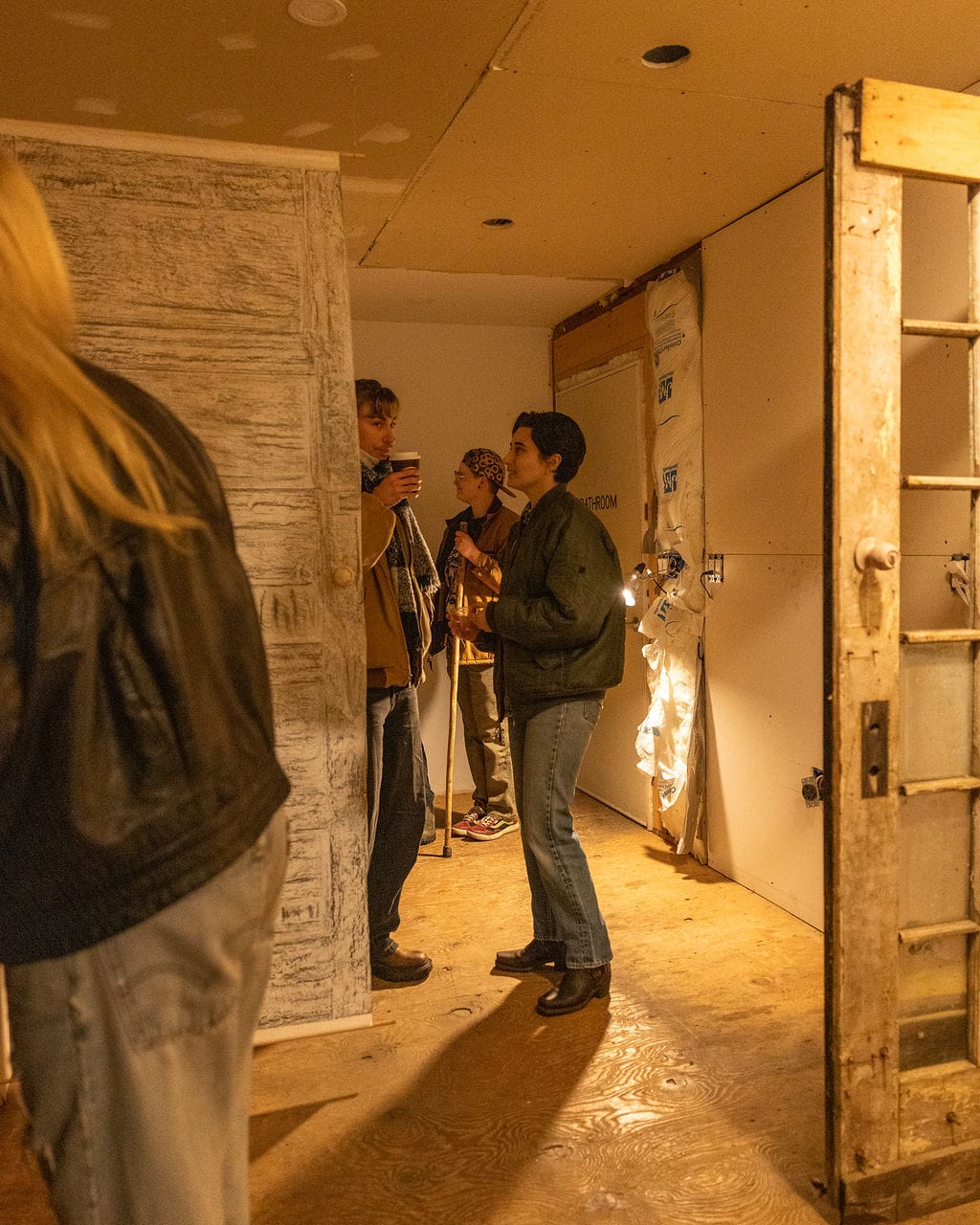
It’s not the first time a condemned house has been filled with art or music, especially in a city with a deep-rooted anti-establishment streak. But in 2026, staging a public exhibition in a soon-to-be-demolished house carries a particular political charge. An escalating housing crisis — Seattle has one of the largest homeless populations in the nation, ranking behind New York and Los Angeles — forms an unavoidable backdrop. But the project addresses something even more pervasive: The sustained loss of shared, in-person cultural space.
“A big part of this is about getting people together,” says Skidmore. “It feels like the pendulum is swinging away from AI slop and hyper-impersonal online experiences. People want to experience things in real life, in the now.”
The two organizers, both 31 years old, met only recently, last summer, after decades of moving through overlapping communities. Their collaboration coalesced quickly around a shared frustration with the limitations of traditional gallery formats.
Hensley floated the idea first. “She said, ‘What do you think about putting art into houses that are about to be demolished?’” Skidmore recalled. “I said we absolutely have to do it.”
Hensley is a practicing artist and gallerist at Foster/White Gallery with extensive experience in woodworking and large-scale installation. Skidmore came to art more recently through her work at Traver Gallery. Her experience as a touring musician — she plays guitar and sings in the band Dining Dead — is part of the recipe that makes the project work.
“Bands have taught me that you can just get out there and start something,” Skidmore said. “You have to be able to take no for an answer — but also to just do it. There’s always a way.”
Through personal connections, the pair found a developer who granted them access to a house awaiting demolition. What was inside remained a mystery until the day they received the keys.
“We were worried it might be way too messed up to work with or way too clean to be interesting,” said Hensley. “It ended up being neither.”
Instead, the house had been left in a suspended state, abandoned mid-renovation, some rooms stripped to spackled drywall. Over five days, five artists worked in the unheated space, racing against the timeline. Hensley hand-painted wall text across doors and walls; other artists embedded or extracted elements from the site.
“It was so cold!” Skidmore recalled. “We were pulling 14-hour days onsite, eating gas station food on the floor next to a space heater — and saying, ‘This is my dream job!’”
The resulting exhibition operated as a close reading of the house — the kind of topoanalytic forensics Gaston Bachelard describes in The Poetics of Space (1957). “In our daydreams, the house is a large cradle,” he writes. “It is our first universe.”
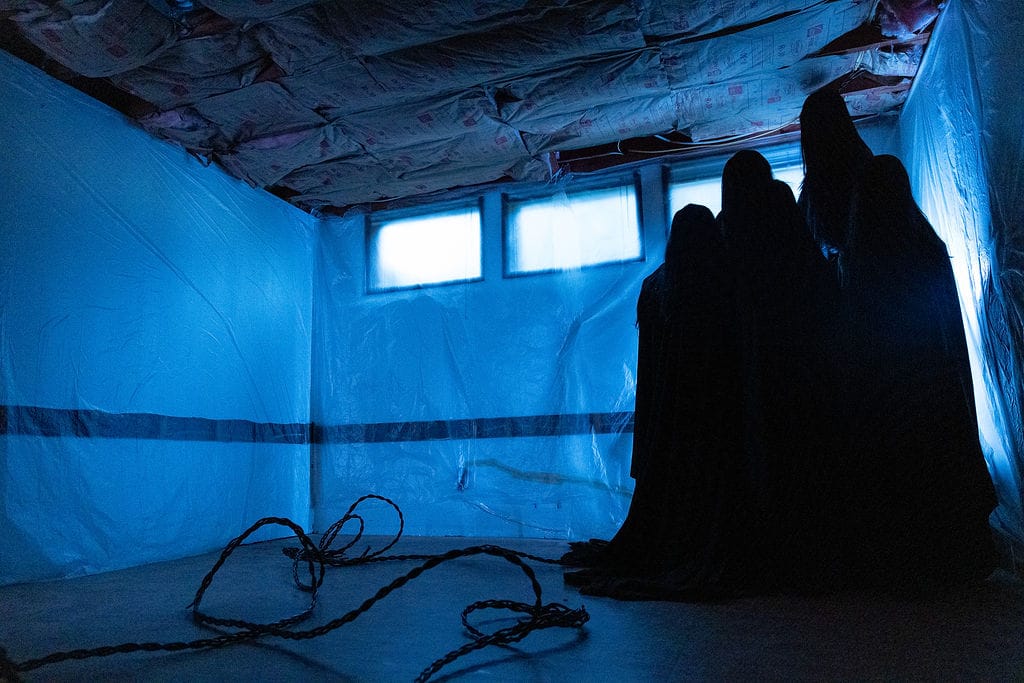
This framework was most explicit in the basement — Bachelard’s locus of irrationality and origin — where Jenikka Cruz staged a scene with undertones of horror: Drone music pulsed through the foundation. Braided black cables coiled across the floor, encircling a cluster of life-size figures. In the low light, they seemed to move.
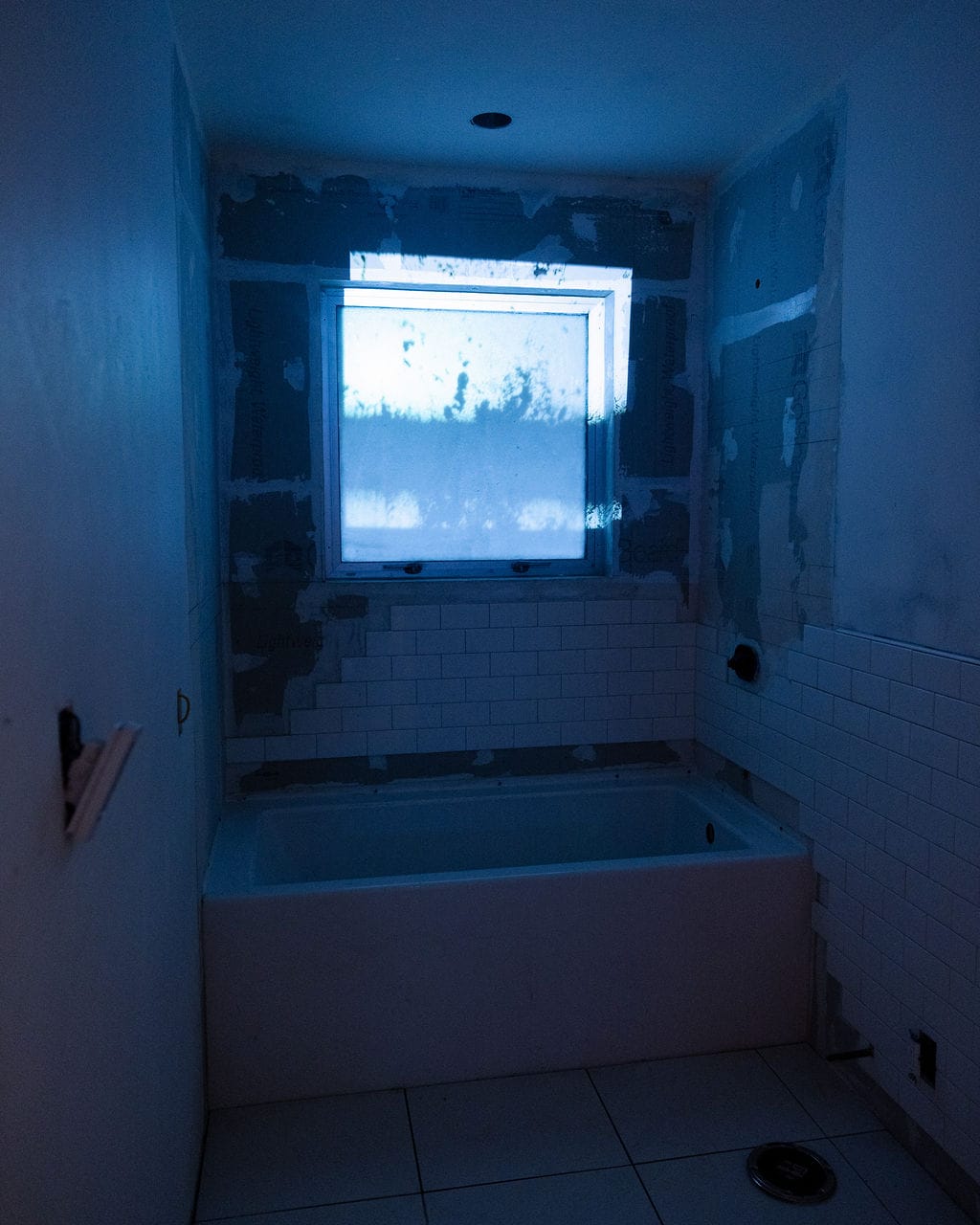
Aboveground, Ali E. Meyer transformed a bathroom into a theater, projecting collaged fragments of childhood memory onto a frosted window. Gaeun Kim’s graphite rubbings made from doors were suspended from the ceiling — fragile impressions that swayed with the movement of the crowd and harkened to rubbings made from tombstones. In a bedroom, Nadia Ahmed turned a closet into a temporary reliquary for the scant remnants found onsite — a few door handles, tiles, oven knobs — drenched in ectoplastic, hot white wax. Beeswax-hardened crochet chains stretched across the walls, spelling out fragments of text taken from her high school diary.
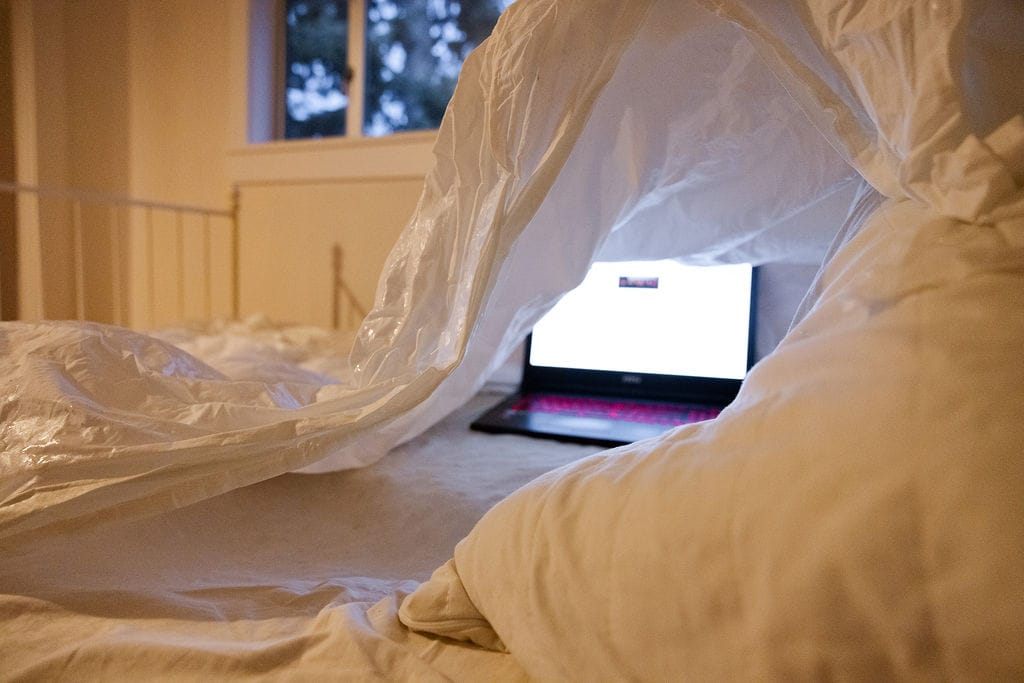
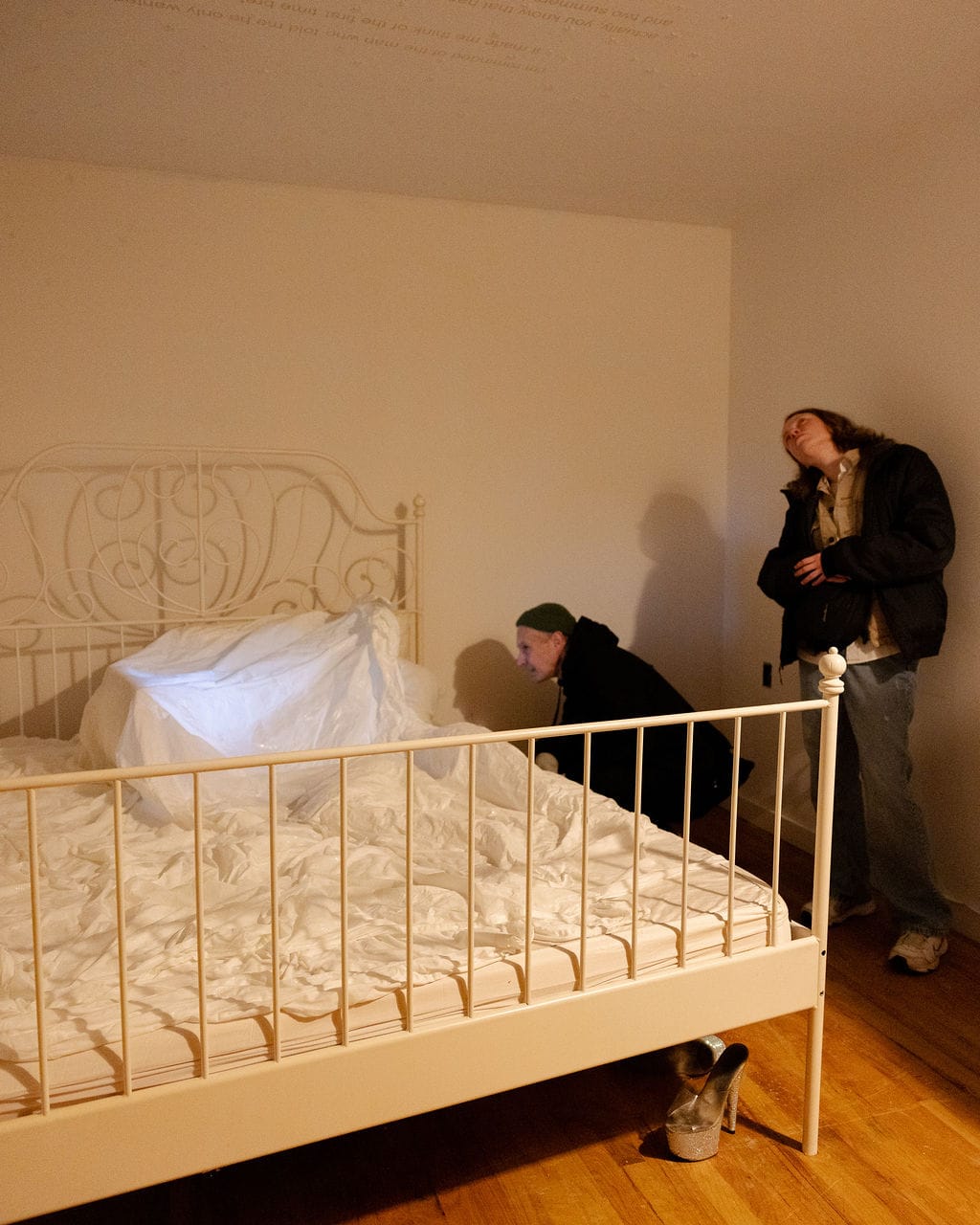
Rachael Comer’s “There Wasn’t One Single ‘Pavlov’s Dog’” (2026) encoded another bedroom as the site of dream, desire, and innocence lost. Glow-in-the-dark stars punctuated the ceiling above a pair of glittery platform heels kicked off at the foot of the bed. Beneath the covers, a hollowed form — made from cornstarch-hardened sheets molded to Comer’s body — invited visitors to look inside. There, a laptop looped a video compiling over 100 porn search queries crowdsourced from anonymous respondents. Nodding to Tracey Emin, the piece oscillated between intimacy and exposure, tracing a generational arc of sexual awakening shaped by the internet.
Approximately 350 visitors attended the opening. Over the course of the evening, the event shifted shape from exhibition to performance to social gathering, with a DJ extending the party into the night.
“There’s a lot of discourse right now about how we’ve lost house parties and the culture around them,” said Skidmore. “That’s what we’re bringing back — but with more intention than just blacking out on Four Loko. People are hungry for it.”
The house remained accessible by appointment throughout the week before it was demolished in early March. Most of the work was left in situ. Prior to demolition, Hensley and Skidmore installed a cheap security camera on one living room wall, capturing the destruction from within. The footage — a collage of collapsing debris interspersed with time-lapse footage taken from across the street — lives on their Instagram page.
From the outset, Once Removed was never conceived as a one-off event. Before they got the keys to the first house, the two were already planning the second and third — each iteration telling a different story.
“We’re thinking of it similar to issues of a magazine,” Skidmore said. “Each space will take on a new life.”
The next installment will take place in West Seattle on June 13, followed by a third in the Ballard neighborhood later this summer. This time, the owners and developers reached out to them first. The West Seattle site — a midcentury two-story constructed in 1947 — comes with the original kitchen, wood-panneled walls, and a view of Puget Sound. Participating artists comprise a bicoastal cohort who were invited or reached out to Hensley and Skidmore with proposals. As with the first house, there won’t be a theme, but they anticipate an entirely different look, with more color and a dash of springtime levity. But it will ultimately depend on the artists.
“There’s something important about the impermanence of it all,” says Hensley. “For a few hours, you create a space where people can encounter something unexpected — something they didn’t know they were looking for.”