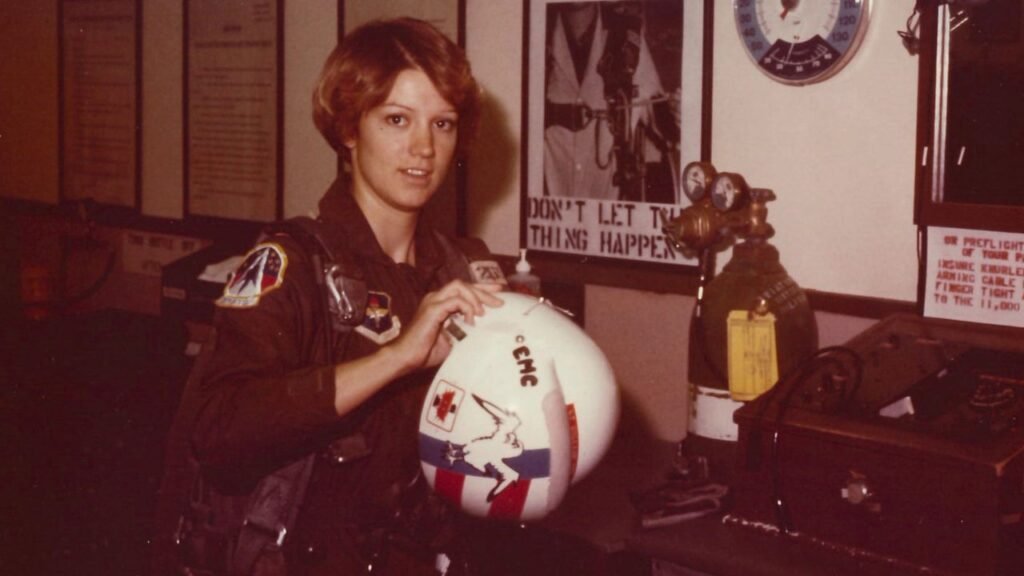
The first time a 17-year-old Eileen Collins drove solo after getting her driver’s license was to follow the ambulance carrying her mother after a suicide attempt. After two decades raising four children on welfare and fending off an abusive, alcoholic husband, her mother was done. It was Collins who found her in time and called the police. After such a traumatizing childhood, had Collins simply gone on to make a stable life, she would have beaten the odds.
But she exceeded that, and in spectacular fashion, becoming the second woman admitted to the U.S. Air Force Test Pilot School and the first to pilot and command a space shuttle. Her skills and composure not only shattered the glass ceiling for future female astronauts but also modeled how to hurdle insurmountable challenges, navigate patriarchal attitudes, and creatively juggle career, marriage, and motherhood. “Until we are tested, we don’t know what we are capable of,” she says.
That mettle is on full display in an inspirational documentary, Spacewoman, which arrives in Los Angeles tonight before its AppleTV debut on June 2. In light of this spring’s historic Artemis II mission, the film underscores Collins’s contributions to the next wave of astronauts while reinforcing the dangers of space travel and the emotional burden it places on loved ones. Even the normally unflappable Collins, now 69, was unprepared for the response she’s received at screenings.
“This one man my age came up to me and said, `I cried through the whole thing,’ and told me how much it touched him,” she tells Fast Company. “He is the third person who told me they cried. A young woman said to me, `That movie changed my life.’ It feels really good to know that people are so positive.”
Based on Collins’ 2021 memoir, Through the Glass Ceiling to the Stars, the film chronicles her journey from a painfully shy, underprivileged teenager from Elmira, a working-class town in upstate New York, juggling odd jobs to pay for flying lessons, to a trailblazing U.S. Air Force test pilot and NASA astronaut. Collins logged more than 872 hours in space over four space flights, culminating in the harrowing first flight after the 2003 Columbia disaster killed seven astronauts in reentry.
Even her marriage felt progressive for its time, as her husband, the Delta Airlines pilot Pat Youngs, took on much of the child-rearing and housekeeping while Collins was training or in space. But the film’s emotional gut punch lies in the toll those dangers and long separations took on her family, especially her daughter Bridget, who grew increasingly aware of the risks her mother faced. The way Collins navigated those pressures becomes a study in balancing grit with grace, and in learning to let go of what she could not control.
It was these nuggets that lured Hannah Berryman, the director, to Collins’s story.
“I wasn’t a space person. I’m interested in what it is to be human, what we’re about,” says Berryman. “But space is an amazing place to do that because the stakes are high. People are more inspired by a film where they see human vulnerability and frailty and that none of us are perfect. You see what people achieve, and you know that nothing’s easy.”
Dreaming the impossible
For Collins, that meant dreaming beyond her circumstances. She grew up on food stamps, in public housing, amid a volatile home life. Her father, a pub owner, often came home drunk to fight with her mother or vent for hours to Collins and her three siblings. School, where girls were bullied for being smart, offered little refuge. What those experiences did teach her was self-reliance, perseverance under pressure, and how to navigate the male psyche. Science fiction and flying became forms of escape and adventure. “I always wanted to be Captain Kirk—the commander of the starship,” she says in the film.
Collins secretly dreamed of becoming an astronaut and saw becoming a test pilot as the path to get there, even though the Air Force did not open flight training to women until she was in college. By the time she graduated in 1978, she was among the first women admitted to its pilot training program. That same year, NASA announced its first class of shuttle astronauts, including three female mission specialists.
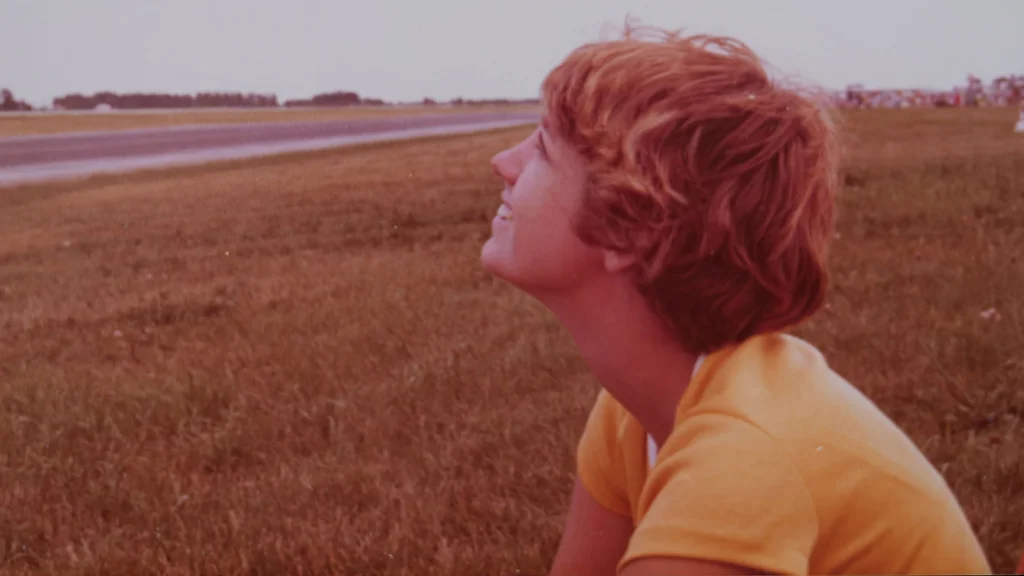
While earning undergraduate and master’s degrees in math, economics, and space systems management, Collins completed USAF pilot training, served as a T-38 Talon instructor pilot at the U.S. Air Force Academy, and, after three attempts, became the second woman admitted to the USAF Test Pilot School before joining NASA’s astronaut program in 1990.
“My first life lesson was don’t give up if you have a big setback along the way,” she says. “If you really love what you are doing, your passion is going to force you to keep going, even if things aren’t perfect for you.”
Flying with boys
Pushing supersonic aircraft to their limits was the easy part; convincing Air Force brass that women could handle pressure like men was quite the other. It demanded she perform better to be considered equal.
“I liked working with the guys, and yes, it was tough,” she elaborates. “The only thing I could do is be the best pilot I could. That was what I could control.”
Collins’s flight training helped hone her leadership skills and pull her out of her shyness. “I think flying airplanes made me more aggressive as a person,” earning her the aviation call name “Mom.”
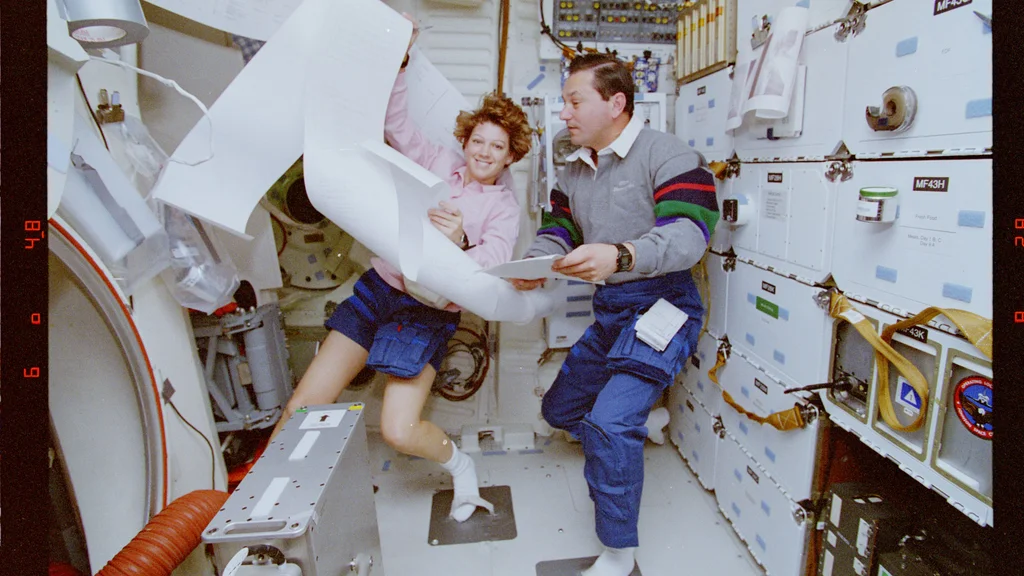
“When I went to the astronaut program, they called me `Mom,’ but for different reasons,” she adds, laughing. “I would tell them, `Make sure you check the weather before you go out and fly that mission.’ And they’re like, `Yes, Mom, we’ll do whatever you say.’”
As a leader, Collins sought a balance between autocratic and collaborative, without appearing weak. (“Other people’s ideas used to threaten me, but I’ve gotten over that,” she says.) She also helped translate some of that authoritative nuance to other female astronauts. While training for the STS-93 mission to deploy the Chandra X-ray Observatory, the mission specialist Cady Coleman recalls Collins helping her better express her competence. “Eileen showed me, in a very male-dominated culture in the astronaut office, that my manner of being in charge of the telescope was not in charge enough,” Coleman says in the film.
“They just assumed that the guy knows what he’s talking about. But for a woman, you had to prove it,” adds Collins in our interview. “It’s getting better, but it’s gonna take generations. But we are making a difference by what we’re doing.”
Within her control
In 1995, Collins became the first woman to pilot the space shuttle during the STS-63 mission, when the Discovery shuttle rendezvoused within 33 feet of the since-deorbited Russian space station Mir, close enough for crews to wave at one another through their windows. She also piloted the STS-84 mission in 1997, docking the Atlantis shuttle with Mir.
Between these missions, Collins became a mom for real when Bridget was born. With that, her career briefly shifted from trailblazing to a social statement when the press questioned how she juggled astronaut duties and maternal responsibilities alongside her husband’s career.
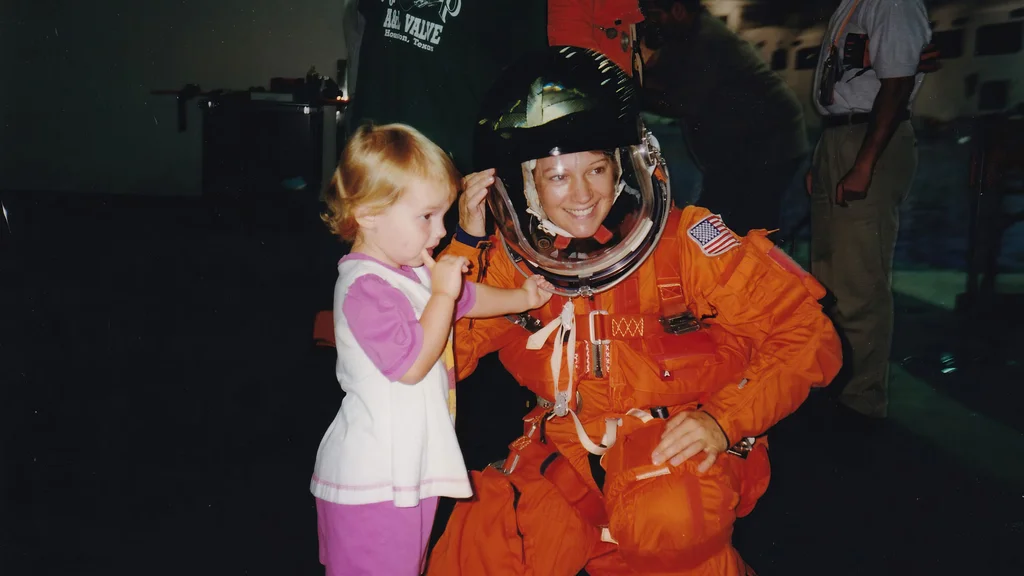
Two years later, in 1999, Collins became the first woman to command a U.S. spacecraft with the STS-93 mission on the Columbia shuttle. It was the scariest launch since the 1986 Challenger disaster, when that shuttle’s solid rocket boosters exploded shortly after launch, killing all aboard, including the highly publicized first teacher in space. This time, Columbia’s faulty engine components caused the engine to leak hydrogen and shut down two engine computers. The shuttle barely made it to orbit, seven miles lower than planned. In a horrific 2003 accident, Columbia disintegrated during reentry after heat-shielding tiles broke off during launch, killing the crew and grounding the shuttle program for two years.
Collins’ next flight would be her most harrowing. At its 2005 launch, all eyes were on STS-114—NASA’s “return to flight” mission on Discovery to test safety improvements and resupply the International Space Station (ISS). Collins was again commander, shouldering immense pressure to ensure this launch went well and the shuttle program continued. But a launch video revealed an ejected thermal tile fragment that threatened the same reentry risk that led to Columbia’s destruction.
“I’m thinking about things that could go wrong that I have control over,” Collins recalls in the film. “Something that could go wrong that I have no control over, I’m not going to think about that. I learned that if you’re thrown a curveball, don’t panic, overreact, or show that you’re afraid. That way, you control any element of fear that might affect you.”
Once in orbit, she rolled the shuttle over so ISS astronauts could photograph the belly and ground crew inspect the images for damage. It was a dangerous move that brought the shuttle flying blindly to within 600 feet of the ISS, making her the first astronaut to fly a shuttle through a 360-degree pitch maneuver. After NASA spotted gap fillers between two tiles that had popped out, two crew members performed a spacewalk to remove them. While the mission ended successfully, Collins opted to remain on Earth, retiring from the USAF later that year as a colonel and from NASA in 2006.
Some two decades later, echoes of those missions haunted Artemis II when the fellow STS-114 astronaut and heat shield specialist Charles Camarda voiced concerns about the viability of the Artemis heat shield. The shield ultimately held during reentry.
Purpose vs. loved ones
Those dangers frame the heroics and fanfare for astronauts and their families. The film’s emotional core exposes the fraught tension between a perilous dream and the worried loved ones left behind, as well as the resulting collateral damage.
Bridget was 7 during the Columbia disaster and 9 when Collins’s final flight threatened a repeat—old and smart enough to understand that Mom could die, despite promises to return. (Son Luke, born just before STS-114, was too young to understand.) Bridget withdrew for a time, feeling betrayed and fearful, and attempting an emotional control that translated to anorexia at 15, which she has since overcome.
“Maybe I lost a piece of my integrity with my 7-year-old daughter,” Collins reflects in the film, while Bridget adds, “I didn’t trust that the engineers would sufficiently fix the problem. I tried to put on a brave face.”
It would take years to repair their relationship fully, but the two are now close. Bridget, now 30, works in alternative energy, while Luke, 25, works in artificial intelligence.
Forwarding the legacy
Collins’s contributions helped shape the legacy that is propelling current space efforts. With the success of Artemis II’s lunar loop and a moon landing planned for 2028, NASA is accelerating a burgeoning lunar economy and potentially longer space missions. As we start building research stations and mining operations there, Collins sees the future astronaut corps requiring expanded skills and mindsets.
“You’ll always need people who know how to fix things and look at problems as challenges, because we’re doing things that have never been done before,” she says. “The technical skill side is easier to evaluate. The psychological side is tougher. Astronauts need to be people who get along with others in a closed environment. You want someone who is an open communicator and won’t be disagreeable, because the missions are getting longer. You can’t just go out for a walk.”