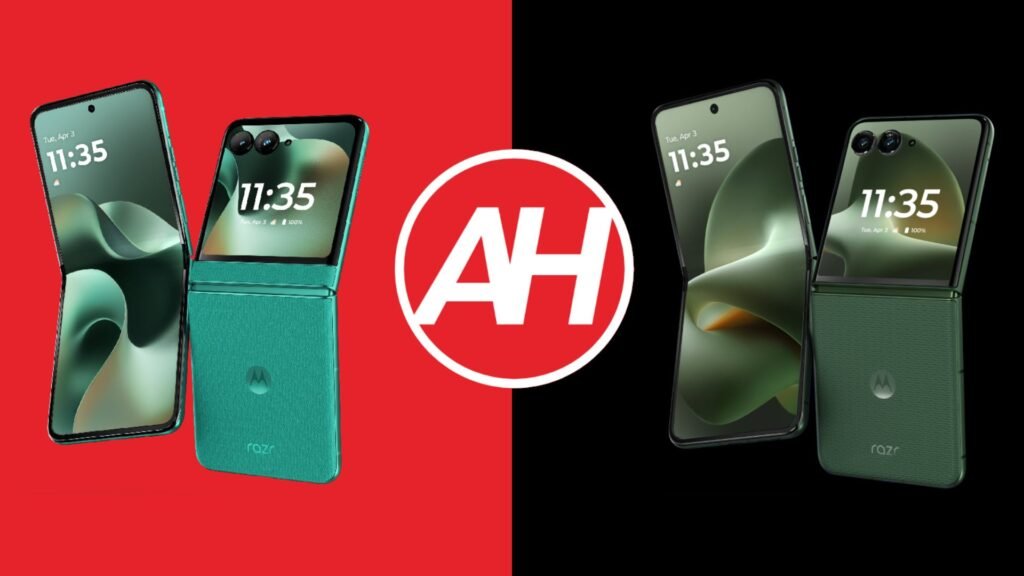

Motorola announced three Razr flip phones as part of its 2026 lineup. The Motorola Razr 2026, Razr+ 2026, and Razr Ultra 2026 were announced. In this article, we’ll compare two out of those three smartphones. We’ll be comparing the Motorola Razr 2026 vs Motorola Razr+ 2026. Is the Motorola Razr+ 2026 worth the extra cash? Well, this article will hopefully help you see the differences and make that call yourself.
As we usually do, we will first list the specs of both smartphones. Following that, we’ll compare their designs, displays, performance, battery life, cameras, and audio. These two phones do look very similar, but you can differentiate them thanks to one notable difference. They do have some spec similarities, but there are quite a few differences there as well. So, let’s get to it.
Specs

Motorola Razr 2026

Motorola Razr+ 2026
| Motorola Razr 2026 | Motorola Razr+ 2026 | |
|---|---|---|
| Dimensions (unfolded/folded) | 171.3 x 74 x 7.3 mm / 88.1 x 74 x 15.9 mm | 171.4 x 74 x 7.1 mm / 88.1 x 74 x 15.3 mm |
| Weight | 188 grams | 189 grams |
| Main display | 6.9-inch Extreme AMOLED (120Hz) | 6.9-inch LTPO AMOLED (165Hz) |
| Cover display | 3.6-inch Extreme AMOLED (90Hz) | 4-inch AMOLED (165Hz) |
| Resolution | 2640 x 1080 / 1066 x 1056 | 2640 x 1080 / 1272 x 1080 |
| Chipset | MediaTek Dimensity 7400X | Qualcomm Snapdragon 8s Gen 3 |
| RAM | 8GB (LPDDR5X) | 12GB |
| Storage | 128GB/256GB | 256GB (UFS 4.0) |
| Main camera | 50MP (f/1.7 aperture, 1/1.95-inch sensor size, 0.8um pixel size, OIS) | 50MP (f/1.8 aperture, 1/1.95-inch sensor size, OIS, PDAF) |
| Ultra-wide camera | 50MP (f/2.0 aperture, 1/2.76-inch sensor size, 122-degree FoV, 1.28um pixel size) | 50MP (f/2.0 aperture, 1/2.76-inch sensor size, 122-degree FoV) |
| (Periscope) telephoto camera | N/A | N/A |
| Selfie camera | 32MP (f/2.4 aperture, 1/3.14-inch sensor size, 0.7um pixel size) | 32MP (f/2.4 aperture) |
| Battery size | 4,800mAh | 4,500mAh |
| Charging | 30W wired, 15W wireless (charger not included) | 45W wired, 15W wireless, 5W reverse wired (charger not included) |
| Colors | PANTONE Hematite, PANTONE Sporting Green, PANTONE Violet Ice, PANTONE Bright White | Pantone Mountain View |
Motorola Razr 2026 vs Motorola Razr+ 2026: Design
If you look at these two phones from the front when they’re open, you’ll hardly be able to tell which is which. They not only have almost identical dimensions, but the same goes for corner curvature and bezels. Both phones include a foldable main display with a centered display camera hole up top. The bezels are thin and uniform. They also have physical keys in the same spot on the right-hand side.
Both smartphones also include a frame that is not entirely flat. You will see a difference the moment we flip the two phones over, though. The Motorola Razr+ 2026 has a larger cover display in comparison. That is easily noticeable as the Motorola Razr 2026’s cover display does not stretch down to where the hinge sits. Both devices do have a flat backplate, which comes in different iterations depending on the color you get.
You will notice that both smartphones also have two horizontally-aligned cameras in the top-left corner of their cover displays. Next to those two cameras, an LED flash is located. The Razr+ 2026 definitely looks more appealing from that perspective due to a larger display that stretches further down. Both phones are IP48 certified and MIL-STD-810H certified as well. Depending on the variant, you’ll get different levels of gripability. The Razr+ 2026 is 1 gram heavier, and they’re almost identical in terms of size as well.
Motorola Razr 2026 vs Motorola Razr+ 2026: Display
The Motorola Razr 2026 features a 6.9-inch Foldable LTPO AMOLED main display. That panel can project up to 1 billion colors, and it has a refresh rate of up to 120Hz. Dolby Vision is supported, and the same goes for HDR10+ content. The peak brightness here is 3,000 nits. The screen-to-body ratio is at around 85%, while the resolution is 2640 x 1080 pixels. The second display measures 3.6 inches, and it’s an AMOLED panel. It also supports 1 billion colors and HDR10+ content. Its refresh rate is 90Hz, and the peak brightness is 1,700 nits. The resolution here is 1066 x 1056, while the Gorilla Glass Victus protects this panel.

The Motorola Razr+ 2026, on the flip side, has a 6.9-inch Foldable LTPO AMOLED main display. That panel can project up to 1 billion colors, and Dolby Vision is supported. HDR10+ is also supported, while the refresh rate goes up to 165Hz. The peak brightness on this panel is 3,000 nits. The resolution you’re getting here is 2640 x 1080 pixels. The second display is also an AMOLED panel, an LTPS panel. That display has a 165Hz refresh rate and can project up to 1 billion colors, while it has a peak brightness of 2,400 nits. The resolution is 1272 x 1080, and the size is 4 inches. The Gorilla Glass Victus protects this panel.
All four of these displays are vivid and have great viewing angles. They’re also more than sharp enough for their sizes. The Motorola Razr+ 2026 panels do have some advantages in direct comparison, though. The refresh rate on both panels is higher than what the Razr 2026 offers, and on the cover displays it’s even more pronounced. The brightness of the cover display is also higher on the ‘Plus’ model.
Motorola Razr 2026 vs Motorola Razr+ 2026: Performance
The Motorola Razr 2026 is fueled by the MediaTek Dimensity 7450X processor, a 4nm chip. That chip is backed by 8GB of RAM and UFS 3.1 flash storage. Do note that the storage is not expandable on this smartphone, so be careful when choosing which storage variant to get. It comes in 128GB and 256GB storage options.
The Motorola Razr+ 2026, on the flip side, is fueled by the Snapdragon 8s Gen 3 processor from Qualcomm. That is also a 4nm processor, and it’s backed by 12GB of RAM. The storage is not expandable here either, and you also don’t have much of a choice in terms of storage variants. It comes in a 256GB option only. It does use UFS 4.0 storage, though.
We did not get to use these two phones for long at this point in time. We did, however, notice that the Motorola Razr+ 2026 is snappier in side-by-side use. The Motorola Razr 2026 does good in terms of performance, but the difference is visible. That’s not surprising considering the chip difference and the faster memory inside the ‘Plus’ model. We still can’t attest to gaming performance, but the Motorola Razr+ 2026 should be able to do a better job.
Motorola Razr 2026 vs Motorola Razr+ 2026: Battery
The Motorola Razr 2026 includes a 4,800mAh battery on the inside, while the Motorola Razr+ 2026 comes with a 4,500mAh battery. We’re still not sure why Motorola went with a smaller battery inside the Razr+ 2026 model, when that variant has a larger cover display. We did not review either phone just yet, so we don’t know how the battery performance will compare. By some logic, the Razr 2026 should do a better job.
On the flip side, the Motorola Razr 2026+ does have more power-efficient storage, plus there’s that memory type difference, which could also play a role there. It could go either way, despite the battery capacity difference. It will also depend on how much you use the cover display vs the main panel. If you’re all about the main display, the battery life probably won’t be great on either one. These phones are meant to be used in a specific way, with the cover display taking up a lot of use time.
When it comes to charging, the Motorola Razr 2026 supports 30W wired and 15W wireless charging. The Motorola Razr+ 2026 supports 45W wired, 15W wireless, and 5W reverse wired charging. The Razr+ 2026 should be able to charge a bit faster despite the fact that it has a smaller battery, but it remains to be seen. Neither of these two smartphones comes with a charger in the retail box.
Motorola Razr 2026 vs Motorola Razr+ 2026: Cameras
The Motorola Razr 2026 includes two cameras on the back. It has a 50-megapixel main camera with an f/1.7 aperture lens and a 1/1.95-inch sensor size. OIS is supported here. The second camera is a 50-megapixel ultrawide unit with an f/2.0 aperture lens and a 1/2.76-inch sensor size. The FoV here is 122 degrees.

The Motorola Razr+ 2026, on the other hand, has a 50-megapixel main camera with an f/1.8 aperture lens and a 1/1.95-inch sensor size. PDAF and OIS are supported here. The second camera is a 50-megapixel unit with an f/2.0 aperture lens and a 1/2.76-inch sensor size. The FoV here is 122 degrees.
So they have the exact same ultrawide camera setup, while there are some differences in the main camera, despite the fact that the same sensor is used. We did not get to test these cameras in a review environment, but the first impressions are not bad at all, considering everything. They won’t win any awards, but they’re probably better than you’d expect. The main cameras are inferior to what the Motorola Razr Ultra 2026 offers, though, that’s for sure.
Audio
Both of these smartphones include stereo speakers. Based on initial impressions, they sounded quite pleasing and were loud enough. The sound quality seems to be alright, without major issues.
There is no audio jack on either device, though. You can use their Type-C ports if you’d like to connect your wired headphones, though. Alternatively, both smartphones support Bluetooth 5.4 for wireless audio connectivity.
The post Phone Comparisons: Motorola Razr 2026 vs Motorola Razr+ 2026 appeared first on Android Headlines.