
Google is pushing hard into agentic AI, and as part of The Android Show I/O Edition announcements, the company is laying out how it plans to keep Gemini Intelligence from being a privacy nightmare. And honestly? After the last year or two of Gemini privacy controversies, this is a conversation Google needed to have.
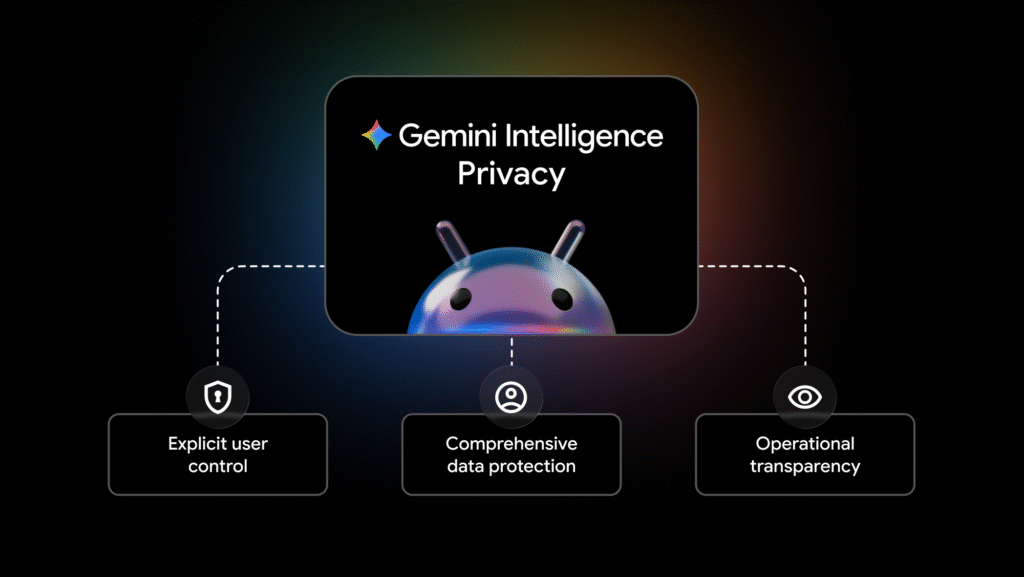
The pitch is pretty simple. Android isn’t just an operating system anymore. It’s becoming what Google calls an “intelligence system,” where Gemini can understand what you’re doing, anticipate what you need, and actually complete tasks for you. But that level of access comes with obvious risks. So Google says it’s grounding Gemini Intelligence in three core principles: explicit user control, comprehensive data protection, and operational transparency.
What this actually looks like in practice
To be honest, every tech company says it cares about privacy. So what is Google actually doing here? A few things stood out to me.
First, everything is opt-in. Connecting Gemini to Autofill is strictly your choice, and you can turn it off at any time. Gemini app automation, which launches for specific apps later this year, will also need to be explicitly enabled. And before Gemini makes a purchase on your behalf? It needs your confirmation. Which, let’s be real, is the bare minimum, but it’s good to see it spelled out.
Then there’s the data protection side. Google is leaning on its existing security infrastructure here. Things like Private Compute Core, Private AI Compute, and protected KVM to safeguard ambient data. Basically, the same architecture that already protects billions of Google product users every day. Google is also building new defenses against prompt-injection attacks, which we don’t talk about enough but absolutely matter as AI gets more access to your stuff.
The transparency piece is probably the most interesting. When Gemini is automating an app, you can hit “View progress” and watch what it’s doing in real-time. There’s also a persistent notification chip at the top of your screen that you can’t dismiss, so you always know when Gemini is working. The Android Privacy Dashboard is getting an upgrade too, showing which AI assistants were active in the last 24 hours and which apps they touched.
Will any of this be enough to win over skeptics? Probably not entirely. But it’s a real step in the right direction, especially given recent reports that Chrome silently downloaded 4GB of Gemini Nano onto users’ devices without consent. Google has work to do on the trust front.
The post Google is making the case that Gemini on Android can actually be trusted appeared first on Android Headlines.