PITTSBURGH — When the landmark exhibition Sensation: Young British Artists from the Saatchi Collection launched at the Brooklyn Museum in 1999, artist Chris Ofili became a major player in the scrum of the culture wars. Ofili’s “The Holy Virgin Mary” (1996), a colorful, yellow-toned mixed-media painting of the mother of Christ collaged with images of women’s genitalia excised from pornographic magazines, and supported by a stand composed of two lumps of dried elephant dung, was deemed by then New York City Mayor Rudy Giuliani as “sick … disgusting,” and a “desecration of someone else’s religion” (Ofili, like Giuliani, is Roman Catholic). The New York Post, in its indomitable way, covered and fueled the controversy (a representative title — “Paint Misbehavin’”), Thomas Cardinal O’Connor condemned Ofili, Giuliani threatened to revoke city funds from the Brooklyn Museum, an elderly vandal attacked the composition with white paint, and a Manhattan real estate developer named Donald Trump labeled “The Holy Virgin Mary” as “degenerate.”
That same year, Ofili’s painting “The Adoration of Captain Shit and the Legend of the Black Stars” (1998) was featured in the 53rd installment of the Carnegie International at Pittsburgh’s namesake art museum. As with the more notorious work, “The Adoration of Captain Shit and the Legend of the Black Stars” is a similarly cheeky composition, in this case of an imagined Blaxploitation character in red-and-yellow robes and a triumphant Afro, the canvas once again held upright with dried elephant dung. Today, that painting can be viewed again at an International, this time in a gallery dedicated to the 130-year history of the series, as the Carnegie launches the 59th iteration of the influential and celebrated art-world event. Purchased by the Carnegie the same year as its initial exhibition, that Ofili work is a convenient symbol for the International itself. A locus for protest in the cosmopolitan metropole of New York, the painting — despite some jokes or snickers from museumgoers — was nonetheless afforded a kind of ecumenical acceptance by audiences in supposedly provincial Pittsburgh.
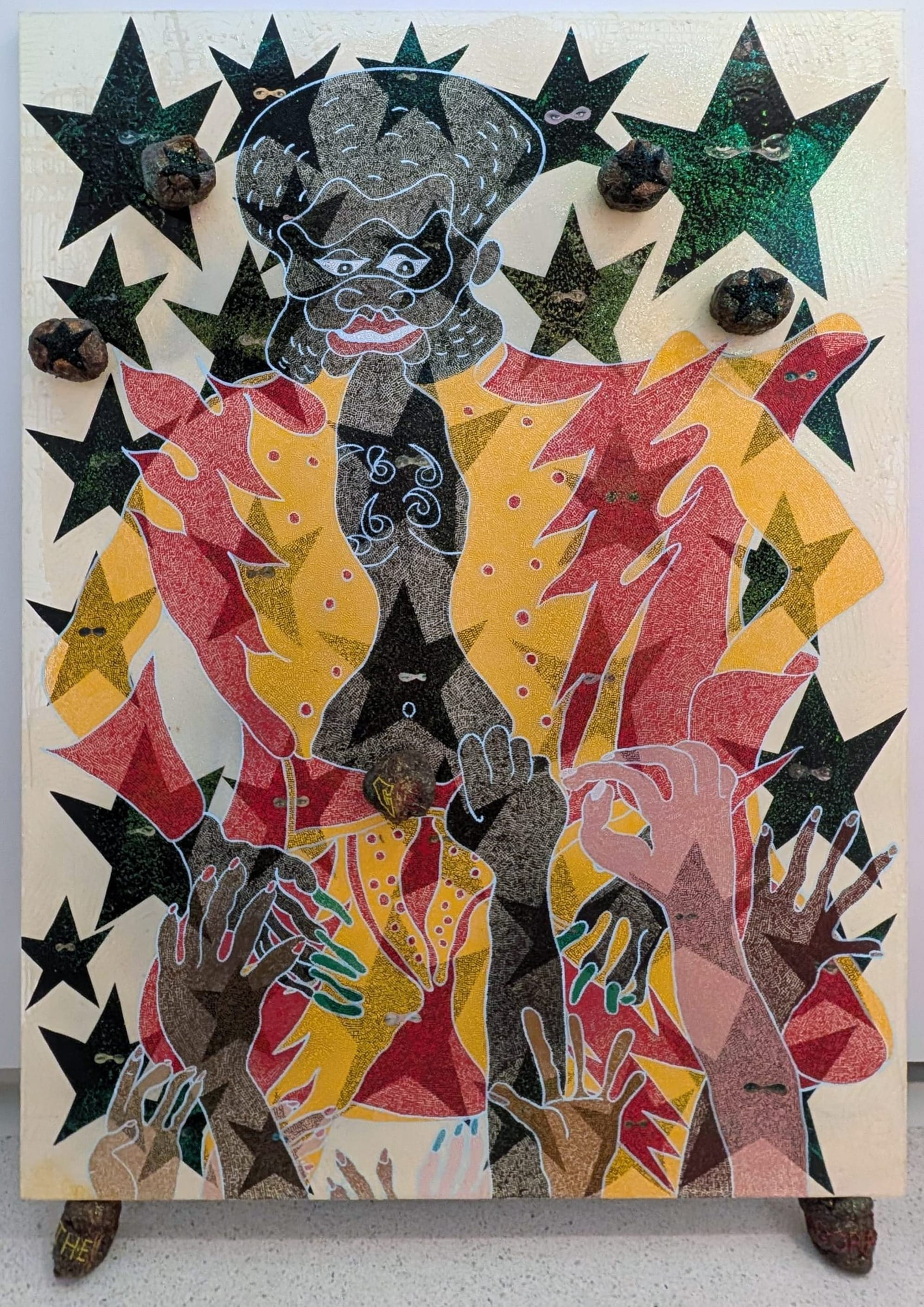
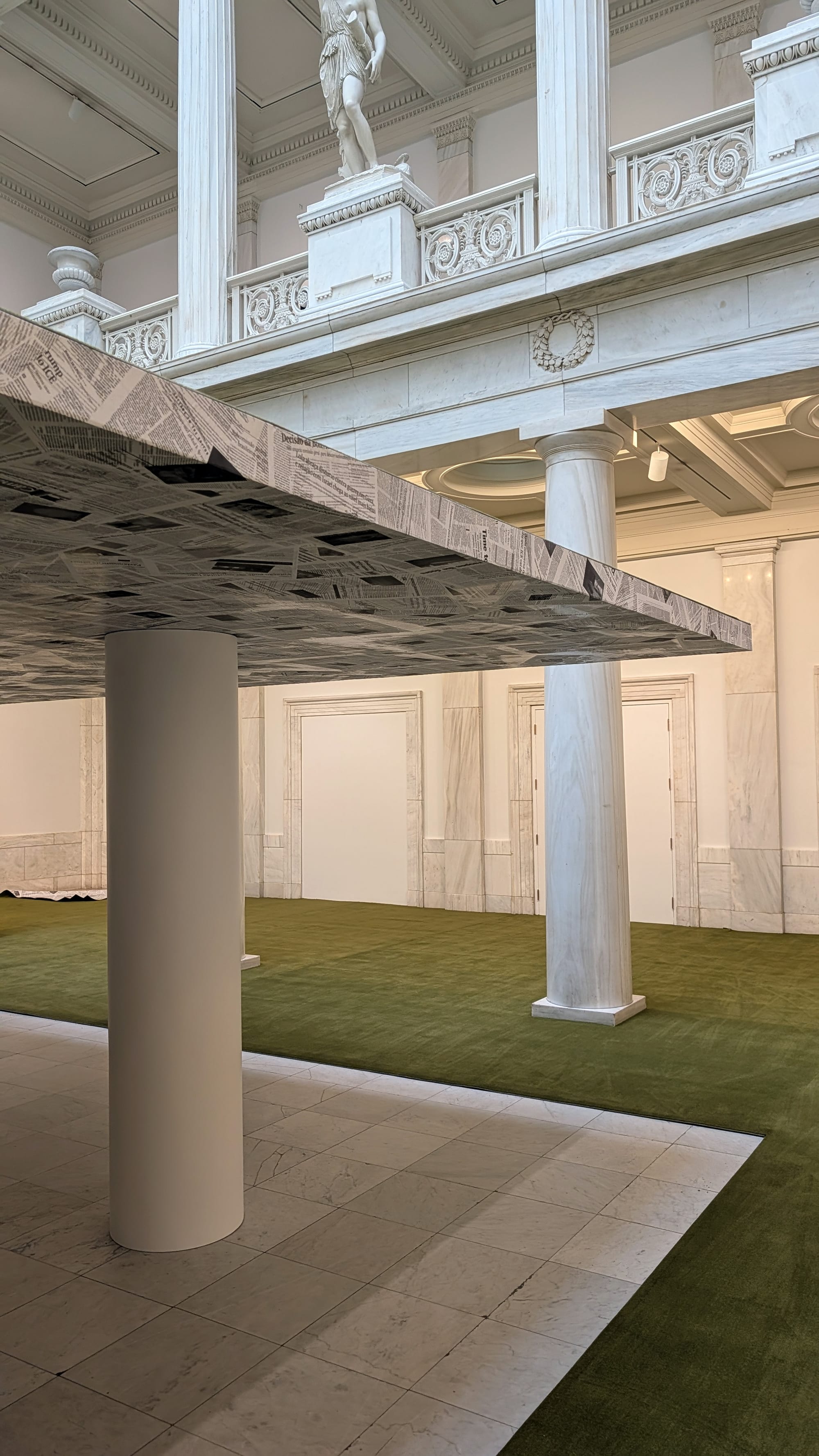
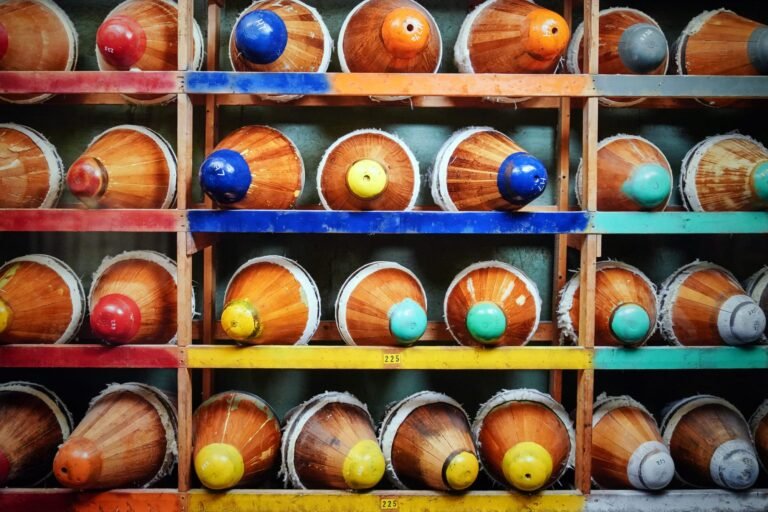
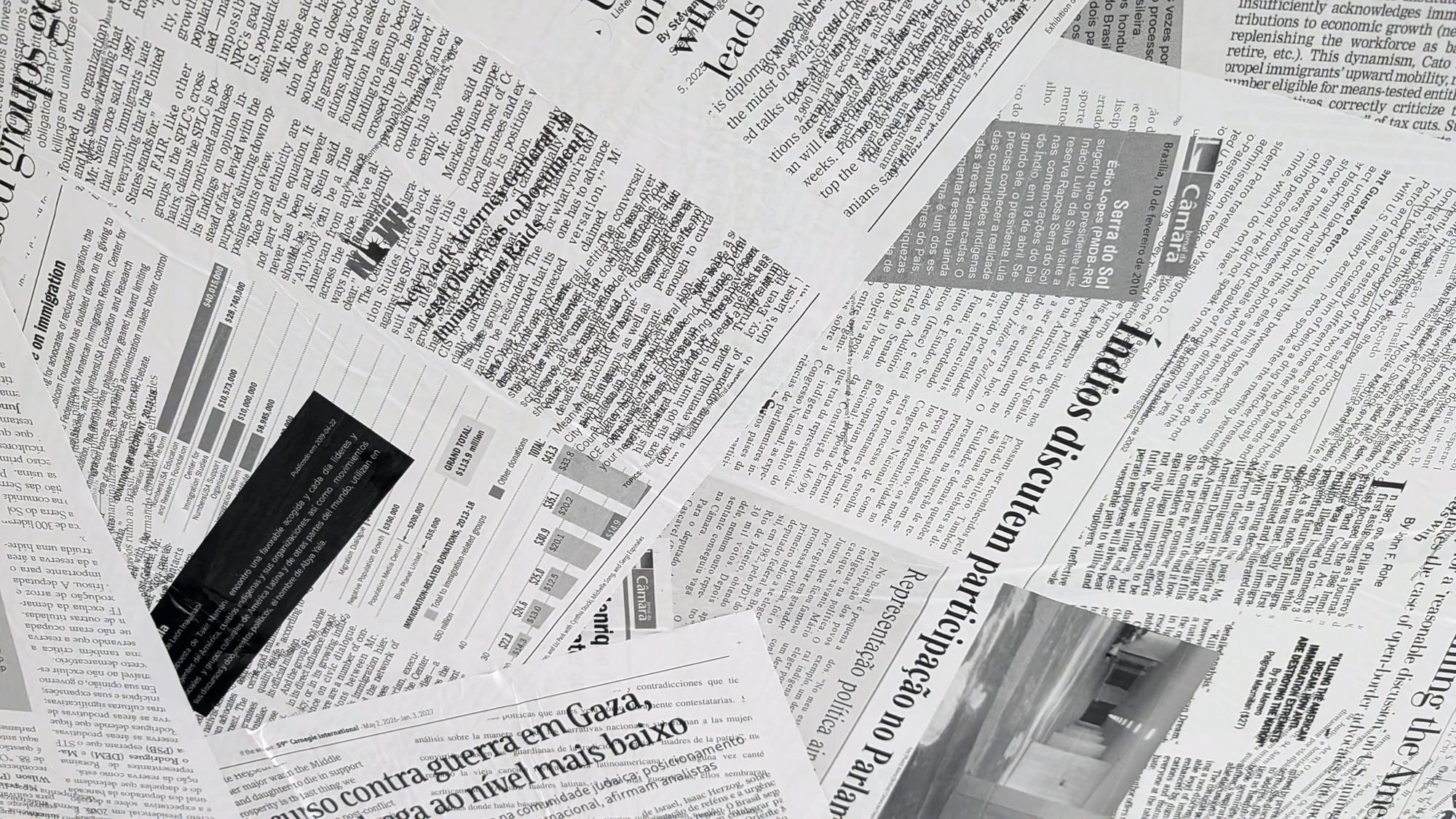
Left: Chris Ofili, “The Adoration of Captain Shit and the Legend of the Black Stars” (1999), acrylic, canvas, multimedia, dung; right: detail of the ceiling from Cinthia Marcelle’s “Green Hall Annex” (2026), newspaper, and glue
Established three decades before the Whitney Biennial, in 1896, the Carnegie International has been introducing American audiences to cutting-edge contemporary art since the Victorian Era, the only longer-running international contemporary art exhibition being the Venice Biennale, which beats Pittsburgh by just a year. Gilded Age industrialist Andrew Carnegie, the museum’s namesake, cannily described the exhibition as a means of displaying the “old masters of tomorrow” (even while, true to his Scottish frugality, it may have been a means to pragmatically avoid buying actual old masters while indulging his love of purchasing expensive dinosaur bones displayed in his natural history museum). Indeed, it has long made Pittsburgh an unlikely participant in the global art scene — as art historian Bruce Altschuler described in the centennial catalog International Encounters: The Carnegie International and Contemporary Art, 1896-1996, the “modern world is our business.” Over the years, the exhibition has padded the museum’s collection with works by Winslow Homer, John Singer Sargent, Mary Cassatt, Georges Braque, James McNeill Whistler, Edward Hopper, and Henry Ossawa Tanner. If we are to take historian Theodore E. Stebbins, Jr.’s argument that “there are no mistakes, there is only history,” then the history of the International provides an unprecedented archive of changing tastes.
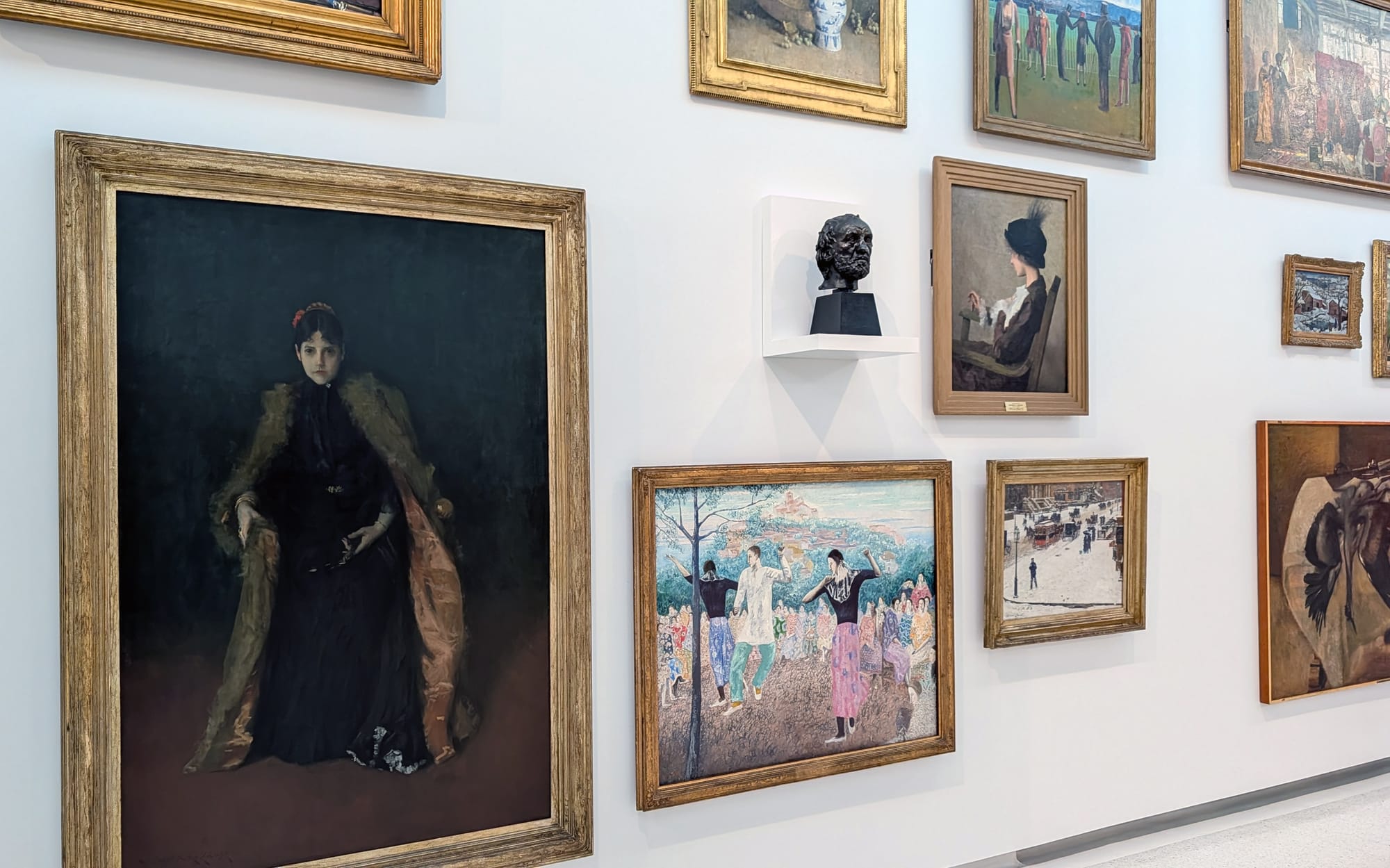
Evidence of the International’s local influence will be obvious to visitors of the new exhibition, which opened to the public this past Saturday, May 2. Across the street from the Carnegie, contractors are busy placing I-beams into place as the new Institute for Contemporary Art (a project of my employer, Carnegie Mellon University) is being erected, while at the press event, journalists were given a pamphlet-cum-map prepared by the local visual arts publication Middle Node that highlights 60 galleries and museums throughout Pittsburgh. Meanwhile, the Carnegie itself has expanded the International beyond its campus in the Oakland neighborhood with site-specific installations at the Kamin Science Center, the Children’s Museum of Pittsburgh (which itself is as much gallery as playground), the Mattress Factory (the largest installation art museum in the world), and the Thelma Lovette YMCA in the historically consequential Black neighborhood of the Hill District. As Louis Bury explains in The Art Newspaper, Pittsburgh’s low cost of living and Gilded Age legacy of abundant philanthropy have attracted gallerists from New York and Los Angeles, so that in terms of elevating the city, the International will perhaps act as a more successful cultural equivalent of last month’s NFL Draft.
But the International has never been just a Pittsburgh show, or indeed an American one, for, true to its name, its purpose has always been to predict the future luminaries of truly global art. To that end, curators Ryan Inouye (formerly of the Sharjah Arts Foundation), Danielle Jackson of New York’s Artists Space, and Liz Park of the Carnegie, have assembled a formidable exhibition entitled if the word we, meant to suggest the simultaneous incompleteness and potential of collectivity, after a line from Egyptian writer Haytham el-Wardany’s catalog essay. With 61 artists representing roughly the same number of countries across every continent — half of whom were commissioned for the event — the International displays a present where the locus of creativity is moving towards the Global South, even while curatorial practice remains unable to fully interrogate its own position in a deeply compromised environment.
To that point, recent Internationals have felt too meandering, perhaps taking Colombian painter and sculptor Beatriz González’s claim in the aforementioned catalog that the “less defined a museum is, the greater its potential to become” a bit too literally, especially when compared to the arresting Life on Mars in 2008 and the untitled 1999/2000 exhibition, featuring artists like John Currin, Kara Walker, and Ofili. Though Inouye (who cocurated the 58th International in 2022), Jackson, and Park haven’t entirely rectified an aimlessness — for that’s a larger issue than a single exhibition — if the word we does suggest a shape of art in the present (and the future) that captures some of the excitement of earlier iterations of the series, providing vital commentary on issues of colonialism, authoritarianism, and militarism.
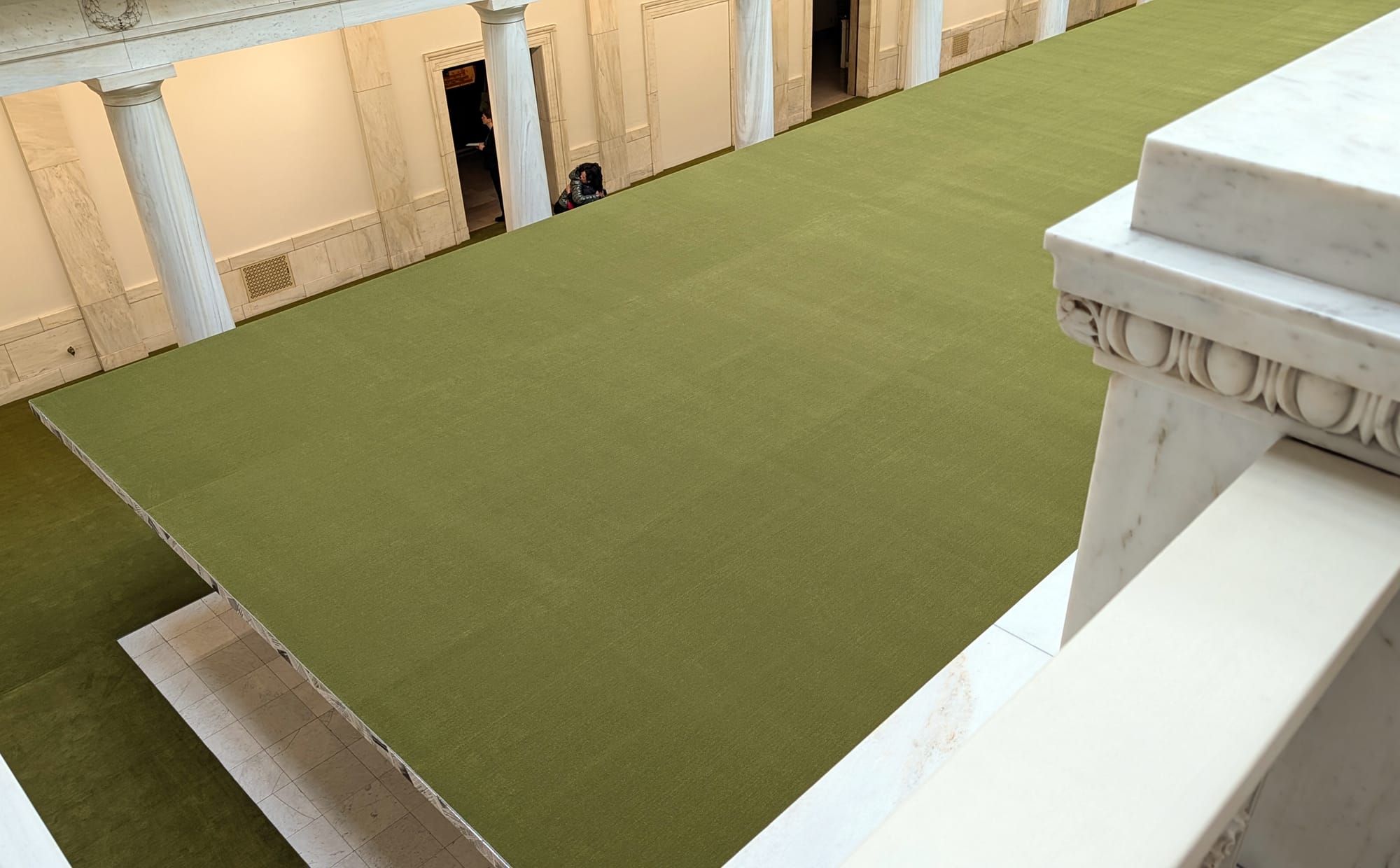
There are, in this regard, some obvious stand-outs. Brazilian artist Cinthia Marcelle’s “Green Hall Annex” (2026) outfits the Carnegie’s neo-classical Hall of Sculpture in the exact carpeting (appearing uncannily as if astroturf) of Brasília’s Chamber of Deputies, which was damaged when supporters of former President Jair Bolsonaro attacked the legislature. Part of the floor in the center of the room rises up so that visitors can walk beneath and see it wallpapered with newspapers reporting on both that 2023 attempted coup and the January 6 insurrection in the United States. Installation has been a theme of the International for decades, though its presence is more deeply felt this year, perhaps due to its partnership with the Mattress Factory. Marcelle, for instance, is joined by Canadian comic book artist Walter Scott, who, by orienting his stark black-and-white images behind a glass display in a confined gallery at various depths, is able to effectively give visitors the illusion of walking into a strip of his celebrated Wendy comic about the life of a disaffected Millennial artist (“REALITY HAS LESS TO DO WITH ME THAN I THOUGHT,” 2026). Meanwhile, American video artist Shala Miller’s incandescent Flight (2026) broadcasts abstract shapes and concrete imagery onto a ceiling, the pictures adapted from an Igbo legend about a group of enslaved people who drowned themselves in Georgia rather than submit to bondage and subsequently magically flew to their home continent, which visitors are invited to watch while laying on a series of (purposefully uncomfortable?) amorphous carpeted furniture pieces.
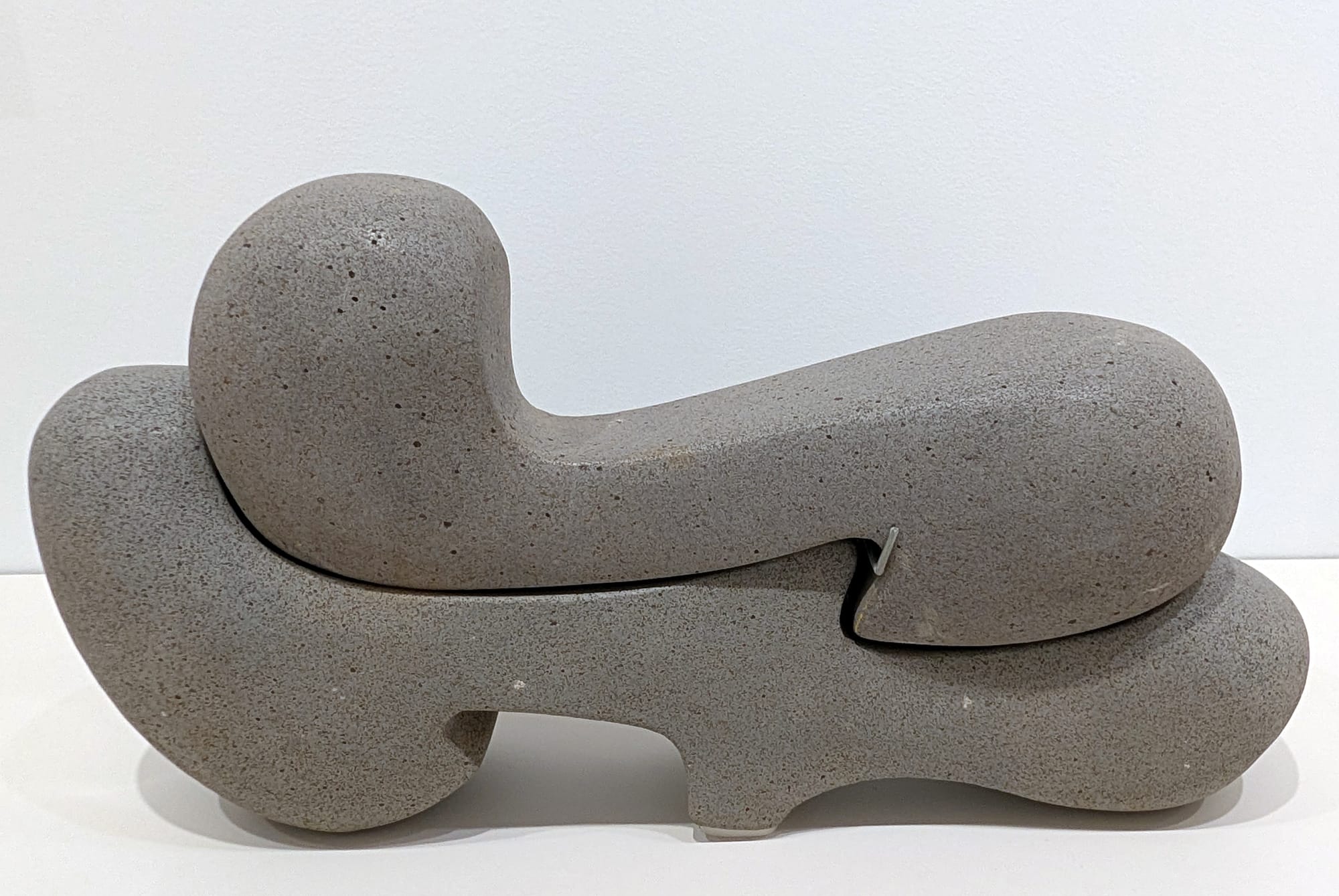
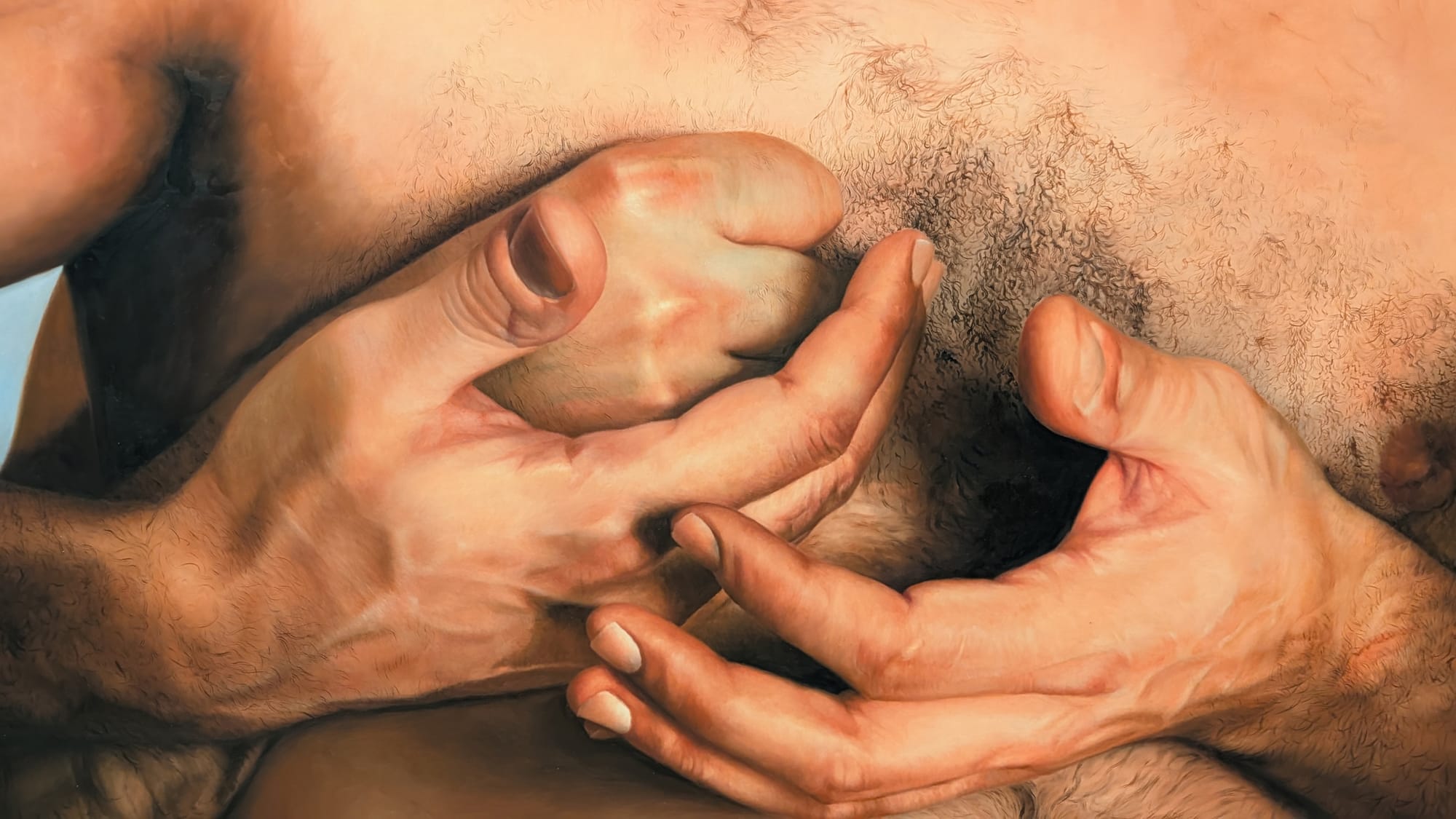
If past Internationals have embraced shocking spectacles or grand pronouncements, then the 59th feels more intimate — an embodiment of the credo that the personal is political. Particularly moving is the work of Palestinian artist Khalil Rabah, the founder of the Palestinian Museum of Natural History and Humankind, whose 2025 series Making a Right Heart features four photorealistic oil paintings focusing on anatomical closeups of the artist’s hands and torso, every bruise, callus, hangnail, and ingrown hair presented for inspection. It’s a political message couched in beauty — a call for empathy and recognition of humanity in a country that doesn’t recognize Rabah’s homeland as a nation and has enabled the genocide of its people. Meanwhile, Lebanese sculptor Saloua Raouda Choucair, who died in 2017, is represented by an assemblage of warm wooden carvings and carefully crafted ceramics that are no less moving or intimate for being abstract. At the very least, a perusal of the exhibition should convince anyone that the future — and the present — of artistic energy is in Africa, Asia, South America, and other non-Western regions.
On the whole, though, the International’s politics reflect a right-leaning liberalism, with some notable exceptions. There is much to this art, but little that is shocking (not that that’s necessarily always a virtue). Much of this speaks to how much the world has changed over the course of the 21st century and how, curatorially, it must be difficult for artistic representation to keep pace with the awful hyperreality of the world itself. As Jerry Saltz put it in Art Is Life: Icons and Iconoclasts, Visionaries and Vigilantes, and Flashes of Hope in the Night (2022), “The avant-garde won and took no prisoners”; the art world now is like “a conference call, a strip city run by a student government, an insider’s game everyone is in on.” On the whole, it’s impossible to really imagine an Ofili today. It’s telling that the most provocative pieces in this exhibition are several decades old; as a case in point, British artist Donald Rodney, who died of complications from sickle cell anemia in 1998, is represented by his 1990 work “Visceral Canker,” which features the exchange of blood through IV tubes between bags attached to two painted wooden heraldic emblems, one of the 16th-century English Hawkins family, known for its trade of enslaved people, and the other of Queen Elizabeth II.
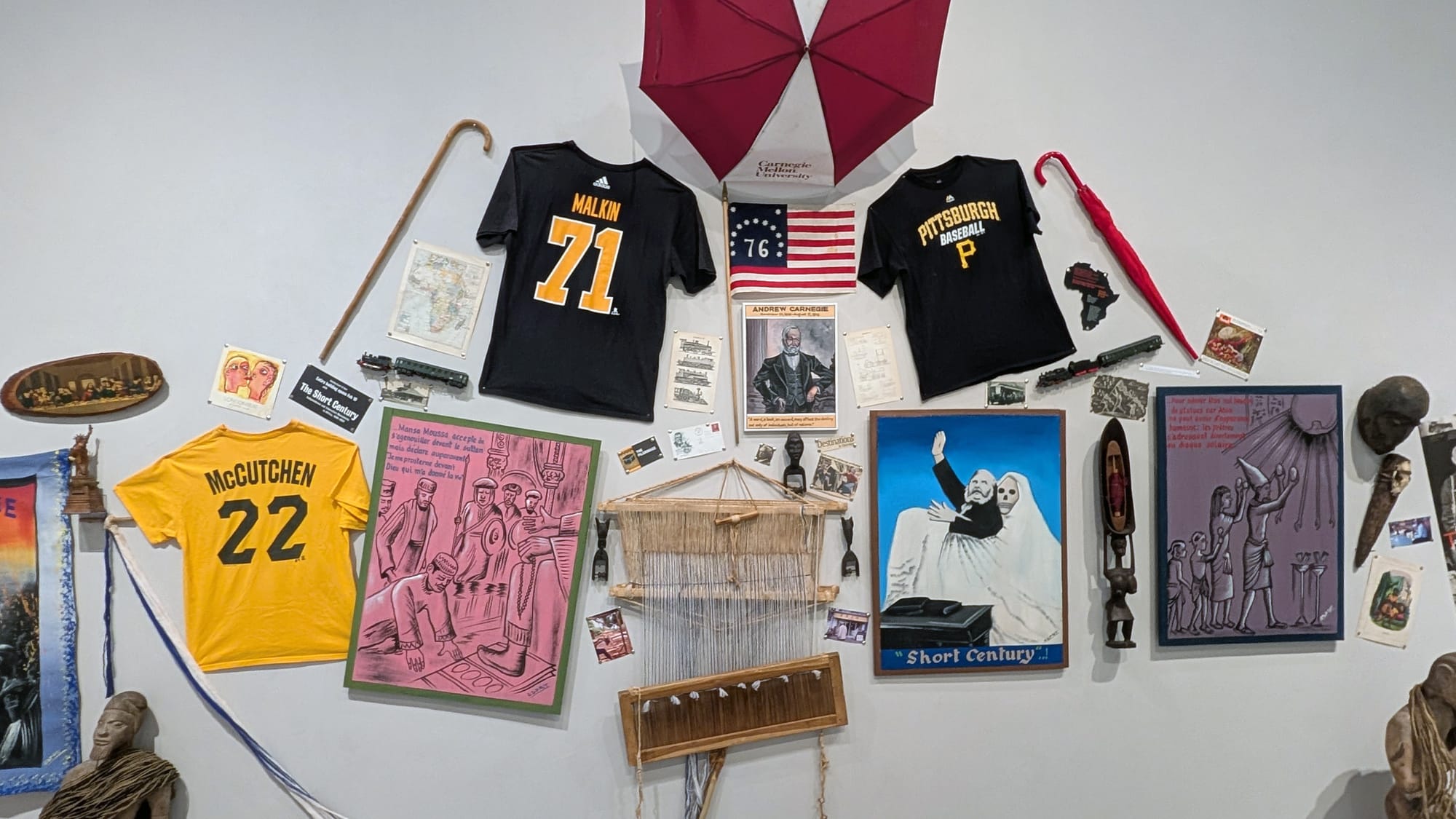
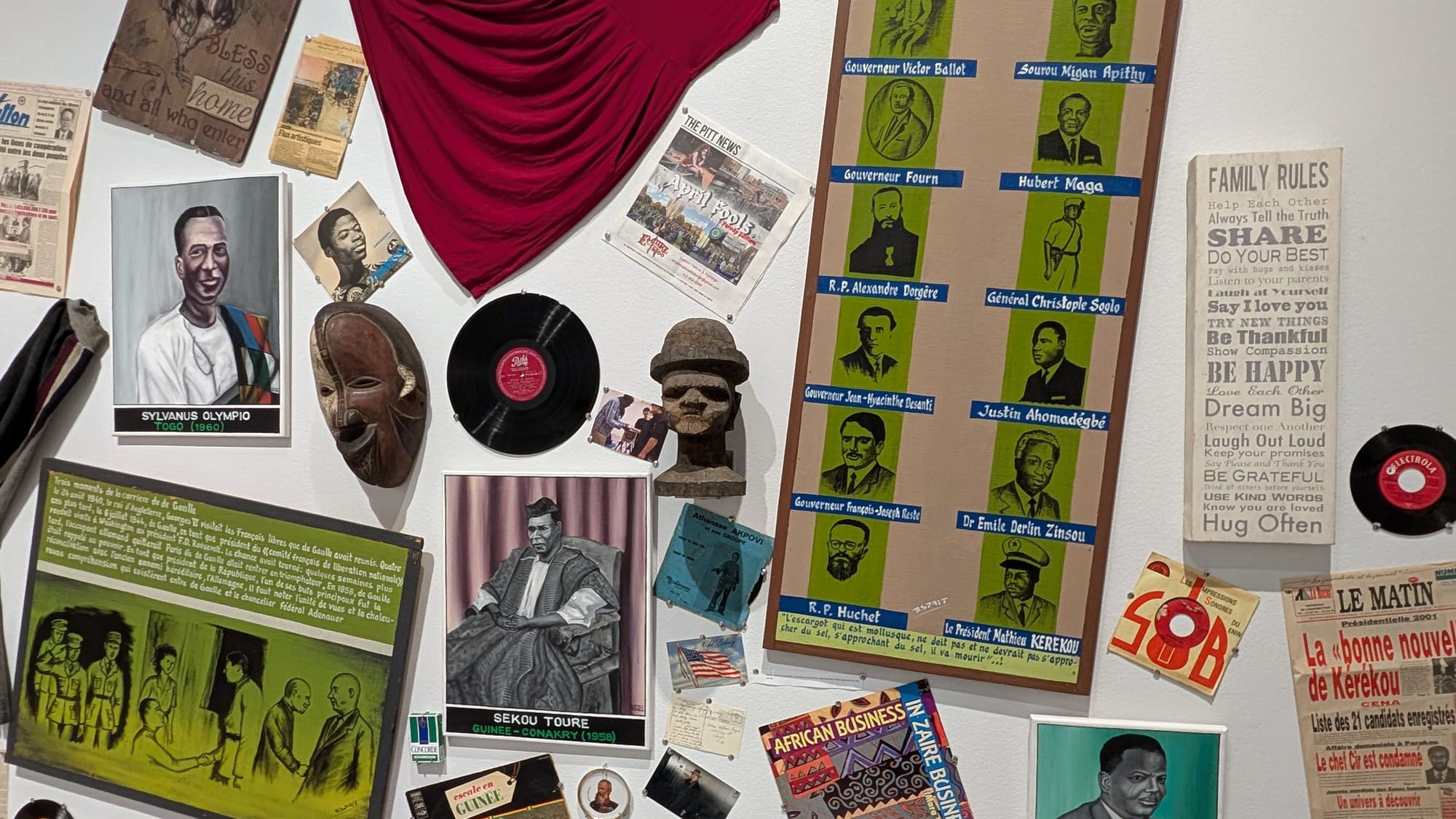
Among the works most cuttingly critiquing predatory capitalism is Beninese artist Georges Adéagbo’s 2001 “Le Socialisme Africain,” originally displayed in the traveling exhibition The Short Century: Independence and Liberation Movements in Africa, 1945-1994. (Another exceptional piece is Torkwase Dyson’s work on extractive exploitation, “I Belong to the Distance 3, (Force Multiplier),” 2023.) Exhibited for the first time in two decades and composed of an assortment of African and Western paintings, posters, and books overlaid together as if a post-colonial yard sale, Adéagbo has added some local flavor, including a black-and-gold jersey of the Pittsburgh Penguins’ Evgeni Malkin and the Terrible Towel brandished by Steelers fans. And there, in the middle, is also a rough portrait of the museum’s namesake, once the richest man in the world, the diminutive robber baron framed with a quote — “A word, a look, an accent, may affect the destiny not only of individuals, but of nations.” The placement of Carnegie’s portrait above an African sculpture, one imagines, is meant to imply something slightly more ominous than what the founder of US Steel might have intended. In that regard, the most radical work of the International in highlighting the webs of complicity between art and capital is ironically not an artwork, but something printed on the back of every journalist’s press pass — “presented by BANK OF AMERICA.” Ponder it more fully, and it’s far more shocking than just a bit of shit on a canvas.
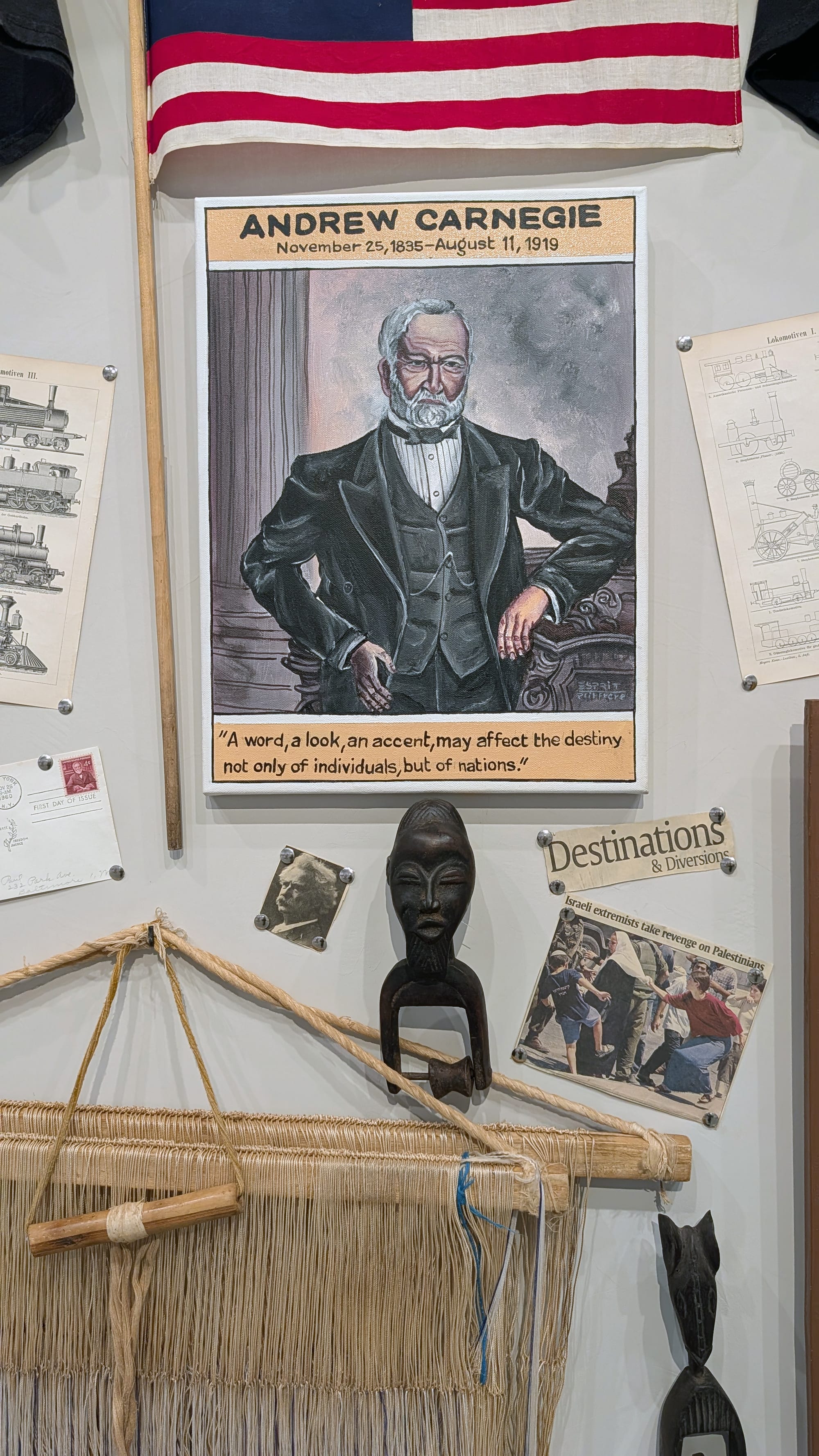
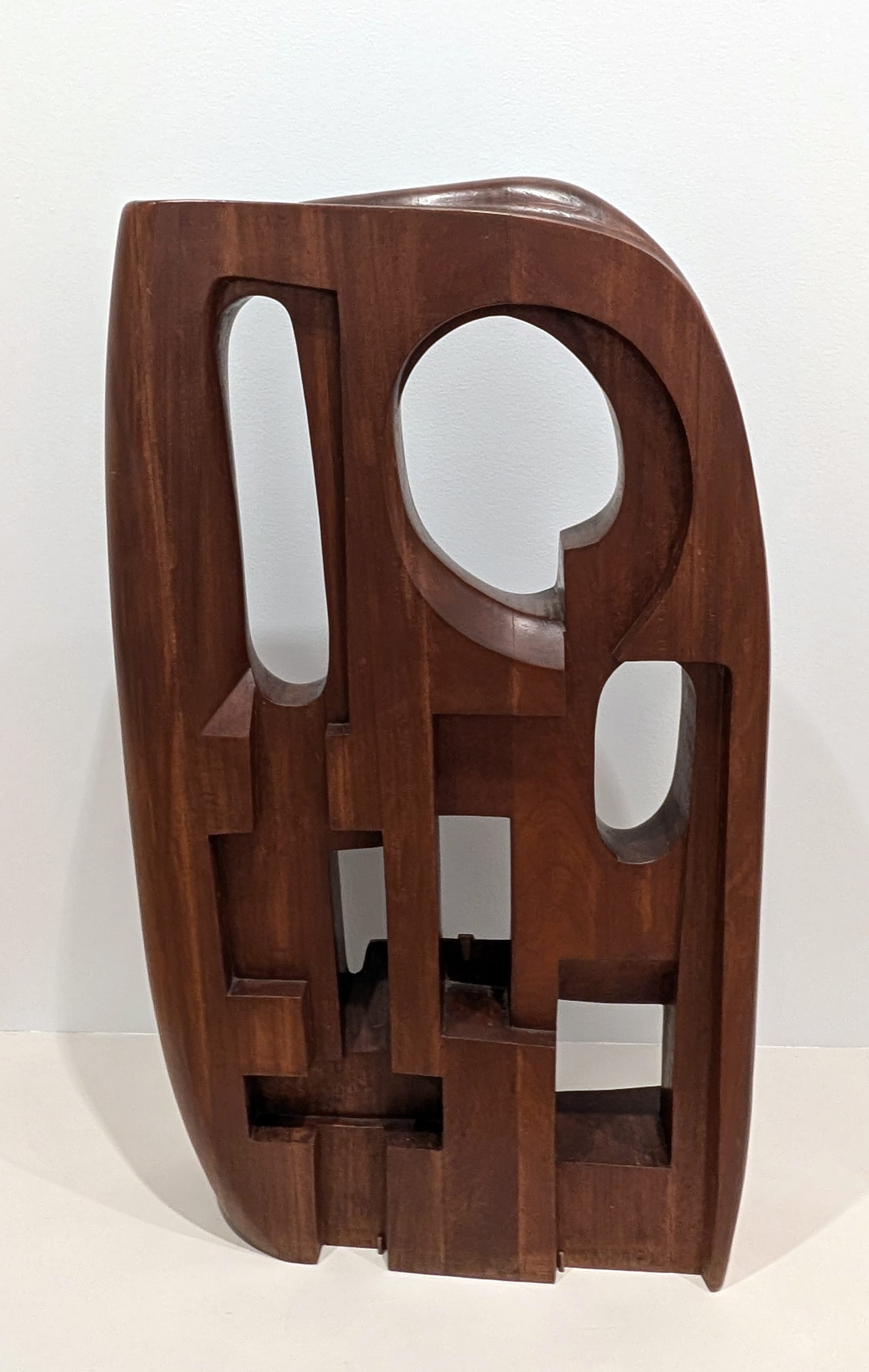
Left: A painting of Andrew Carnegie added to this iteration of Georges Adéagbo’s 2001 “Le Socialisme Africain” (note the African mask beneath); right: Installation view of sculpture by Saloua Raouda Choucair
If the word we: 59th Carnegie International continues at the Carnegie Museum of Art (4400 Forbes Avenue, Pittsburgh, Pennsylvania) through January 3, 2027. The exhibition was curated by Ryan Inouye, Danielle A. Jackson, and Liz Park.