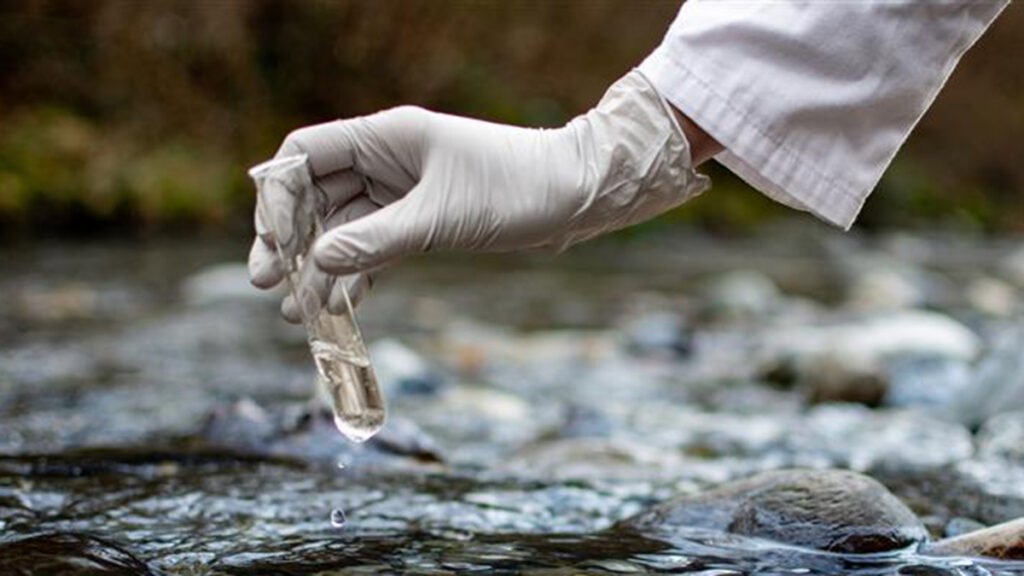
This month, Eos is taking a long look at “forever chemicals.” Per- and polyfluoroalkyl substances (PFAS) have been percolating through our industrial environment since the 1940s. They help make products nonstick, waterproof, and stain resistant. They also make their way into air, soil, and water, as well as our bodies, where they have been linked to impaired immune systems, developmental delays in children, and some cancers.
Since discovering that PFAS might be harmful to human and environmental health, researchers and industries have reformed the chemicals into novel substances. The behaviors of these novel PFAS are proving difficult to pin down, as Grace van Deelen explores in her feature “Chemical Companies Are Churning Out New PFAS. Where in the World Are They Ending Up?”
From the deep ocean to alpine glaciers, scientists are being forced to play “chemical Whac-A-Mole” to study novel PFAS, one scientist told van Deelen. Researchers are also searching for—and finding—PFAS in the isolated interior of the White Continent, as described in Rebecca Owen’s “Tracing the Path of PFAS Across Antarctica.”
Once PFAS have been identified, scientists work to disarm them with filtration, heat, and even sunshine. In an innovative approach, “A Peculiar Polymer Paired with Sunlight Could Remove PFAS,” writes Emily Gardner.
Another option is to put PFAS to work. Read about how scientists are using trifluoroacetic acid, a less toxic PFAS, to gain a rough idea of how recently an aquifer has been recharged in Saima May Sidik’s “Pollution Is Rampant. We Might As Well Make Use of It.”
As PFAS permeate our environment in different ways, scientists are taking the lead in developing proactive approaches to search for, study, and maybe take the “forever” out of “forever chemicals.”
—Caryl-Sue Micalizio, Editor in Chief
Citation: Micalizio, C.-S. (2026), The persistence of PFAS, Eos, 107, https://doi.org/10.1029/2026EO260135. Published on 30 April 2026.
Text © 2026. AGU. CC BY-NC-ND 3.0
Except where otherwise noted, images are subject to copyright. Any reuse without express permission from the copyright owner is prohibited.