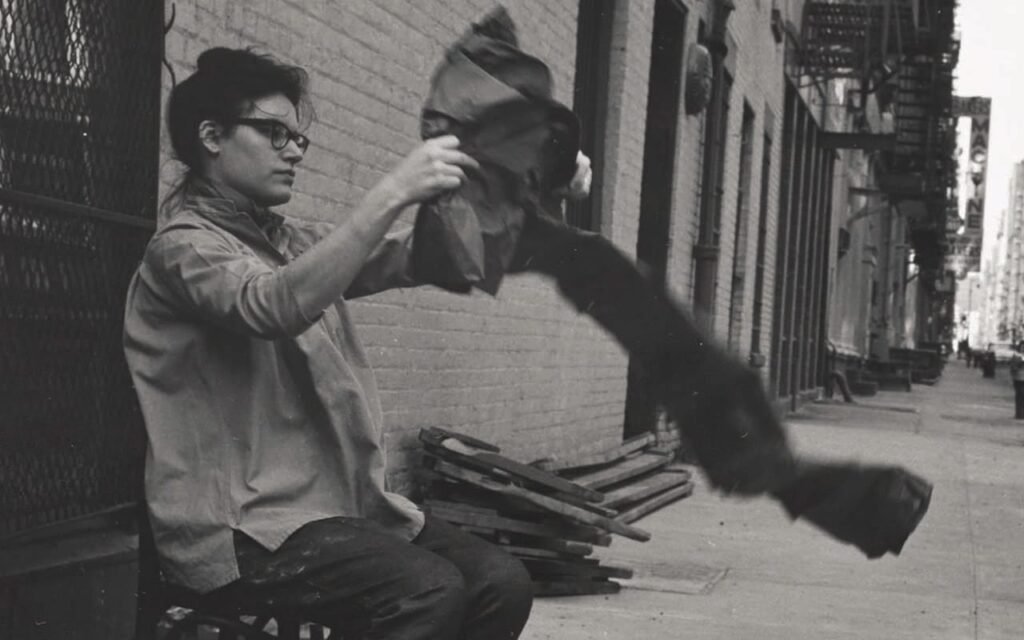
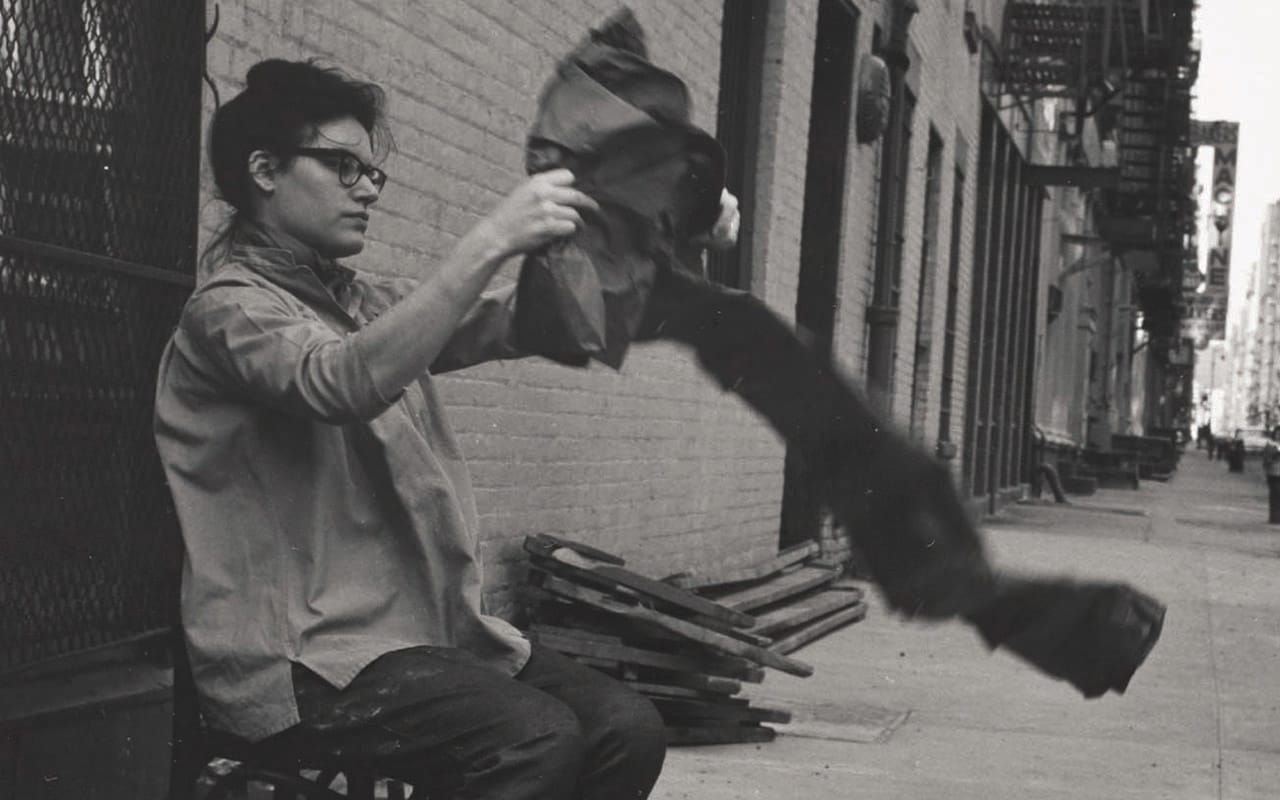
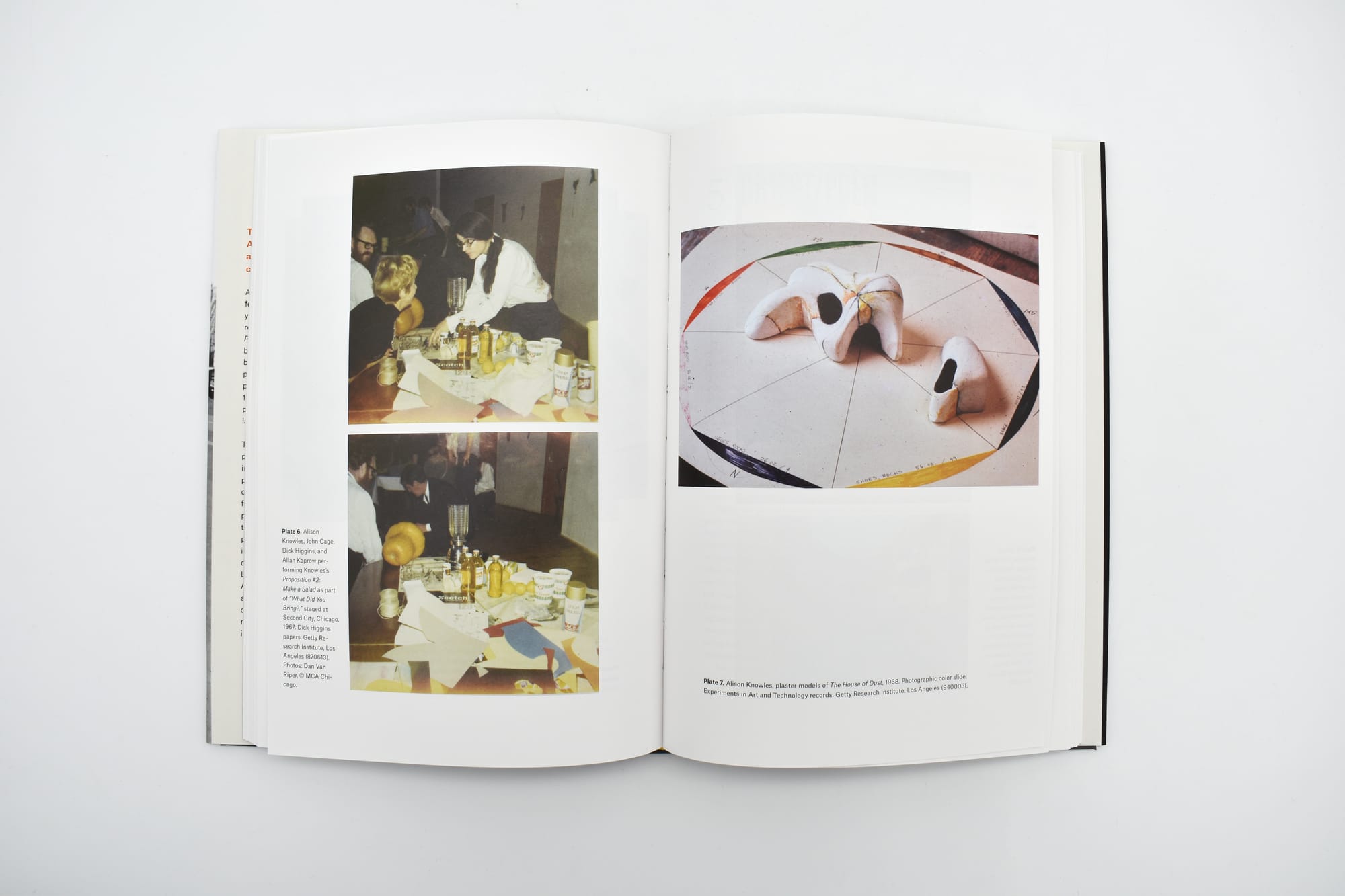
In October 1962, Alison Knowles turned the simple act of preparing a salad into a new kind of art. Proposition #2: Make a Salad debuted at London’s Institute of Contemporary Arts as part of the raucous Festival of Misfits, an event curated by poet and art dealer Victor Musgrave that introduced the Fluxus group to Great Britain. In the performance, the artist and her colleagues chopped and mixed the fresh ingredients in a pickle barrel on the stage of a small concert hall before plating and serving the dish to the roughly 100 people in attendance. The event was an early example of Knowles’s knack for creating unexpected situations that elevate everyday acts into something convivial and transcendent. Quietly radical projects like this one would continue to define the artist’s six-decade-long career.
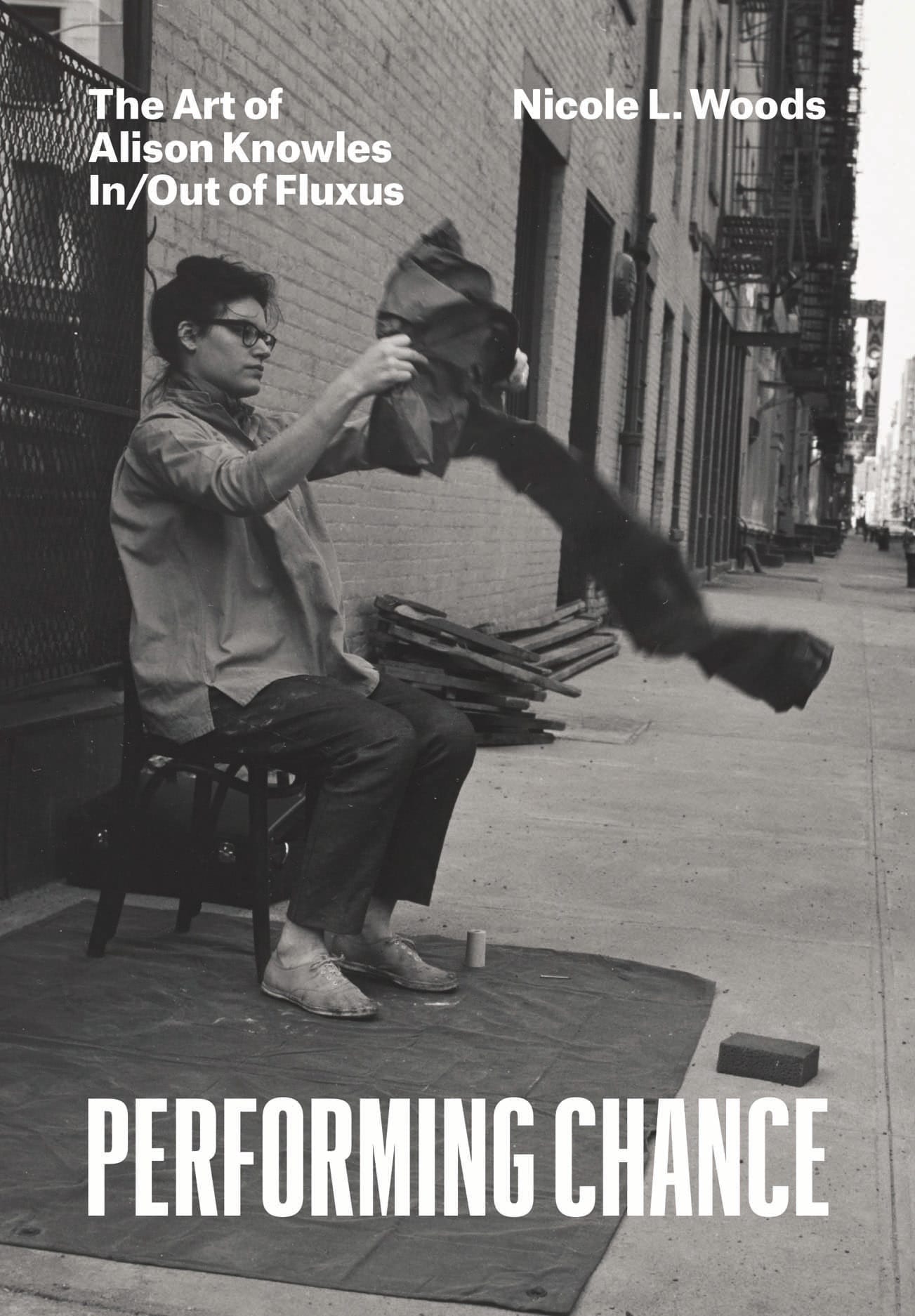
Performing Chance: The Art of Alison Knowles In/Out of Fluxus by art historian and critic Nicole L. Woods is the first major book on the artist, who died in New York City last fall at age 92. Despite her prominence as the only female founding member of the international avant-garde group Fluxus, Knowles “has remained a mystery” and is “generally noted but woefully understudied,” Woods writes. The reasons for this are manifold: The artist’s work was often ephemeral, multidisciplinary, and difficult to categorize. She experienced a “marginalized position relative to Fluxus men,” and sometimes burned her works when she was ready to move on to new creative territory. Most of all, Knowles’s “unpretentious” artwork is “stubbornly subtle,” like the artist herself. As the author notes in her thoughtful obituary for Artforum, Knowles was “an artist of shockingly little ego.”
The book brings the first two decades of the artist’s career — a period ranging from approximately 1958 to 1975 — into the spotlight. In each chapter, the author focuses on one or two of Knowles’s artworks, offering a chronological account of her artistic evolution. In her first chapter, Woods pinpoints the crucial moment when, despite studying painting at Pratt Institute in Brooklyn under Adolph Gottlieb and Franz Kline and seeming poised to become, in the artist’s words, “the next Helen Frankenthaler,” Knowles left painting behind. The pivotal episode took place at Syracuse University, where Josef Albers cruelly exiled the artist to the school’s basement for not following his strictures closely enough. Afterwards, Knowles “didn’t want to pursue the traditional methods of artmaking anymore,” as she told Woods in 2007. Experimental works combining performance, installation, poetry, writing, sculpture, and computational art would instead follow.
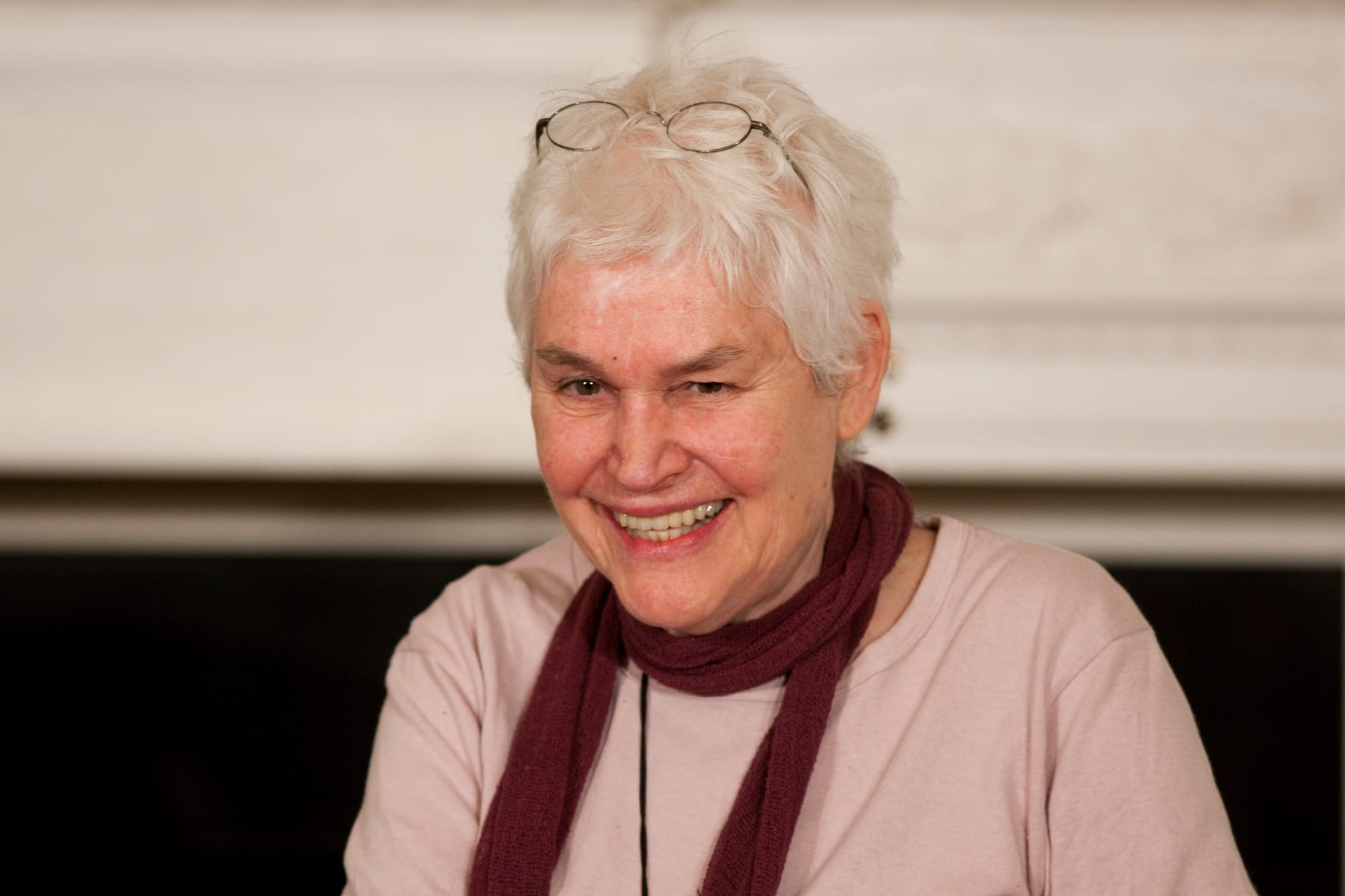
The majority of the text is dedicated to Woods’s meticulous analysis of Knowles’s artworks. Many of these passages are incisive and convincing, as when the author points to art historical connections between Knowles’s Journal of the Identical Lunch (1971) and newspaper snippets visible in early Cubist collage, or the powerful parallel between the artist’s Poem Drop Event at The House of Dust (also 1971) and helicopter imagery from the Vietnam War that also evoked the antiwar movement. Sometimes, though, Woods’s scholarly readings squash the artist’s joyful liveliness, spontaneity, and emphasis on the unpredictable. About Knowles’s Identical Lunch — a performance from the 1970s in which the artist blended tuna fish sandwiches, lettuce, and buttermilk into what she called “a creamy fish drink that is much enjoyed” by her audiences — Woods claims that the artist’s “intent” was to explore themes of “ecological disaster,” “corrupt food industry practices,” “public health concerns,” “sustainability and environmental protection.” Was it? Certainly those concepts could come to mind, but to say it was the artist’s intent without much further evidence seems to be a reach.
In the introduction to the book, Woods states her intention to “hold Knowles’s art and life in productive tension.” It’s curious, then, that so little of that life is fleshed out here. Take, for example, Knowles’s husband and fellow Fluxus member, the multifaceted artist Dick Higgins. He already identified as gay when they met in 1959, and Woods summarizes their relationship — which resulted in marriage, two daughters, artistic collaborations, divorce, and later reunion — as simply “a vexed entanglement” without further comment. And the years Knowles juggled life, work, parenting, and partnership between California and New York was merely, in Woods’s words, “tricky business.” Intrepid readers will find more details in the book’s notes section, but not enough to give a fuller picture of what the artist faced outside of her pioneering art practice.
Of course, women artists’ personal lives can often take on an unfairly outsized role in the reception of their work, and the book is described as a “monographic study” rather than a biography. But the author persuasively asserts that Knowles’s work is “grounded in the language of daily experience and gendered domesticity,” and writes in her obituary that “affection, daily routines, trust, and intimacy were always at the heart of Alison’s practice.” Yet the people who surely shaped Knowles’s experiences of “intimacy” and “gendered domesticity” — her partner and children — get precious little attention here, nor do we get much of a sense of what the artist’s “daily routines,” leisure time, or home life looked like. I come away from this book with many insights about Knowles’s artistic innovations and influences. But one of the author’s key arguments is that Knowles’s work is “protofeminist” in that it is tied to and informed by her position as a woman (in a conceptual, relational, and corporeal sense), and in that it incorporates themes of the home and the everyday. Learning so little about Knowles as a person therefore prevents us from fully seeing her as an artist.
Woods is undeniably an expert on Knowles: she wrote her doctoral thesis on Fluxus, contributed to a catalog of her ongoing travelling international retrospective, researched her archives, and — crucially — spent nearly 20 years interviewing the artist in her SoHo studio loft. Despite this, she rarely brings the artist’s voice into the book, though when it does appear, it’s unfailingly engaging and revealing. This reader would have liked more of those moments to better understand Knowles’s groundbreaking artworks, performances, and legacy on her own terms.
Performing Chance: The Art of Alison Knowles In/Out of Fluxus by Nicole L. Woods (2026) is published by the University of Chicago Press and is available online and in bookstores.