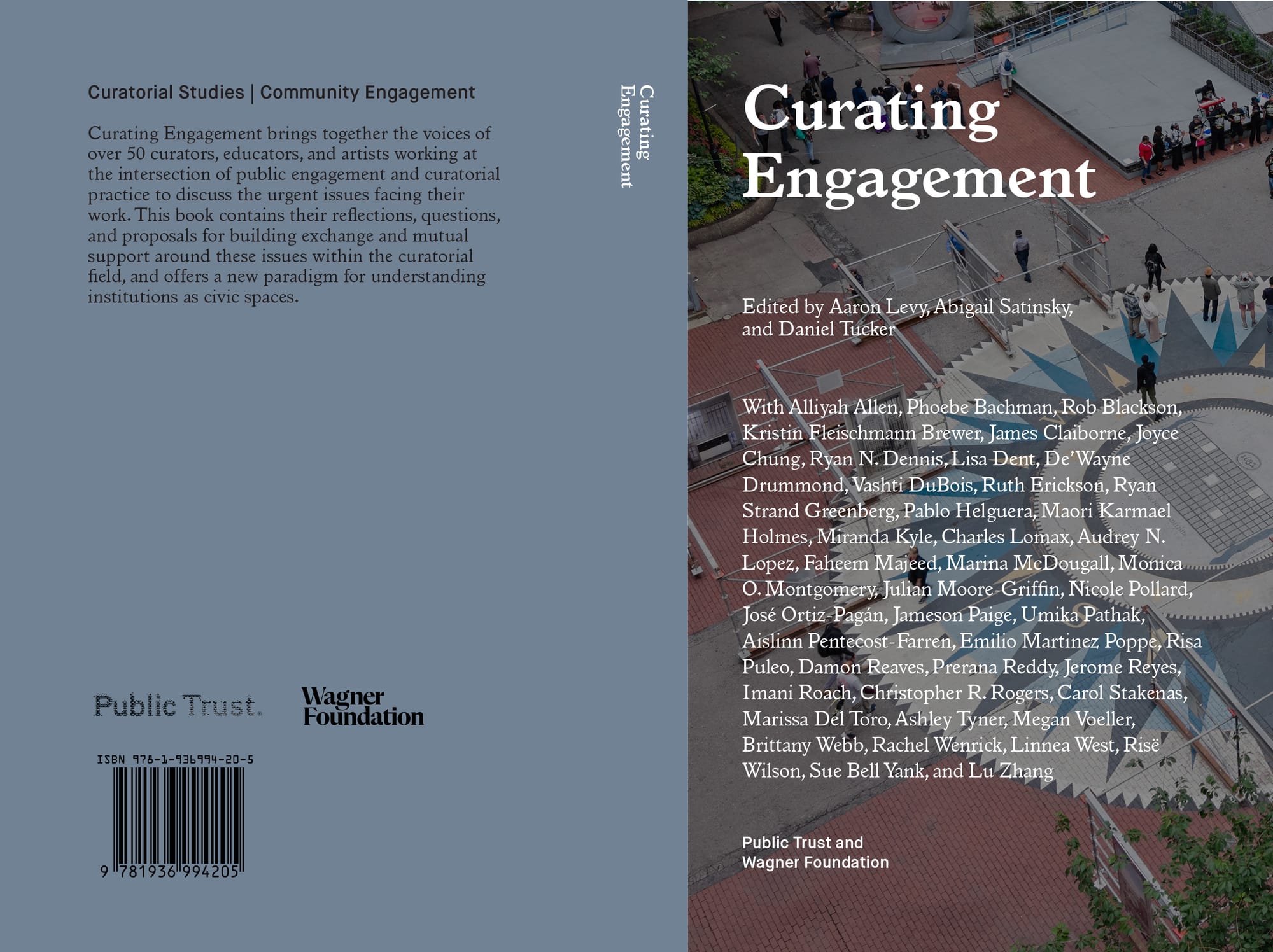
Editor’s Note: The following text has been excerpted with permission from Curating Engagement (2026), a new field resource developed by the Wagner Foundation and the Public Trust. Curating Engagement is available as a free downloadable PDF and will officially debut at the Curatorial Forum of Expo Chicago in partnership with Independent Curators International on April 10.
My career has been defined by a steady effort to collapse silos: between curatorial and educational work, between institutions and communities, between what museums have been and what they might yet become. The path from arts engagement to institutional leadership has not been linear, but the throughline is clear: a conviction that art has the capacity to build community, shift narratives, and open conditions for change.
This reflection offers nine lessons drawn from two decades of practice. They are not prescriptive models but propositions, ways of thinking and acting that emerged from navigating the porous boundary between engagement and leadership.
1. Curiosity as Practice
My first experiences at the Menil Collection in Houston taught me that curiosity is foundational. The exhibition Lessons from Below: Otabenga Jones & Associates (2007) transformed a gallery into an education room activated by a slew of incredible public programs. At the Menil, extended labels and participatory spaces were rare, yet this project made clear that deeper engagements, like turning the gallery into a “classroom” with ongoing public facing programs, were possible.
At the same time, I was volunteering at Project Row Houses (PRH) in Third Ward. The racial, educational, and socioeconomical contrast between audiences at the Menil and PRH raised urgent questions: How do you bring new audiences and communities into spaces? Who feels welcomed, and who remains excluded? What draws people to return to a space? These questions became formative, grounding my practice in the belief that institutions must not only collect but also connect.
2. Engagement as Service
At the Laundromat Project in New York, I learned that engagement is not about extraction, but about service. Projects were embedded in neighborhoods and emerged from lived realities, not imposed agendas. This orientation sharpened my understanding that to be useful as a curator, one must be accountable first to people, and only then to institutions, echoing what bell hooks called an “ethic of love” in educational and cultural practice.
3. Site and History as Teachers
While working with the Museum for African Art, I encountered the challenge of curating without a permanent building. Jane Alexander: Surveys (from the Cape of Good Hope), staged in the Cathedral of St. John the Divine in Harlem, reminded me that the site itself can be an active collaborator. The project illustrated how history, architecture, and community memory transform exhibitions into civic encounters. This recognition prepared me for the work ahead at PRH.
4. Community as a Site of Possibility
Project Row Houses remains one of the most formative chapters of my career. Founded in 1993 by Rick Lowe and six other artists, PRH reimagined 22 shotgun houses as a platform for art and community life. There, I learned that engagement is not a discrete program but a way of being.
The work was deeply responsive: hosting domino games to shift the energy of a troubled gas station corner, organizing “rounds” of exhibitions where artists engaged both the architecture of the shotgun house and the realities of neighborhood life, and planting gardens to honor local histories. These interventions demonstrated that small, intentional actions can transform both physical and social landscapes.
This practice resonates with Joseph Beuys’s notion of soziale plastik (social sculpture), in which society itself can be shaped through collective creativity. Yet at PRH, this idea was not abstract; it was materially grounded in Third Ward and accountable to its residents.
5. The Importance of Documentation
Another lesson from PRH was the necessity of documentation as accountability. Editing Collective Creative Actions: Project Row Houses at 25 allowed us to narrate our history from within, naming every artist, every mother, every collaborator. In a sector that often erases collective labor, documentation resists erasure and affirms lineage, echoing Grant Kester’s call for dialogical aesthetics that privilege process and exchange as much as product.
6. Translating Engagement into Institutional Practice
In 2020, I became Chief Curator and Artistic Director of the Center for Art and Public Exchange at the Mississippi Museum of Art. My charge was to reimagine acquisitions and curatorial practice through equity and engagement.
The exhibition A Movement in Every Direction: Legacies of the Great Migration, which I co-curated with Jessica Bell Brown, and which was organized by the Mississippi Museum of Art and the Baltimore Museum of Art, embodied this approach. We sought to expand migration narratives beyond trauma, foregrounding resilience and plenitude by asking 12 artists what their connections to the South are, and to engage in a deeply personal exploration of the question. Crucially, the work was not only on the walls; it was in block-walking through neighborhoods, hosting conversations in community spaces, and inviting residents into the museum on their own terms.
For some, it was startling that the chief curator would knock on their door. For me, it was an extension of engagement — the accountability museums must embrace if they are to remain relevant.
7. Leadership as Shared Practice
Today, as Co-Director of Contemporary Arts Museum Houston (CAMH), I am learning to translate these values into leadership. Institutional leadership requires attention to budgets, boards, and bureaucracy, but it must also hold fast to engagement, care, and accountability.
One project that crystallizes this is Rebirth in Action, a multiyear collaboration with the Houston Freedmen’s Town Conservancy, the City of Houston, and artist Theaster Gates. At its center are handmade bricks, paid for and laid by formerly enslaved people, that have been displaced, neglected, and stolen from the neighborhood and its residents over the years. Preserving and returning these bricks is both a material and symbolic act: safeguarding heritage while affirming dignity.
The work is complex, involving archaeologists, architects, city officials, church leaders, residents, and descendants. My role is not to dictate but to share leadership, amplifying community voices and ensuring that CAMH serves as a responsible partner. This resonates with current scholarship on “distributed leadership” in cultural organizations, where authority is shared across networks rather than concentrated at the top.
8. Joy and Grounding
Through all of this, I remain grounded by the wisdom of bell hooks, the integrity instilled by my mother, the love of my family, and the restorative power of nature. These sources remind me that leadership is not only strategic, but also spiritual. Without joy and grounding, institutional work risks becoming transactional; with them, it retains the possibility of transformation.
9. Engagement as Compass
The movement from engagement to leadership has not meant leaving behind the values of community work. Instead, it has meant carrying those values with me into new spaces, insisting that museums can be places of care, accountability, and possibility.
The central lesson is this: Leadership in the arts must be porous. It must listen as much as it speaks, serve as much as it directs, and hold close the wisdom of communities too often marginalized. The moment leadership becomes detached from engagement is the moment its purpose must be reexamined. Leadership, like engagement, is not a destination; it is a practice that is renewed daily, in collaboration with others.