
At Windsor Castle, a one-of-a-kind architectural marvel isn’t a structural part of the building itself or even a full-size feature. Here, you’ll find Queen Mary’s Dolls’ House, widely regarded as the largest and most famous in the world. Designed by architect Sir Edwin Lutyens, the house was built between 1921 and 1924 and contains items and furnishings conceived of by hundreds of the leading craftspeople and artisans of the day.
Queen Mary, consort to King George V between 1910 and 1936, was an enthusiast of all things miniature. Her dolls’ house even contains scale versions of nearly 600 real books in its library, including works by literary giants like A.A. Milne and Sir Arthur Conan Doyle. Commissioned from publishers around the U.K. and farther afield, many of these books are also held in the collections of the V&A, where they have been on long-term loan since 1916.
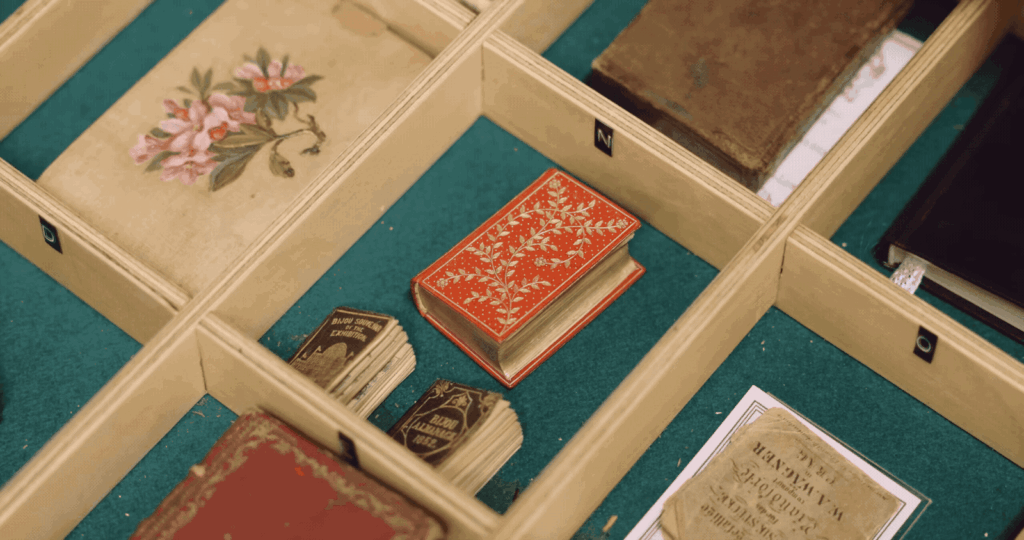
A recent video produced by the museum glimpses some of these tiny treasures with the expert guidance of National Art Library Assistant Librarian Amy McMullan and Catherine Yvard, Curator of National Art Library Collections. Examples include a red leather-bound Bible published in 1896 by Glasgow-based David Bryce & Son, in addition to a Quran, a collection of poems by Robert Burns, and more.
The National Art Library is housed within the V&A, and more than a million publications related to art, design, and performance comprise an archive that spans the 8th century to today.
Many more miniature books comprise the museum’s holdings, in addition to Queen Mary’s collection. Little almanacs in their embellished folios were published annually and included notable dates, such as sunrises and sunset times, holidays, and other practical information. Many of the titles sport gilt edges, marbled papers, and even metal cases that double as lockets so that they could be worn.
The collection includes diminutive dictionaries, a souvenir of The Great Exhibition of 1851 in Hyde Park, and children’s books—including a number of tunnel books, or paper peep-shows. These accordion-style tomes look at first glance like any other publication, but they expand into long tunnels through which viewers can take in a layered, dimensional scene.

The oldest object in the V&A’s collection is an early 1700s silver-bound miniature prayerbook in French that’s embellished with the semi-precious stone lapis lazuli. And the tiniest is fittingly called The Smallest Book in the World, published in 2002 and measuring 2.4 by 2.9 millimeters. It was designed by a German typographer and is so tiny that it’s accompanied by a small pamphlet showing what you would see if you could page through the book. As McMullen explains, the physical size of the book begs an interesting question: “Is it really a book if you can’t read it?”
Visitors are welcome to peruse the online catalogue and interact with items in the collection in person in the V&A East Storehouse’s reading rooms. Explore more on the museum’s YouTube channel.


Do stories and artists like this matter to you? Become a Colossal Member today and support independent arts publishing for as little as $7 per month. The article You’ll Need a Magnifying Glass to Read Some of the World’s Smallest Books at the V&A appeared first on Colossal.