How much money is climate change costing humanity? The social cost of carbon, a term for the monetary damages caused by excess carbon emissions, provides one answer.
That calculation has traditionally disregarded the impacts that climate change has on the ocean—until now.
“Once you see it, you cannot unsee it.”
“Once you see it, you cannot unsee it,” said Bernie Bastien-Olvera, a climate change scientist at the National Autonomous University of Mexico.
Bastien-Olvera is the lead author of a new paper published in Nature Climate Change that reevaluates the social cost of carbon, taking into account climate change’s effects on marine ecosystems. The study found the social cost of carbon nearly doubled when impacts on the ocean were considered.
“We usually think of the ocean economy as much, much smaller than the land-based economy. So the idea that climate change’s impacts on it could be as big as [they are] on land, where all of our infrastructure and people live, is surprising,” said James Rising, a climate economist at the University of Delaware who was not involved in the new study.
Involving the Ocean
Calculations of the social cost of carbon typically consider the economic impacts of climate change on property, agricultural productivity, and human health. Ocean elements, if they’re included at all, are usually limited to the ability of the ocean to absorb carbon.
Both the National Academies of Sciences, Engineering, and Medicine and the U.S. EPA have published reports emphasizing the need for marine ecosystem representation in calculations of the social cost of carbon.
“It’s so huge a gap,” Bastien-Olvera said. “It’s very well-documented that the oceans are a big missing piece in the social cost of carbon.”
Climate change is having a clear effect on ocean elements, regardless of whether those elements are included in calculating the social cost of carbon. As greenhouse gas emissions rise, marine chemistry is changing, and oceans are heating up, leading to interrelated phenomena, including ocean acidification, a loss of coral reefs, extreme weather events, and ecological imbalances.
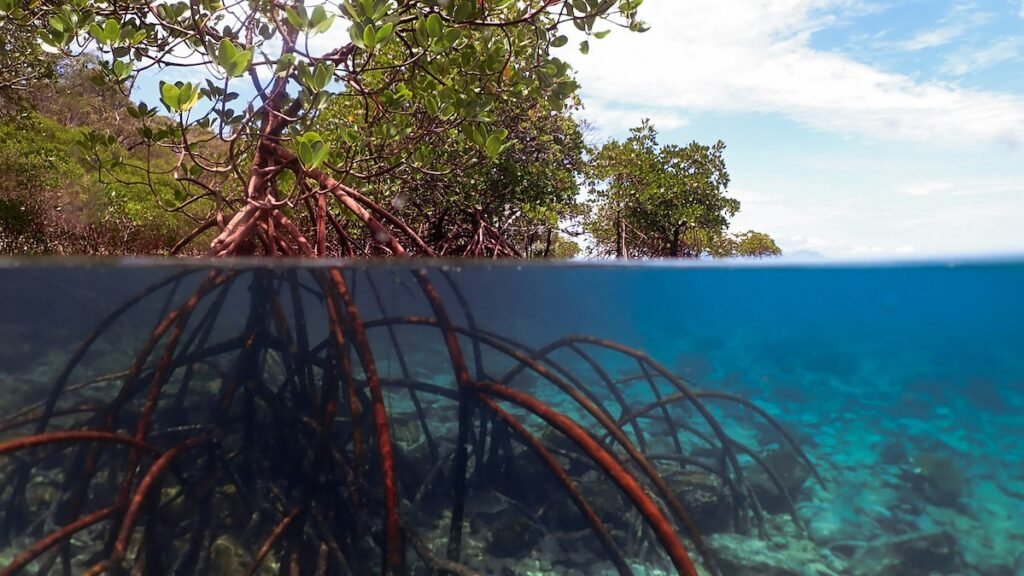
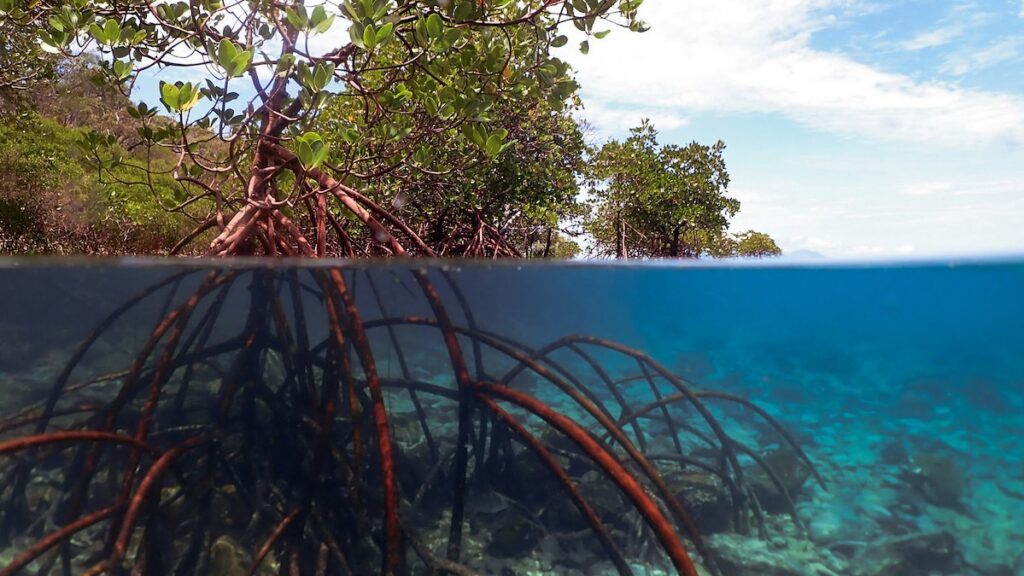
Bastien-Olvera and a team of scientists from seven countries integrated recent literature about the impacts of climate change on marine ecosystems and economies into the Regional Integrated Climate-Economy model (RICE50+) traditionally used to calculate the social cost of carbon. The researchers incorporated impacts on fisheries and marine agriculture, corals, mangroves, and seaports into the model, projecting costs under multiple climate change scenarios.
“It’s a very significant component to the total social cost of carbon.”
When impacts on marine ecosystems and infrastructure were considered, the social cost of carbon jumped to $97 per ton of carbon dioxide,nearly double the cost when only terrestrial ecosystems were included, which was calculated at $51 per ton of carbon dioxide. “It’s a very significant component to the total social cost of carbon,” Rising said.
Bastien-Olvera considers this number conservative because his team accounted for only a few of the ways that climate change is affecting oceans. “There’s a very, very long list of things that are not yet represented,” such as the existence value of deep-sea animals, the benefits of coastal protection from kelp forests, and the habitat offered by seagrasses, he said.
Modeling Marine Ecosystem Services
Economists calculating the monetary value of nature use so-called substitution parameters to evaluate how a natural system—like a coral reef—could be replaced with capital inputs from humans. Some benefits of natural systems, such as corals’ ability to protect shorelines from flooding, require fairly straightforward substitutions. Other benefits, like simply knowing that coral reefs exist and are beautiful, are much more difficult to put a price on.
Rising said that the current study used simple substitution parameters to evaluate intangible elements such as enjoyment. He said more research on climate change’s impacts on the ocean is needed to help models better reflect the different economic values of different marine ecosystems.
Overall, the paper’s authors “do a really convincing job” and use “very reasonable economic steps” to estimate the social cost of carbon, Rising said.
Rising said the new paper could have an immediate policy impact for governments and organizations that use estimates of the social cost of carbon and is a great first step for other scientists attempting to estimate the measurement.
“What these authors have done is give us a framework for thinking about further improvements, and it’s going to be exciting,” he said.
—Grace van Deelen (@gvd.bsky.social), Staff Writer
Citation: van Deelen, G. (2026), With the ocean included, the social cost of carbon doubles, Eos, 107, https://doi.org/10.1029/2026EO260067. Published on 25 February 2026.
Text © 2026. AGU. CC BY-NC-ND 3.0
Except where otherwise noted, images are subject to copyright. Any reuse without express permission from the copyright owner is prohibited.