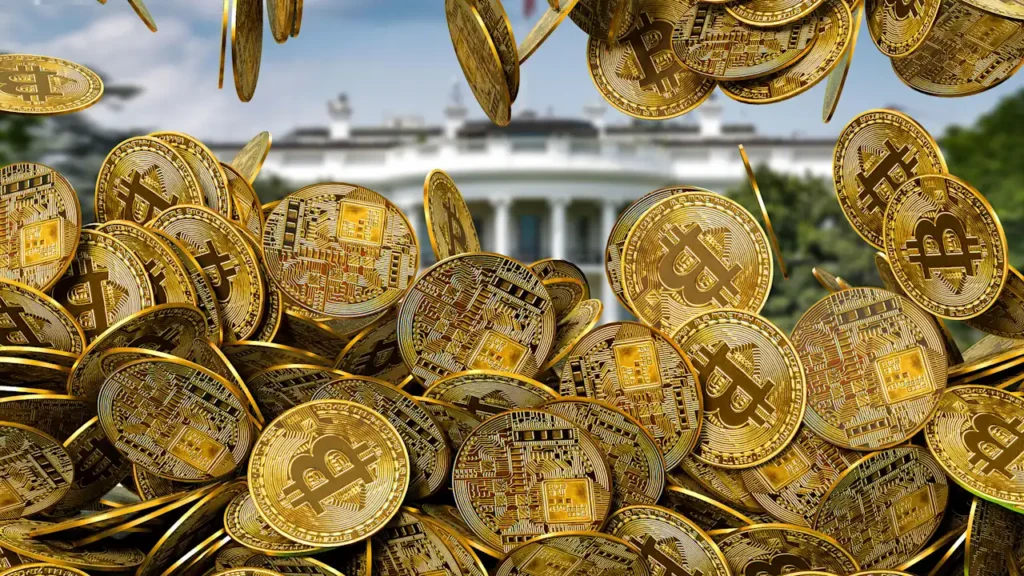
Last March, President Donald Trump signed an executive order declaring that the government would launch a strategic reserve of Bitcoin. For the crypto industry, the move was a major win, the next step in its quest to normalize digital assets.
Now, nearly a year later, the amount of Bitcoin held by the U.S. government does seem to be growing, but the federal government also seems somewhat reluctant to talk about about if, and how, the stockpile will actually be set up.
As of January, the U.S. government appears to have amassed about $29 billion worth of Bitcoin, many from seizures that follow criminal investigations, according to a new analysis by Chainalysis, a blockchain data firm. That’s up nearly 50% from May of last year, when the group last conducted a study of government-linked crypto wallets.
“Those [BTC] numbers continue to go up over time,” Eric Jardine, Chainalysis’s head of research, told Fast Company. That stockpile is smaller than some private firms also amassing crypto, he explained, but “the current total for the U.S. government is quite sizable—as big, if not bigger, than every other government.”
The growing reserves align with Trump’s executive order, which stated there was a “strategic advantage” to building up the American government’s cryptocurrency troves because, like gold, there’s a “fixed supply.” The White House suggests that building up a supply of Bitcoin, like any “resource,” is good for the national interest, though there are forceful criticisms of that notion.
Still, for all the initial fanfare, the Treasury Department has since been relatively quiet about its progress on moving forward with the reserve. While the government does seem to have begun to hold—rather than sell off—seized Bitcoin, federal agencies mostly ignored Fast Company’s requests for comment on how they’re actually enacting the terms of the order. One source in Treasury Department circles said that there’s been radio silence when it comes to the stockpile.
In fact, it seems like the reserve may be facing some legal hurdles. As Fast Company reported the story, Patrick Witt, a White House staffer working on crypto issues, indicated on a crypto-friendly podcast that legal conversations about setting up the reserve were still ongoing. “That one is—it’s interesting,” he said. “It seems straightforward, but then you get into some obscure legal provisions, and why this agency can’t do it, but actually, this agency could. We’re continuing to push on that. It is certainly still on the priority list right now.”
Making the executive order a reality
Executive Order 14233 instructed the Treasury Department to set up offices to manage both a Strategic Bitcoin Reserve and a United States Digital Asset Stockpile, an office to handle blockchain-based assets other than Bitcoin. According to the order, the Treasury Department was supposed to manage both stockpiles and begin looking for ways the government could potentially acquire more Bitcoin without increasing costs for taxpayers. The order also restricted government agencies from selling or getting rid of digital assets, except in a limited set of circumstances.
In June, Tyler Williams, the Treasury Department’s counselor for digital assets, briefly mentioned the stockpile—according to minute meetings from the Financial Stability Oversight Council, which is housed within the department—but provided few details. A policy report from June also discussed the reserve and noted that the Treasury Department had sent considerations to the White House about the reserve and would “move forward” with the next steps, including looking at ways to actually hold crypto in custody.
Chainalysis looked at crypto addresses that seem to be associated with the government, calculating they held about $29 billion worth of crypto. The company noted there might be some consolidation of Bitcoin accounts, but didn’t say which agencies might be currently holding them.
It’s not clear if further progress has been made on developing a Treasury-operated stockpile. Earlier this month, Bitcoin Magazine suggested that the U.S. Marshals Service may have even sold government-seized crypto, prompting an outraged post on X from Sen. Cynthia Lummis (R-WY), one of the most pro-Bitcoin legislators in Congress. Witt, from the president’s council of advisers for digital assets, later said on X that he’d confirmed that the wallet in play had not been liquidated, as per the executive order. A U.S. Marshals spokesperson told Fast Company: “The reporting about the sale of that wallet was in error. They did not fact-check. The Bitcoin is still being held, as per direction of the executive order.”
The reserve no one will talk about
Still, the government seems otherwise reluctant to discuss the reserve. When asked about the state of the stockpile at the World Economic Forum’s annual meeting, held a week ago in Davos, Switzerland, Treasury Secretary Scott Bessent only told reporters: “The policy of this government is to add seized Bitcoin to our digital asset reserve after the damages are done. … Our view was first you have to stop selling—which we have done—and then we can add the assets and asset forfeitures.”
The Treasury Department has not responded to multiple requests for comment from Fast Company regarding more details on the stockpile’s operations, and it’s not clear if the department has actually set up any offices, as the order stipulates.
Witt, meanwhile, has recently hinted that there are still ongoing discussions on how to, legally, make the reserve actually work. During a podcast interview, he mentioned “good engagement” with a team led by Stephen Miller, White House deputy chief of staff for policy. “I think with some of the latest … kind of developments and things that we’ve learned, and engagement from general counsels and different agencies,” he said, “[they have] some good guidance on where we can move out on this executive order of the president, and can do so in a legally sound way. So more to come on that.”
Notably, the executive order also established responsibilities for various federal agencies, which are supposed to communicate with the Treasury Department about Bitcoin and other digital assets they might have on hand. Deadlines for those updates have long passed. Still, only one of more than a dozen federal agencies contacted by Fast Company commented on what they specifically had done to meet the executive order’s requirements. That was the Secret Service, which, in addition to protecting the president and foreign diplomats, has a cybercrime team.
“The U.S. Secret Service is compliant with the reporting standards set forth in the executive order,” said Alexandria Worley, a USSS spokesperson. “A majority of the U.S. Secret Service’s forfeited digital assets belong to victims of criminal activity, and one of the agency’s primary investigative goals is to recover and return those assets to their rightful owners.” Worley said that the amount of crypto retained by the government is nominal.
Coinbase, which currently has a contract to hold crypto for the U.S. Marshals Service, did not respond to a request for comment about whether it’s also holding a U.S. stockpile. Neither did Kraken or Gemini, which also offer services for maintaining crypto. Fast Company was not able to identify any solicitations from the Treasury Department that mention the strategic Bitcoin stockpile, and Sen. Lummis’s office also ignored multiple requests for comment.
Pro-crypto groups are still rooting for the stockpile, though, and the validation it offers. Hailey Miller, an executive director for the Digital Chamber’s policy group, said that the reserve can “become not just a balance sheet item, but a pillar of U.S. economic and technological competitiveness.” Ji Hun Kim, CEO of the Crypto Council for Innovation, similarly told Fast Company that the “digital asset reserve showcases policymakers’ understanding that digital assets have a crucial place.”