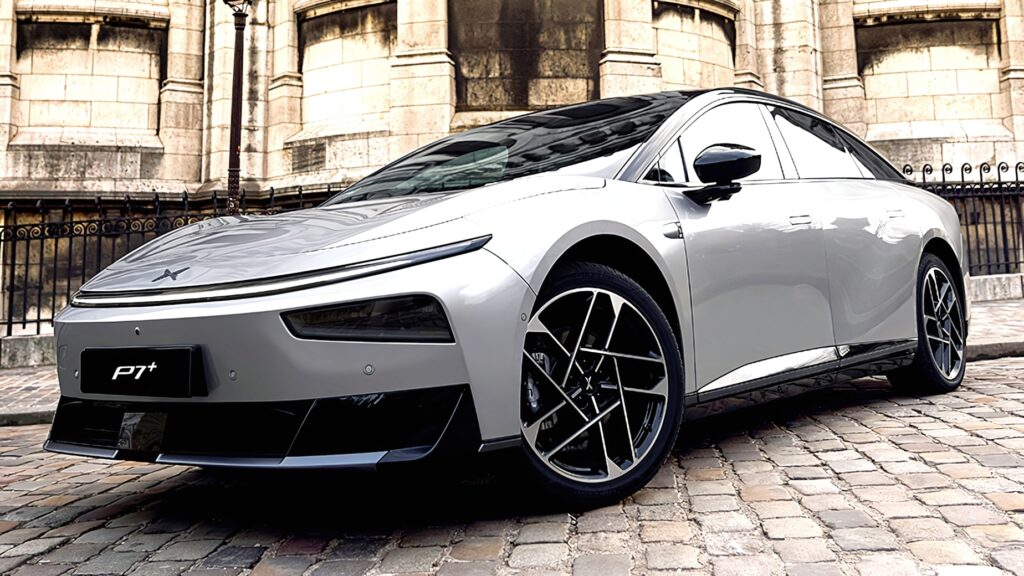
- Xpeng’s P7+ undercuts VW’s ID7 with a €43,600 starting price.
- It uses 800V tech for faster 350 to 446 kW charging speeds.
- Long-range P7+ offers 530 km versus ID7’s 619 km estimate.
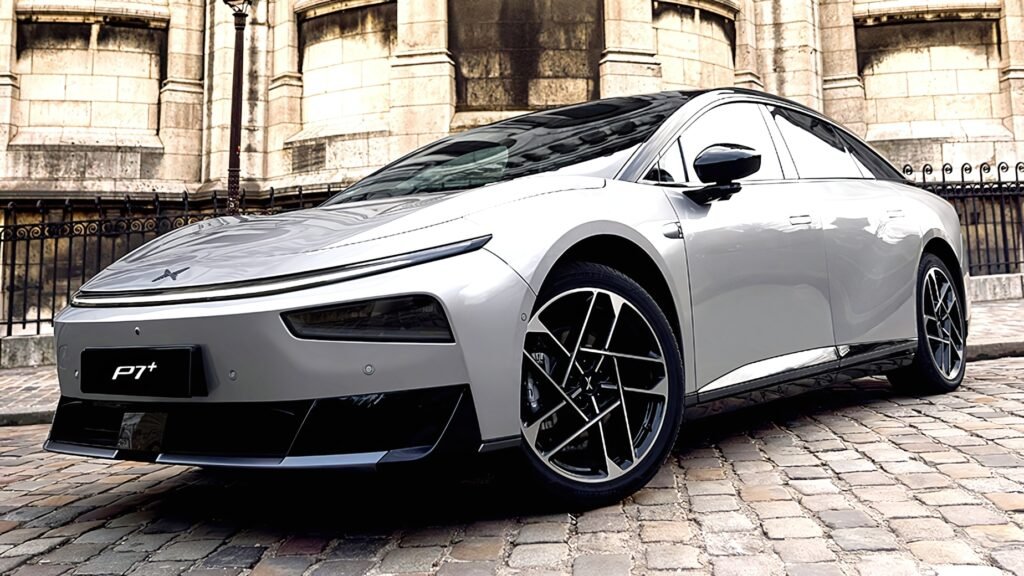
While VW and Xpeng are teaming up to develop new EVs for China, the partnership hasn’t stopped a quiet rivalry from unfolding. Xpeng has just rolled out its latest electric sedan, the P7+, across European markets, and it’s not shy about naming its target, which is none other than the VW ID.7, one of Europe’s top-selling EVs.
Read: Xpeng P7+ Is The Latest Ultra-Efficient EV From China
The P7+ has already spent time on the Chinese market, but it recently arrived in Europe with more than just a new badge. It debuted in European specification at the Brussels Auto Show earlier this month and is now being built locally at Magna Steyr’s contract manufacturing facility in Graz, Austria.
Like the ID.7, it’s a streamlined, low-profile sedan with a strong focus on range and high-speed charging.
A Cheaper Entry, With Compromises
One thing the Xpeng has going for it over the VW is price. In Germany, the entry-level P7+ starts at just €43,600 ($51,200), significantly undercutting the ID.7 that kicks off from €54,105 ($64,900). However, whereas the base ID.7 uses a 77 kWh battery and has a WLTP driving range of 385 miles (619 km), the base P7+ uses a much smaller 62 kWh pack, restricting its range to 283 miles (455 km).
Shoppers who want to travel farther between stops will need to pay at least €49,600 ($59,500) for the long-range model, which boasts a 75 kWh pack and a 329-mile (530 km) range. However, that pales in comparison to the flagship ID.7 Pro S with its 86 kWh pack and 440-mile (708 km) range.
Charging Without Compromise
According to Sven De Smet, head of brand and marketing at Xpeng Europe, who spoke to AutoNews, one of the key advantages of the P7+ is its faster charging capability. The VW tops out at 200 kW for DC fast charging, while the base P7+ can reach 350 kW, and the long-range version peaks at 446 kW.
“We believe charging is one of the pain points,” De Smet said. “A big battery is heavier, which means it consumes more electricity, which means you charge it more.”
Xpeng also points out that the smaller, lighter battery packs in the P7+ should have a positive impact on handling and overall driving dynamics. That could prove appealing to European drivers, who often place a premium on responsiveness and efficiency.
The question now is whether the P7+ can match the ID.7’s strong European sales. Last year, VW moved 76,368 units of the ID.7 across the continent, putting it in seventh place among all EVs sold. That figure put it just 10,000 units behind the Tesla Model 3. Xpeng may be the challenger in this case, but it’s stepping into a crowded field.
Strategic Partners, Not Just Rivals
VW holds a five percent stake in Xpeng following a $700 million investment, but the ties run deeper than capital. The two brands are jointly developing several EVs for the Chinese market, including at least one model built on Xpeng’s Edward platform. VW has also committed to integrating aspects of Xpeng’s tech stack, including its proprietary Turing chip and VLA 2.0 software, into future models.
Xpeng