
vivo has really made a name for itself in the past few years for offering the best camera experience on a smartphone. Of course, their “Ultra” models do have that 1-inch sensor, much like OPPO and Xiaomi, but even the base and Pro models have really incredible cameras. That was the biggest reason why I was so excited to check out the vivo X300 Pro, as I’ve never used a vivo phone before. And I will say, I was not disappointed.
Before we jump into the review, it’s important to note that vivo was very quick to get the global launch for the X300 Pro out the door. It launched globally about 3 weeks after the China mainland launch. Which is quite quick, typically, that would take a few months.

Pros
- Exceptional camera quality with ZEISS partnership, rivaling or exceeding competitors like OPPO Find X9 Pro
- Excellent thermal management—stays cool even during extended gaming sessions at max settings
- Nearly 13 hours of screen-on time with heavy camera use
- Fast charging at 90W with included charger (full charge in under 40 minutes)Fast charging at 90W with included charger (full charge in under 40 minutes)
- Dimensity 9500 delivers flagship performance with great efficiency
- OriginOS 6 is smooth, customizable, and includes useful features like estimated charging time
Cons
- Included charger uses USB-A instead of USB-C
- Software support trails Samsung and Google (5 years vs 7 years)
- Slightly behind Snapdragon 8 Elite Gen 5 devices in raw benchmark scores
- Large camera bump causes phone to sit at an angle on flat surfaces
vivo sent over both the X300 Pro and X300 for us to review. Due to the sheer number of phones that launched in a short period of time in September-November, it was put on the back burner for a bit. But, before writing this review, we did use it for two weeks. And this is not a sponsored review, vivo did not see this review before it was published.
vivo X300 Pro Specs
vivo X300 Pro Specs
| Display | 6.78″ LTPO AMOLED 120Hz |
| Processor | MediaTek Dimensity 9500 |
| RAM/Storage | 12GB/256GB, 16GB/512GB, 16GB/1TB |
| Battery | 6,510mAh |
| Charging Speeds | 90W wired; 40W wireless |
| Cameras | 50MP primary at f/1.6; 200MP 3.7x telephoto at f/2.7; 50MP ultrawide |
| Front-camera | 50MP f/2.0 at 20mm |
| Colors | Phantom Black, Mist Blue, Dune Brown, Cloud White |
vivo X300 Pro Review: Hardware and build quality
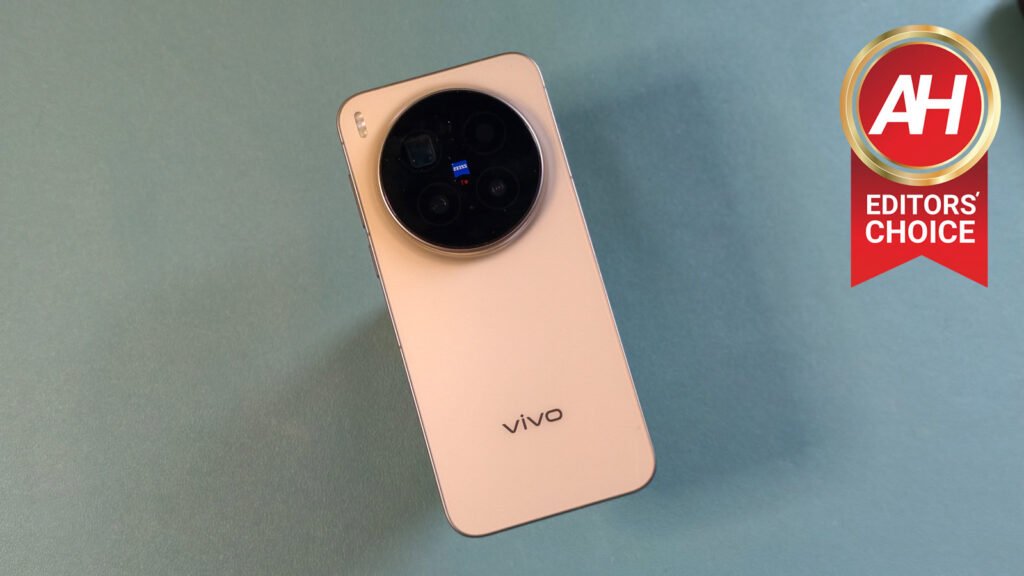
Starting off with the hardware, this is a very solid phone here. Of course, I’d expect nothing less from vivo – a former BBK brand. It does feel a bit thicker than other phones I’ve reviewed lately, even though it’s only 8mm thick. It is sort of using that “iPhone-style” for the design here, with a flat back and flat sides. Though the back is matte, which looks and feels amazing. I do have the “Dune Brown” color here, which is a lighter brown color that looks quite nice. And it doesn’t hold onto fingerprints like some other phones on the market.
Of course, with those big cameras comes a pretty large camera bump. And surprisingly, vivo seems to be the only one sticking with that round camera module in the center of the phone. OnePlus and OPPO both ditched it this year. I really like this style, because it gives my finger a place to rest, while I’m holding the phone. Obviously, when you sit it down on a table, it does sit at a pretty insane angle.
I do really like the dark frame on the X300 Pro, when contrasted with the lighter brown back of the phone. It gives it a really nice look, in my opinion.


As you’d expect, vivo did also copy Apple’s Action Button, much like OPPO did, and this button can be used for a number of different shortcuts. Since I use the camera so much on this phone, I left it as a shortcut to open the camera quickly. On the right side is the volume rocker and power button of course.
Then on the front you have that stunning 6.78-inch display with razor-thin bezels. I haven’t measured them, but they do look to be about as thick as the bezels on OnePlus 15 and OPPO Find X9 Pro. It’s a great looking phone, and one that feels very premium when you hold it in your hands.
vivo X300 Pro Review: Display
The display on the vivo X300 Pro looks amazing. It is a 6.78-inch LTPO AMOLED display, which has a 120Hz refresh rate, and a 2800×1260 resolution. And something I was surprised to see on this and the X300, is that vivo sets the default resolution to that 2800×1260. Whereas most other phones set it to FHD+ out of the box. This shows just how confident vivo is with this battery.
vivo says that it can hit a peak brightness of 4,500 nits, which is not something I really like, because you’ll never get anywhere close to that outside of a lab. The number I like to see instead is the HBM or High Brightness Mode, but vivo doesn’t share that. However, in our testing, we were able to get it to surpass 1,800 nits of brightness. And it was also very easy to see outdoors in direct sunlight. So brightness is not a problem whatsoever.

Bottom line is, no issues with this display. This is an incredible display, and I’d put it right up there with the Galaxy S25 Ultra, OPPO Find X9 Pro, and OnePlus 15.
vivo X300 Pro Review: Performance
Now let’s get into the important part: performance. As you likely know, this is powered by the MediaTek Dimensity 9500. Our particular unit has 16GB of RAM and 512GB of storage. So it’s a slight upgrade over the base model of the X300 Pro, which has 12GB of RAM. But I don’t think that would make a huge difference, as OriginOS 6 absolutely flies on this phone. It’s snappy, and I’ve never had a slowdown. Even when the device gets warm from playing games like MLBB.
The Dimensity 9500 is by far my favorite chip in this generation. It’s powerful, yet still very efficient and stays very cool too. I spent a couple of hours playing MLBB at max settings and max brightness, and the X300 Pro still stayed very cool. It was not cold, it did heat up a little bit, but I barely noticed it. Which is a pretty big deal.
Of course, when it comes to the fingerprint sensor, it worked just as you’d expect. It was quick and accurate, though not quite as accurate as an ultrasonic fingerprint sensor would be. The speakers were also quite good here. The sound was nice and bassy, but not too bassy. While the mids and highs were crystal clear. Honestly, the performance is top-notch here.
Benchmarks
Now let’s talk about some benchmarks. For every phone that we review, we run a number of benchmarks on each device. This includes Geekbench 6, AnTuTu and 3D Mark Wildlife Extreme Stress Test. Now that last one probably sounds very familiar since it has been part of some controversy with the OnePlus 15, and its overheating. So let’s find out if the Dimensity 9500 has the same problem with the X300 Pro.
| Device | Geekbench 6 Single-Core | Geekbench 6 Multi-Core | Geekbench 6 GPU |
|---|---|---|---|
| vivo X300 Pro | 3,388 | 10,393 | 23,051 |
| OnePlus 15 | 3,648 | 10,788 | 24,530 |
| OPPO Find X9 Pro | 3,483 | 10,344 | 29,999 |
| Samsung Galaxy S25 Ultra | 3,128 | 9,793 | 18,379 |
So here, we are compareing the vivo X300 Pro to the OnePlus 15 (Snapdragon 8 Elite Gen 5), the OnePlus 15 (also MediaTek Dimensity 9500), and the Galaxy S25 Ultra (Snapdragon 8 Elite). This will show us how the vivo X300 Pro compares to the current gen, as well as last-generation processors, while also showing us how close it is to what OPPO is offering.
As we can see here, it is a bit behind what OPPO has, but the numbers are very close in single-core and multi-core, I’d say its within the margin of error. Though the GPU score for OPPO is still insane. Scores are also very close to the Snapdragon 8 Elite Gen 5 here, only about 7% lower on the Single-core. Overall, pretty well done by vivo.
| Device | AnTuTu Score |
|---|---|
| vivo X300 Pro | 3,533,222 |
| OnePlus 15 | 3,701,202 |
| OPPO Find X9 Pro | 3,403,119 |
| Samsung Galaxy S25 Ultra | 2,439,788 |
When it comes to AnTuTu, the scores were basically what we expected. The vivo X300 Pro was a bit higher than the OPPO Find X9 Pro, and still a bit behind the OnePlus 15. While OEMs keep saying that these new devices can surpass 4 million on AnTuTu, I have yet to see that – even on their reference devices. But 3.5M is still quite good, considering the Galaxy S25 Ultra was only about 2.5M last year.
Now let’s talk about 3D Mark Wildlife Extreme Stress Test.
The vivo X300 Pro was able to make it through the entire test without any issues. It did get up to about 112.8 degress Fahrenheit, so there is a bit of a thermal limitation here, but it was more stable than the OPPO Find X9 Pro, and the OnePlus 15 (the one time I was able to run it without it shutting down). With the Best Loop being 6,809, and stability being 52.3%. Typically, anything in my experience that is above 50% is pretty good. The OPPO Find X9 Pro had a higher best loop score, but stability was down around 29.7%. Even the Galaxy S25 Ultra was down below 50% at 47.7%. So this is all very good to see.
Thermals
Now let’s talk thermals. The temps for our tests were right where we expected them to be. MediaTek is typically pretty good with its efficiency and keeping its chips pretty cool, and we’re seeing that again here.
So, for thermals, we run three tests. There’s the 3D Mark Wildlife Extreme Stress Test, which of course pushes the phone to its absolute limits. We also play Genshin Impact for an hour at max settings and max brightness, and also record video in 4K60 for 10 minutes. Measureing the temperature during each test. Here’s how it stacked up.
| Device | 3D Mark Thermal | Genshin Impact | Camera 10min |
|---|---|---|---|
| vivo X300 Pro | 112.8 F | 93.5 F | |
| OnePlus 15 | 119.6 | 97.6 | 100.7 |
| OPPO Find X9 Pro | 112.4 | 92.4 | 87.8 |
| Samsung Galaxy S25 Ultra | 104.1 | 95.1 | 97.9 |
vivo X300 Pro Review: Battery Life and Charging
Before I start talking about battery life, it’s important to note that I do have the global version but not the EU version. So this has a 6,510mAh capacity battery. Still about 1,000mAh lower than the OPPO Find X9 Pro, but I was surprised to see that the battery life was about the same.
Since most Android skins are now making it harder for you to see battery stats, I used Franco Kernel Manager app on the Play Store to see how the battery would last. On this particular cycle, I was just shy of 13 hours of screen on time, with a little over 17 hours of standby. That is pretty good, if I do say so myself. Compared to the X300 which saw about 10 hours of screen on time with about the same standby.

Most days, I’d end the day with over 50% charge left, and that’s with using this camera a ton. This phone has become my main camera for product photography – as you’d expect. So I do use this one pretty heavily, and it can still handle it.
While the vivo X300 Pro can charge at up to 90W with its included USB-A charger – which I hate, but that’s a rant for another time – I will give vivo a lot of credit for its USB-C PD charging speed. I was able to see speeds of up to 45W over USB-C PD. That puts it up there with the likes of the iPhone 17 Pro Max and the Galaxy S25 Ultra. Typically, phones like this that use USB-A for charging have absolutely dismal USB-C PD charging (looking at you OPPO and OnePlus), I mean like 18W. Which is incredibly slow for a battery of this size. But thank you vivo for adding decent USB-C PD speeds.
Benchmarks
Similar to performance, we also have a couple of benchmarks we run for battery life and also for charging.
Starting off with battery life. We charge the phone to 100%, and keep it charging to ensure it is truly at 100%. Then we set the brightness to around 150nits, and play a YouTube video until the phone dies. For this test, anything over 20 hours is quite good, many struggle to hit 24 hours (including the vivo X300 Pro), so anything over that is impressive and class-leading.
| Device | Battery Time |
|---|---|
| vivo X300 Pro | 23hr, 57 min |
| OnePlus 15 | 23 hr, 52 min |
| OPPO Find X9 Pro | 24 hr, 28 min |
| Samsung Galaxy S25 Ultra | 22 hr, 03 min |
What this tends to show us is just how optimized a phone is for video playback. As we can see here, the vivo X300 Pro is more optimized than the OnePlus 15 which has a 790mAh larger battery inside, which vivo beat by 5 minutes.
Now for charging, after the battery test is complete – usually around 1% or sometimes dead – we then plug it in. Use the charger that came in the box, or a charger that can reach max speeds for said device. For vivo, we used the included charger with an adapter since it was the EU charger, and we are in the US. Here’s how it stacked up.
| Device | Charging time |
|---|---|
| vivo X300 Pro | 39 minutes, 20 secs |
| OnePlus 15 | 40 minutes, 21 secs |
| OPPO Find X9 Pro | 1 hr, 6 mins |
| Samsung Galaxy S25 Ultra | 1 hr, 14 secs |
So that 90W charger does quite well. Though I was expecting to see a bit more of a difference between the X300 Pro and the OnePlus 15, remember that neither one holds that max charging speed of 90W and 80W, respectively, for very long. Still, a full charge in under an hour is quite impressive.
vivo X300 Pro Review: Software
The big story this year for vivo is the move to OriginOS globally. Previously, vivo used FunTouch OS outside of China and kept OriginOS exclusive to China. With the X300 series, that is no longer the case. All vivo phones moving forward will use OriginOS, which is supposedly much better. Now, I never used a vivo phone before the X300 Pro, therefore I never used FunTouch OS, so it’s hard for me to say if it’s better or not.
But I will say, I love OriginOS.

It’s not my favorite Android skin yet, but it is a very close second, behind ColorOS/OxygenOS/realme UI, and the big difference for me is all of the mac features that OPPO and OnePlus have, and it also feels a bit more mature than OriginOS.
That said, vivo did leave a feature in that OPPO, realme and OnePlus all took out last year, from their software – estimated charging time. I have no idea why this was taken out, especially on phones that boast such fast charging. This makes it very hard to see if there’s an issue with charging speeds or not. But thankfully, vivo has left that in.
OriginOS is very smooth, it looks great, and has a ton of customization. vivo has put a lot of effort into the animations here too, making it feel more responsive. Which does make a pretty big difference with the smoothness of the OS.
vivo also does not force you to split your quick settings from notifcations, which seems to be the default for most other skins these days. Yes, most do allow you to change it back – except for HyperOS – but it’s nice that it is not the default option.
Overall, OriginOS is very nice to use. I have thoroughly enjoyed using this skin, and while I do still prefer ColorOS, OriginOS is quickly becoming one of my favorites. And it’s likely going to be my second phone moving forward.
vivo did launch the X300 Pro with OriginOS 6 based on Android 16. It also promises 5 years of software updates. So that means you’ll get updated until Android 21. That’s quite good, not on the same level as Samsung and Google with 7 years of updates, but 5 years isn’t shabby either.
vivo X300 Pro Review: Camera
Now it’s time for the main event – the vivo X300 Pro camera. vivo, like a lot of other Chinese smartphone makers, have partnered with a popular camera company, ZEISS. OPPO has Hasselblad, Xiaomi has Leica and realme has Ricoh. And these partnerships aren’t just about branding, they do make a pretty huge difference with the cameras. And perhaps no one has made a bigger difference than ZEISS with vivo.

Compared to the X200 Pro, vivo made very little changes to the hardware here. vivo has a new-generation Sony LYTIA LYT-828 sensor replacing the 818 on teh X200 Pro, which is still the same size at 1/1.28″. While the telephoto has swapped out Samsung’s Isocell HP9 sensor for what vivo calls “HPB”. This is a new 200-megapixel sensor being used for telephoto. And it’s a similar sensor to what OPPO is using on the Find X9 Pro. It’s a tiny bit larger at 1/1.4″ making it one of the largest telephoto sensors on a smartphone.
After seeing these specs on paper, and knowing how good previous vivo cameras were, I went into this review expecting great things from vivo. And I was not disappointed. Now, since I am using this as my main camera for product photos for reviews and such, a lot of the sample photos in this review are going to be of other devices. This is also why some photos have the vivo watermark while others don’t. Rest assured all of these were taken on the vivo X300 Pro, however.
It does take some great photos with plenty of bokeh, it’s quickly become one of my favorite phone cameras. I’ve even found that it outperformed the OPPO Find X9 Pro.
One prime example is of my dog. I really like using her as a camera test for phones, because of her black and brown fur, a lot of smartphone cameras really struggle. Some will smooth out her fur, or take a while to focus in and make her look blurry. Really, there’s only two cameras that don’t do that – Pixel and iPhone. And now I can add vivo to that list. But vivo took it a step further and really nailed the colors of her fur. Which you can see below. You’ll see that she does have quite a few different colors of black and brown fur on her, which is a struggle for a lot of cameras.
The first image is the normal 1x focal length, while the second one is 3.7x using the telephoto.


Night photography is no match for the X300 Pro either. I’ve yet to take a bad photo at night. And what I really like about vivo is that it doesn’t overly brighten up your photo. A lot of phones really brighten up your night photos, so they no longer look like they were taken at night. But that’s not the case for vivo here. Here are some night photos I took while using the phone, they all look pretty good and we’re all taken on auto mode.


Overall, the cameras are really good here. Even the telephoto, you can get great shots up to about 20x, depending on the lighting. I’ve added plenty more photos that I’ve taken with this phone down below, that you can check out. And you’ll see plenty more over the coming months, if you follow our work.


Unfortunately, vivo did not send over the photography kit. So I do not have the zoom lens, which I was really hoping to get, and compare to the OPPO Find X9 Pro. But sadly, that didn’t happen. The kit costs around $200, so it’s not to bad of a price hike, and if you want to take a lot of photos with your X300 Pro, then it might be worth the investment.
Disclaimer: All photos taken of the vivo X300 Pro were taken by the vivo X300.

Should you buy the vivo X300 Pro?
The vivo X300 Pro represents a compelling flagship offering that excels where it matters most to photography enthusiasts. Powered by the MediaTek Dimensity 9500, the phone delivers strong performance while maintaining impressive thermal efficiency—a standout trait when competitors struggle with overheating. The 6.78-inch LTPO AMOLED display is gorgeous, pushing past 1,800 nits in real-world brightness testing, and vivo’s confidence in battery optimization is evident from shipping with the higher resolution enabled by default. Speaking of battery, the 6,510mAh cell delivers nearly 13 hours of screen-on time and charges fully in under 40 minutes with the included 90W charger.
The camera system is the phone’s crowning achievement. The ZEISS partnership clearly pays dividends, producing images that rival or exceed competitors like the OPPO Find X9 Pro. Whether capturing challenging subjects with mixed fur tones, shooting in low light, or using the 200-megapixel telephoto sensor, the X300 Pro consistently delivers natural, well-balanced results. On the software side, OriginOS 6 marks vivo’s decision to bring its Chinese software experience globally, and the result is a smooth, customizable interface that the reviewer found nearly as polished as ColorOS. With 5 years of promised updates, solid build quality featuring that distinctive centered camera module, and premium touches like the Action Button, the X300 Pro makes a strong case as one of the best camera-focused flagships available—particularly for those who want excellent photography without stepping up to the pricier Ultra tier.
You should buy the vivo X300 Pro if:
- You prioritize camera quality above all else.
- You want great battery life and great camera.
- You want fast charging.
You should not buy the vivo X300 Pro if:
- You are deeply invested in another ecosystem.
- You prioritize longer software support.
- You want the best performance available.
The post vivo X300 Pro Ultimate Review: Photography First, Compromises Never appeared first on Android Headlines.