The University of North Texas (UNT) abruptly shuttered an exhibition of works by Victor “Marka27” Quiñonez, whose practice centers the lived experience of immigrants in the United States and their inhumane treatment by federal agencies.
Ni de Aquí, Ni de Allá — Spanish for “neither from here nor from there” — opened on February 3 and was slated to run through May 1 at the College of Visual Arts and Design (CVAD) Galleries in the UNT Art Building.
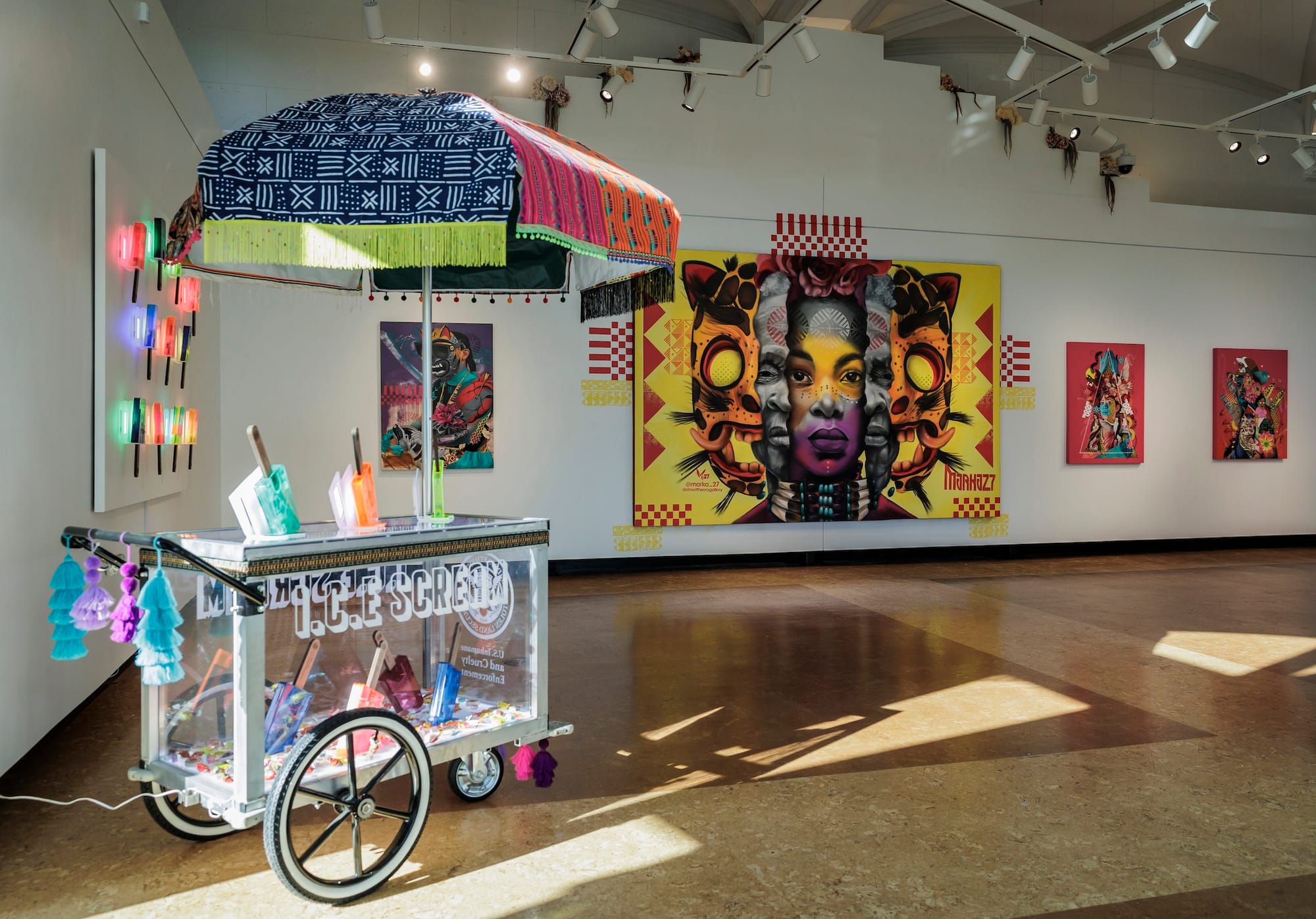
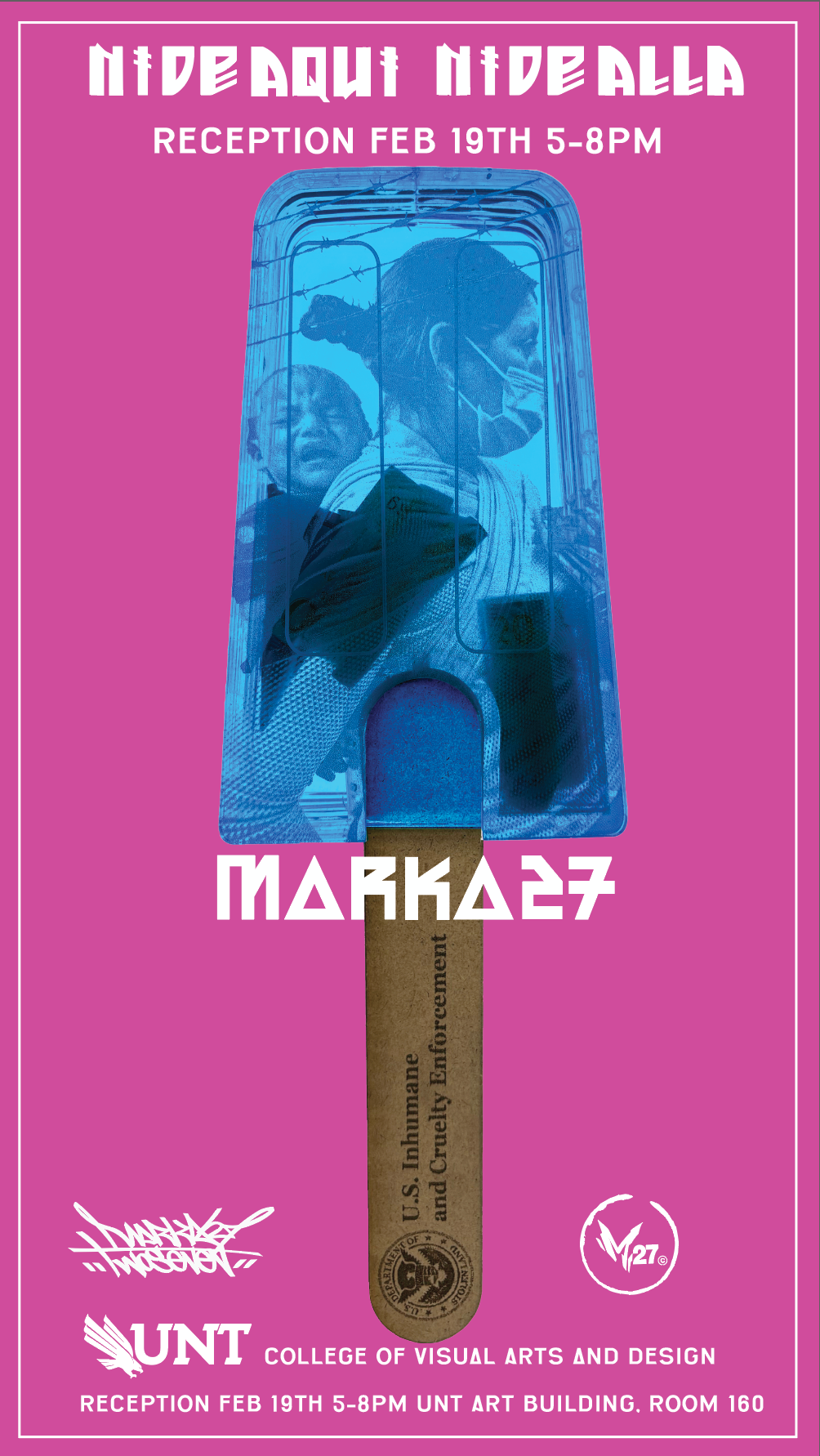
Initially curated by Kate Fowle for Boston University Art Galleries, where it was on view for three months last year, the show notably included several works from Quiñonez’s acclaimed I.C.E. Scream series — life-sized sculptures of paletas, or ice pops, that are both tributes to Latine immigrant culture and searing critiques of the violence inflicted by Immigration and Customs Enforcement (ICE). Certain pieces feature handcuffs or revolvers suspended in the transparent resin. Other works in the exhibition, including graffiti, paintings, and an immersive installation, touched on Quiñonez’s Indigenous roots and street art background.
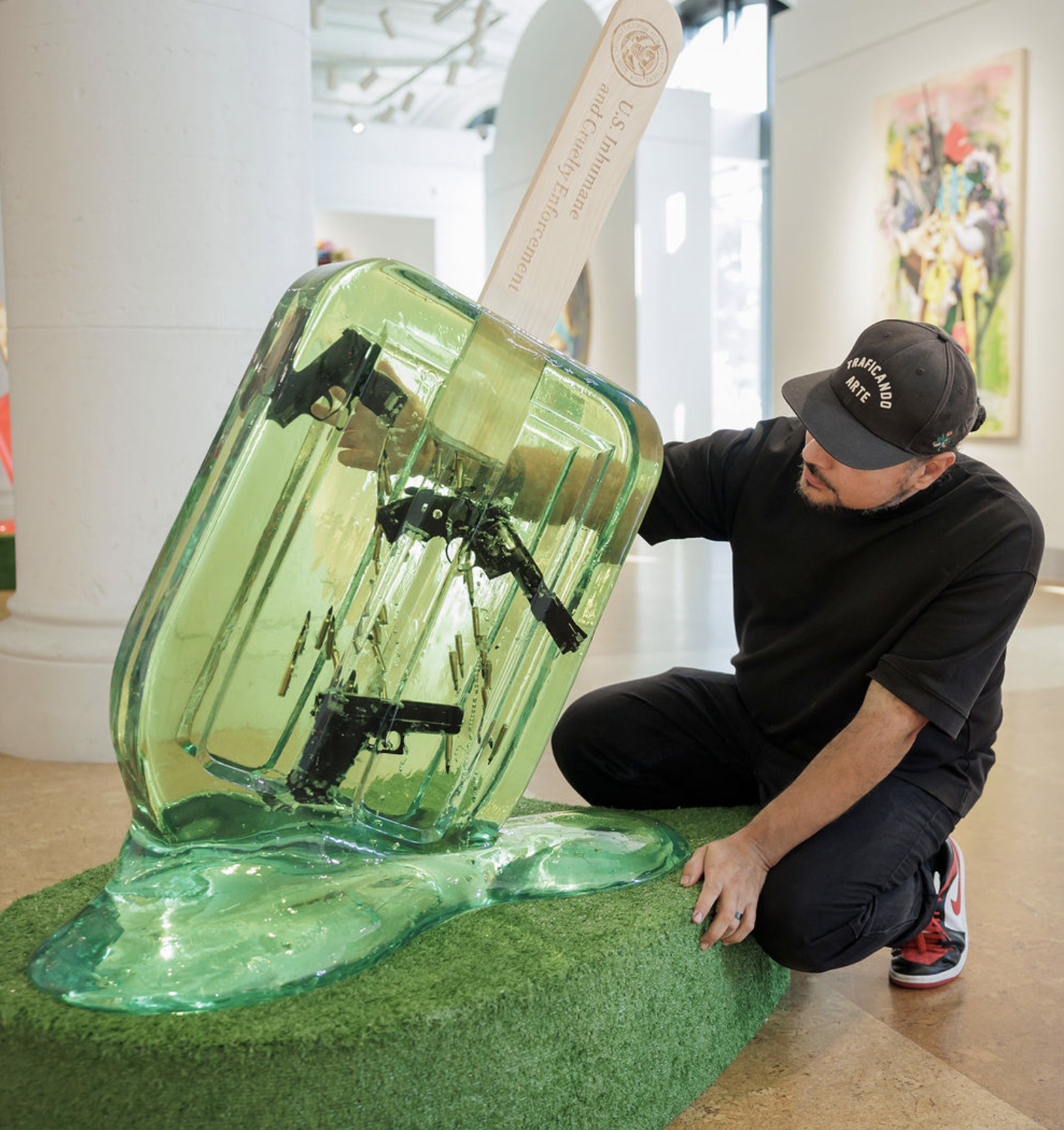
Quiñonez told Hyperallergic that he learned about the show’s abrupt closure through messages from students on social media. They sent him photos showing the gallery’s distinctive glass windows covered with brown paper sheets, blocking the view inside. Mentions of the exhibition were scrubbed from the school’s website.
A few days later, on February 11, the artist received a four-line email from Stefanie Dlugosz-Acton, director of the CVAD Galleries.
“I am writing to let you know that the university has terminated the art loan agreement with Boston University Art Galleries for ‘Ni de Aquí, Ni de Allá.’ The university is making arrangements to return the exhibit to Boston University,” read the email, reviewed by Hyperallergic.
“Any activities associated with the exhibition are no longer necessary,” Dlugosz-Acton continued, concluding with the offer to reimburse Quiñonez for any travel expenses.
The University of North Texas did not immediately reply to Hyperallergic‘s request for comment. The school has not issued a public statement about the exhibition closure.
UNT’s main campus is located in Denton, about 40 miles from Dallas, the Mexican-born artist’s native city. On its website, UNT proudly boasts being “one of the nation’s most diverse universities,” with 11,000 students — about a quarter — identifying as Hispanic.
In a phone call from Brooklyn, where he currently resides, Quiñonez said the show’s cancellation hit him especially hard, given his own immigrant story and the surge of aggression under President Trump.
“I saw my father get deported,” he said. “I’ve seen families and children being pulled away from each other in front of my eyes, in New York, in Texas. It’s heartbreaking.”
The exhibition, he continued, was “about dual identity, about what it means to grow up in the US but also be from another country.”
Since the start of Trump’s second term, the administration has deported over half a million people inside the country and at the border. A record 73,000 individuals are being held in detention as of mid-January, many of them in dangerous and inhumane conditions, with reports of sexual abuse and physical torture.
Quiñonez acknowledged that he was not given a reason for the exhibition’s termination and could only speculate about the motive, but suspects that it was part of an eerily familiar pattern of censorship against artists who speak out against the government.
“It’s been a trend in this country to suppress any kind of expression that’s going against what this administration is doing to civilians and this regime that’s been harming and murdering people,” Quiñonez told Hyperallergic.
“They say ICE is supposed to be helping people, but detention centers are just another word for privatized prisons,” he continued. “My work speaks to the vulnerability of the communities affected by that.”
Parallel to its escalation in violence against immigrants and civilians, including deadly attacks by ICE and Customs and Border Protection in Minneapolis, the Trump administration has unleashed a campaign of repression in the cultural sector. Amy Sherald’s withdrawal of an exhibition at the Smithsonian Institution over fears that her portrait of a trans woman would be censored is a major example, but similar incidents have unfolded at institutions across the country, including universities. Last fall, a long-running exhibition of political art at East Tennessee State University was discontinued after a wave of right-wing backlash over works critical of conservative figures.
“What we need more than anything right now is for galleries and museums and institutions to step up and show important work that speaks to the challenges in our country,” Quiñonez said, “and to have the courage to exhibit that work and support the artists who are making it.”