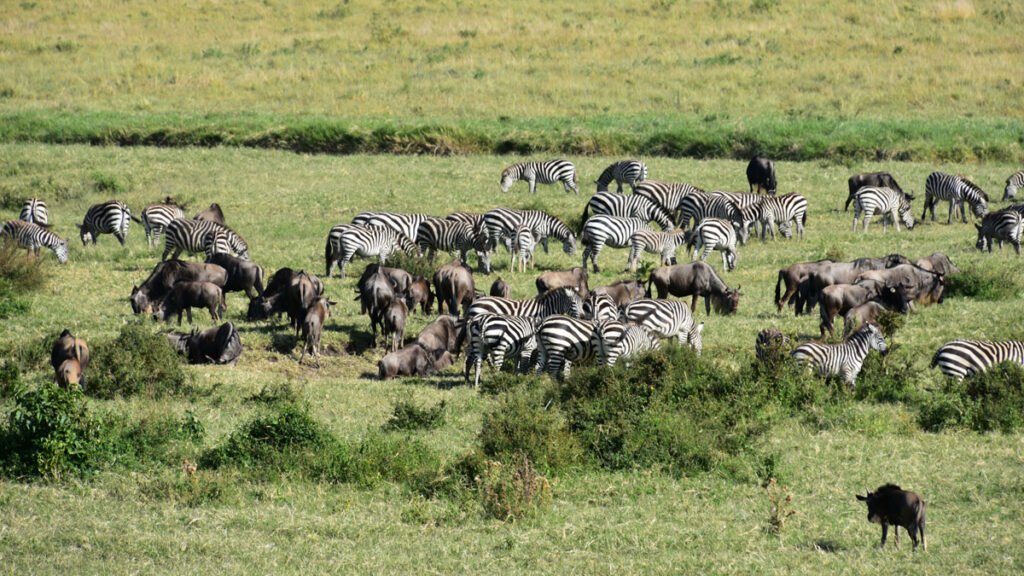

The Serengeti is one of the most diverse ecosystems on Earth. The massive savanna stretches more than 30,000 square kilometers across Tanzania and southwestern Kenya, and conservation sites, including national parks and a United Nations Educational, Scientific and Cultural Organization World Heritage Site, mark its significance as one of the world’s last intact large-animal migration corridors.
Life in the Serengeti is shaped by interactions between herbivores, vegetation, fire, and rain. Every year, millions of wildebeest, zebras, and gazelles hoof it across the savanna for their great migration, an 800-kilometer loop through the Serengeti and Kenya’s adjacent Maasai Mara game reserve. The iconic migration is dictated by rainfall, with herbivores following the green grass brought by the rainy season.
New research documenting the far-reaching impact of increasing rainfall on the Serengeti will be presented on Monday, 15 December, at AGU’s Annual Meeting. Megan Donaldson, a postdoctoral researcher at Duke University’s Nicholas School of the Environment, and her colleagues will share how vegetation is consumed by both grazing herbivores and fire in the Serengeti and how that consumption is reflected in the landscape. Studies like Donaldson’s are emerging as an important area of research for scientists assessing how climate change will affect the closely intertwined biotic and abiotic components in tropical grassland ecosystems around the world.
“For now, we’re just looking at how those interactions are feeding back to each other, how increased rainfall is affecting the dynamics between vegetation, herbivores, and fire,” said Donaldson.
Rainfall, Fuel, and Food
Rainfall controls how much grass grows in the Serengeti: When rainfall is intense, grasses grow quickly.
That growth is consumed in two primary ways: by fire as fuel and by herbivores as food.
Fire can eradicate excess vegetation, which is why a previous rainy season in the Serengeti might be a reliable predictor for how much land will burn there in the near future.
More than 30 species of large herbivores consume vegetation in the Serengeti, each with its own ecological niche.
“Some are constantly on the move, others are residents, some are grazers, some browsers, others are mixed feeders, and they range in size from the minuscule dik-dik to the massive elephant. They all thrive together by seeking out seasonal sources of water and feeding differentially on the rich diversity and abundance of grasses, shrubs, and trees,” said Monica Bond, a wildlife biologist at the University of Zurich who was not part of the recent study.
Herbivores consume vegetation at a much slower rate than fire does. Under normal conditions, grazing herbivores keep grass levels low enough to reduce the spread of fire across large areas. But it can take several seasons for animal populations to adjust to differences in food availability, so as rainfall totals increase and cause explosive growth in savanna vegetation, herbivores are unable to maintain their ability to minimize the fuel available for wildfires.
In the new research, Donaldson and her colleagues examined weather station and camera trap data from sites inside Serengeti National Park in Tanzania.
In particular, the researchers tracked how recent shifts in the Indian Ocean Dipole caused rainfall totals to increase across the Serengeti. The Indian Ocean Dipole is a weather pattern similar to the El Niño–Southern Oscillation phenomenon that spawns El Niño or La Niña conditions in the Pacific. It alters wind, rain, and temperature conditions in East Africa. Between 2019 and 2024, mean rainfall totals in the Serengeti were 268 millimeters higher than in the period from 1999 through 2003.
The researchers found that within the park, rainfall was not uniform. “There’s a rainfall gradient. You get low rainfall in the south and high rainfall in the north,” said Donaldson.
In the northern Serengeti, surplus rainfall supported such rapid growth of grass that herbivore consumption had little influence on reducing the amount of fuel available for wildfires.
In the typically drier south, however, herbivores were able to keep grasses short enough to slow the buildup of fuel.
But during periods of increased rainfall, Donaldson explained, “we see that those feedbacks are quicker. You’re getting fuel buildup much quicker, and you need all the [animal] migrants to come through that system to have any effect on fire.”
Untangling a Complex Ecosystem
Between 2019 and 2024, fire size in the Serengeti increased, but the increase was more complex than “more fuel feeding more fires.”
“The number of fires necessarily isn’t changing; it seems to be staying stable,” explained Donaldson. “We’re not seeing this very strong correlation between increased rainfall and increased fire. What is driving that? Why are we seeing that? And what are herbivores doing to that? Those are the things we’re trying to tease apart right now.”
“Because the Serengeti is one of the few intact biologically functioning ecosystems left on the planet, it makes for a perfect natural laboratory.”
Future work from Donaldson and her colleagues will further researchers’ understanding of how the Serengeti’s four major players—herbivores, biomass, fire, and rainfall—connect.
“Because the Serengeti is one of the few intact biologically functioning ecosystems left on the planet, it makes for a perfect natural laboratory to study complex ecological interactions and how these are affected by climate change,” said Bond. “This research has important implications for fire management and thus for wildlife conservation in this ecologically critical landscape. It is incredible the research that they have done here in fostering understanding of how this system works.”
—Rebecca Owen (@beccapox.bsky.social), Science Writer
Citation: Owen, R. (2025), Tracing fire, rain, and herbivores in the Serengeti, Eos, 106, https://doi.org/10.1029/2025EO250444. Published on 2 December 2025.
Text © 2025. The authors. CC BY-NC-ND 3.0
Except where otherwise noted, images are subject to copyright. Any reuse without express permission from the copyright owner is prohibited.