
China’s medieval Tang Dynasty, which spanned 618 to 907 C.E., was something of a golden age in the nation’s long and storied history. The realm’s territory expanded while governmental stability helped to ensure relative peace, and trade routes like the Silk Road were kept relatively safe. And as people enjoyed more exposure to materials and styles from other parts of the world, the arts of this era reflected curiosity about new techniques and forms.
The advent of modern paper can be traced to China a little more than 2,000 years ago, so it’s fitting that a unique archaeological discovery in the Mogao Caves at Dunhuang contained some strikingly well-preserved paper artifacts. The area is also often referred to as the Valley of the Thousand Buddhas, where overland trade between China and the West via the Silk Road led to a commercial and cultural intersection.

Among the Mogao Caves’ nearly 500 surviving chambers and temples, which are filled with statuary and wall paintings spanning a millennia of Buddhist art, one particular space known as Cave 17 revealed some extraordinary objects. It was excavated in the early 1900s by an archaeologist named Marc Aurel Stein.
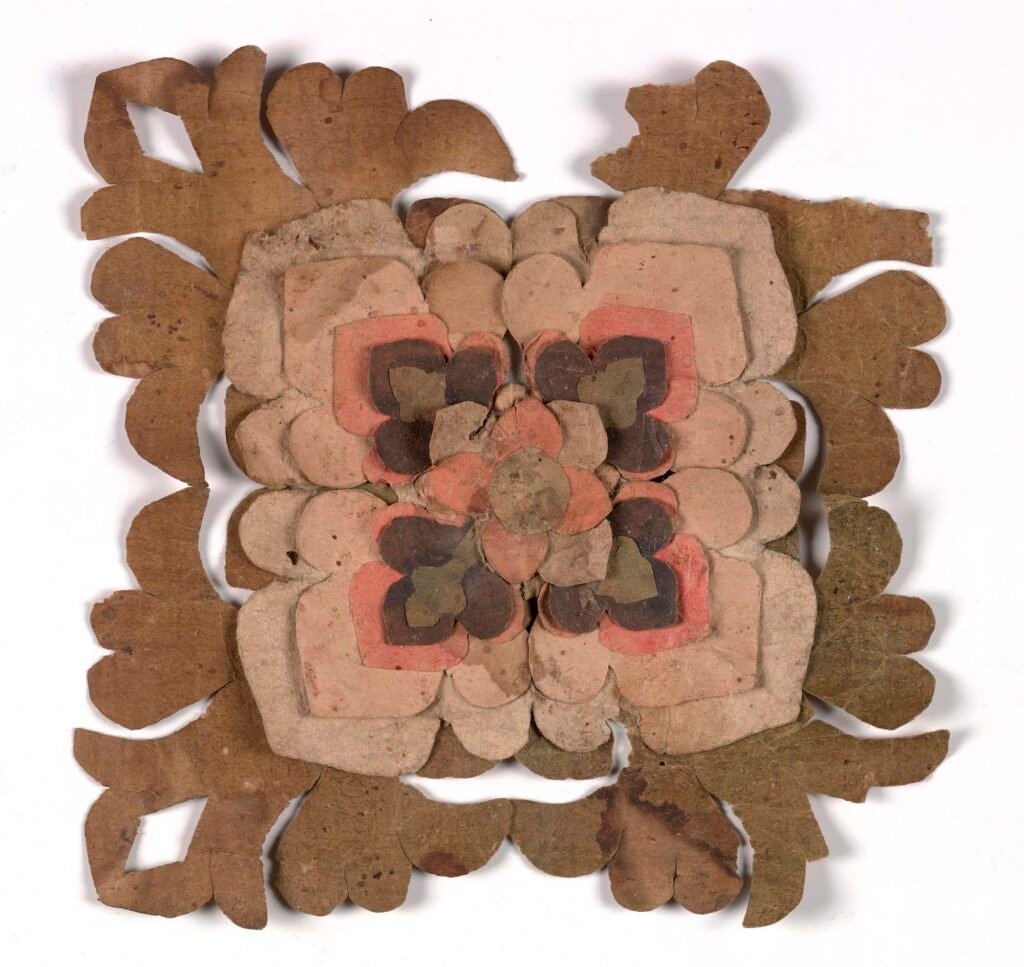
Some 50,000 documents, textiles, and other objects emerged from the cavern, which had been sealed up some time during the 11th century. Among these were a series of cut and folded paper flowers, several of which are part of The Stein Textile Collection, stored at the British Museum and the V&A in London.
Loosely based on a square format, similar to other architectural rosettes of the period, the paper flowers were likely attached to a wall or some other substrate, as they still have a dab of glue on their reverse sides. And their characteristics vary greatly, from a relatively simple painted composition to layered floral designs made with a range of paper thicknesses.
While the sheer number of Buddhist artworks, relics, and environments in Dunhuang is remarkable unto itself, the existence of the delicate florets, manuscripts, paintings, and other items created with organic materials marked an incredibly rare find. And while the flowers at the British Museum are not currently on display, if you want to take a look yourself, the piece below comprising nine flowers attached to a textile backing can be viewed by appointment at the V&A’s state-of-the-art East Storehouse.


Do stories and artists like this matter to you? Become a Colossal Member today and support independent arts publishing for as little as $7 per month. The article These 1,000-Year-Old Paper Flowers, Sealed in a Cave, Are a Marvel of Preservation appeared first on Colossal.