Hello again, welcome to Fast Company’s Plugged In, and a quick note: A couple of weeks ago, I mentioned a game I was vibe-coding using Claude Code, and said I would share it once I finished it. Here it is, along with more thoughts on the uncanny experience of collaborating with AI on a programming project.
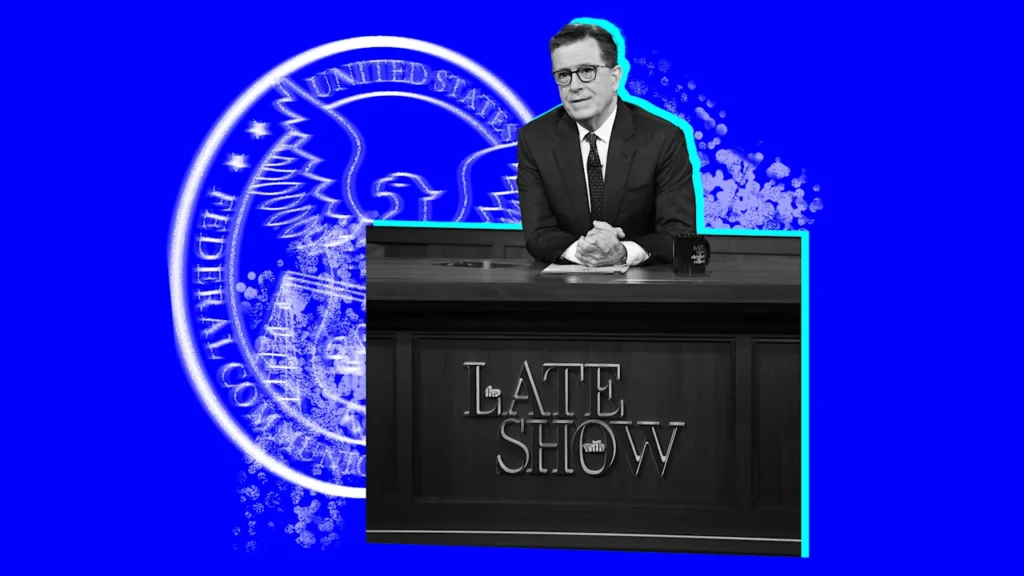
Late Show host Stephen Colbert and his network, CBS, are still at odds over why his planned interview with James Talarico, a Democratic candidate for a Texas U.S. Senate seat, didn’t air last Monday. In Colbert’s account, CBS lawyers forbid the broadcast after Federal Communications Commission chair Brendan Carr said talk show interviews might trigger the FCC’s equal time rule, which requires broadcasters to give equivalent airtime to competing candidates if requested. For its part, CBS maintained that its lawyers didn’t quash the interview but rather informed Colbert of the equal-time issue.
Either way, Colbert had a problem on his hands—but an easily solvable one. The Late Show simply put the interview on YouTube, which—like all streaming services—is not subject to the equal time rule. It’s since racked up more than eight million views, well over three times the typical live/DVR viewership of Colbert’s program in its classic form.
For CBS, the incident was particularly touchy. Its parent company, Paramount Skydance, is currently trying to engineer a takeover of Warner Bros. Discovery, a deal that would require approval by the Trump administration’s Department of Justice. Given that the FCC was already investigating ABC’s The View over a Talarico interview, Carr—the guy who managed to get Jimmy Kimmel knocked off the air for four nights last September—could have seized on a Late Show interview as a provocation. Bumping the segment to YouTube eliminated it as grist for his mill. (For the record, Carr claimed to be “entertained” by the whole affair.)
Along with the Trumpy intrigue, the Colbert-Talarico-Carr drama provides more evidence that YouTube has eaten TV—a topic I explored last October in an oral history titled, well, “How YouTube Ate TV.” Once Colbert concluded he couldn’t run the Talarico interview on his broadcast show, it’s tough to believe he spent much time figuring out where to put it. What about Paramount+, Paramount Skydance’s own streaming contender? Well, maybe, if Colbert had wanted to reach its 77.5 million subscribers. But releasing it on YouTube, which has two billion logged-in watchers a month, was the surest way to make the interview available to the largest possible audience.
The fact that YouTube is now the U.S.’s largest video service, period, only makes the equal time rule—and its focus on media brought into homes by antennas—look more antiquated. It’s certainly possible to see noble intentions in the FCC mandate, which predates the agency’s 1934 establishment and happens to be almost exactly the same age as CBS. (Both will mark their respective centenaries next year.) Radio, the medium that inspired it, used public airwaves, was greatly constrained by available spectrum, and exerted tremendous power over political candidates’ ability to reach voters. So did TV, once it arrived in force in the late 1940s.
But just a decade after that, the equal time rule was already regarded as counterproductive if not faintly ridiculous. A Chicago kook/perennial candidate named Lar Daly—who campaigned in an Uncle Sam suit—seized it to secure TV airtime in his 1959 campaign for mayor of Chicago. The following year, when he ran for president, he even forced his way onto The Tonight Show. His antics helped prompt Congress to carve out exemptions protecting many broadcasts from having to comply with the rule, including the 1960 Kennedy-Nixon debates.
By the 1980s, so many types of programming were exempt—including newscasts and news interview shows such as Meet the Press—that when the equal time rule came into play, it was often in edge cases such as stations choosing not to run old Ronald Reagan movies during his presidential campaigns. (Sorry, Bedtime for Bonzo fans.) As recently as 2006, the FCC told a California gubernatorial candidate that incumbent governor Arnold Schwarzenegger’s appearance on The Tonight Show did not entitle him to equivalent time. (Carr’s recent stance that talk shows may be subject to the rule is at odds with that ruling.)
Maybe there was an argument for the rule when streaming video did not yet exist, and even cable TV reached a minority of U.S. households. But according to the Pew Research Center, 78% of American households have broadband. Another study, from Nielsen, found that only 18% of homes had an antenna rigged up for over-the-air broadcasts, and that most of those also had access to streaming services such as Hulu and Netflix. That’s not accounting for people who watch internet video on a phone via a cellular connection.
Bottom line: Very few people are watching broadcast TV solely because they don’t have other options. Indeed, it’s old-school TV that’s become a niche. Which helps explain why Paramount Skydance is so eager to scarf up Warner Bros. Discovery’s colossal back catalog but so disinterested in Colbert that it canceled his show. (The company maintains the cancellation was a prudent financial decision, not a token of goodwill to Trump as his DoJ was preparing to sign off on Paramount’s merger with Skydance; regardless of the motivation, it’s a sign of traditional TV’s diminished relevance.)
YouTube is hardly immune to government interference in its political content. On Wednesday, attorneys general from 16 states sent a letter to Alphabet Chief Legal Officer Kent Walker claiming it had censored videos from conservative political commentators such as Glenn Beck and Ben Shapiro. Still, as far as I know, nobody argues that anything resembling the equal time rule should apply on YouTube. Given that there are millions of YouTubers, it would hard to know where to start. But with millions of YouTubers of wildly different predilections posting videos to the platform, a powerful form of equal time is built in.
Meanwhile, broadcast media’s control by a shrinking number of giant companies is a bigger problem than ever, and Carr doesn’t seem to care, at least as long as it might tilt in a Trump-friendly direction. On Wednesday, he said he supports lifting an ownership cap on TV stations to allow the right-leaning media company Nexstar to acquire its rival Tegna.
Carr will presumably continue to wield the equal time rule as a cudgel against Trump critics, particularly if it leads media companies to obey in advance, as CBS seems to have done. I don’t discount the possibility of some future Democratic FCC chair abusing it in a similar fashion. But it’s nice to think that the mandate—which, in our lifetimes, always seemed both impotent and misguided—might continue to fade away along with the 20th-century forms of media that inspired it.
You’ve been reading Plugged In, Fast Company’s weekly tech newsletter from me, global technology editor Harry McCracken. If a friend or colleague forwarded this edition to you—or if you’re reading it on fastcompany.com—you can check out previous issues and sign up to get it yourself every Friday morning. I love hearing from you: Ping me at hmccracken@fastcompany.com with your feedback and ideas for future newsletters. I’m also on Bluesky, Mastodon, and Threads, and you can follow Plugged In on Flipboard.
More top tech stories from Fast Company
AI’s biggest problem isn’t intelligence. It’s implementation
Culture, workflows, and human habits may set the real pace of the AI economy. Read More →
Viral sleuths are turning the Nancy Guthrie case into content
True-crime enthusiasts are spreading theories, chasing clout, and complicating an active missing-person investigation. Read More →
What it’s really like to use the ‘Tesla of induction stoves’
We tried testing Charlie, a sleek induction range that can outperform its gas counterparts. Read More →
Palantir is caught in the middle of a brewing fight between Anthropic and the Pentagon
The Defense Department is threatening to blacklist Anthropic over limits on military use, potentially putting one of its top contractors in a bind. Read More →
New AI models are losing their edge almost immediately
Competitors can now match state-of-the-art systems in weeks, raising fears about distillation and shrinking advantages. Read More →
Meta patents AI that lets dead people post from the great beyond
Meta’s latest patent outlines AI that could mimic dead users’ activity across Facebook and Instagram, but the company says there are no plans to use the technology. Read More →