Transportation Secretary Sean Duffy this week launched a new advisory council that could reshape American transportation in President Donald Trump’s aesthetic preferences.
The U.S. Department of Transportation’s newly created Beautifying Transportation Infrastructure Council held its inaugural meeting February 2, and quickly outlined plans to make a highly influential mark on the look and design of U.S. transportation infrastructure. The council could impact an array of initiatives including interstate highways, bridges, transit hubs, and airports, and has been established to provide recommendations on the policies, designs, and funding priorities of the DOT.
Though the council was created to serve an advisory role with no decision-making or funding authority, it currently has two major agenda items that could form the basis of a widespread makeover of American transportation infrastructure.
The first is the oversight of a national conceptual design competition that is seeking innovative thinking around transportation infrastructure design. The second is the creation of a design guidebook that would set new aesthetic recommendations for the design and renovation of federally controlled transportation projects. Its tentative title: “Beauty and Transportation.”
On the surface, these efforts seem open to a variety of design approaches, however the October announcement of the council states that the advisory effort will “align” directly with the aesthetic preferences laid out in Trump’s August 2025 executive order “Making Federal Architecture Beautiful Again.” That order defines the traditional and classical architecture of ancient Athens and Rome as the basis of a preferred architectural style for federal buildings.
This aesthetic preference is likely to influence whatever comes out of the Beautifying Transportation Infrastructure Council. Its chair is Justin Shubow, president of the National Civic Art Society, the Washington, D.C., nonprofit that champions classical architecture and which helped write Trump’s executive order to make traditional architecture the preferred style for federal buildings.
“That order called for new federal buildings to be beautiful, uplifting, and admired by the common person. It reoriented architecture away from modernism toward the classical and traditional design that is so appreciated and often preferred by ordinary people,” Shubow said during his opening remarks at the council meeting. “This council, I believe, should not recommend that any particular style be mandated, but it should make clear that classical and traditional design are legitimate options.”
Council guidelines
The council has set additional guidelines to govern its work. Shubow noted that the Transportation Department has drafted five preliminary principles to help shape the council’s advice and the creation of its design guidebook. These include ideals that “transportation infrastructure should be designed to uplift and inspire the human spirit and lend prestige to the nation,” and that it “should foster a sense of place and inspire national and community pride in a way that builds upon the past.”
The council’s members include architects, landscape architects, state transportation officials, engineers, and construction specialists. None were overtly dogmatic about design preferences, at least during this initial meeting.
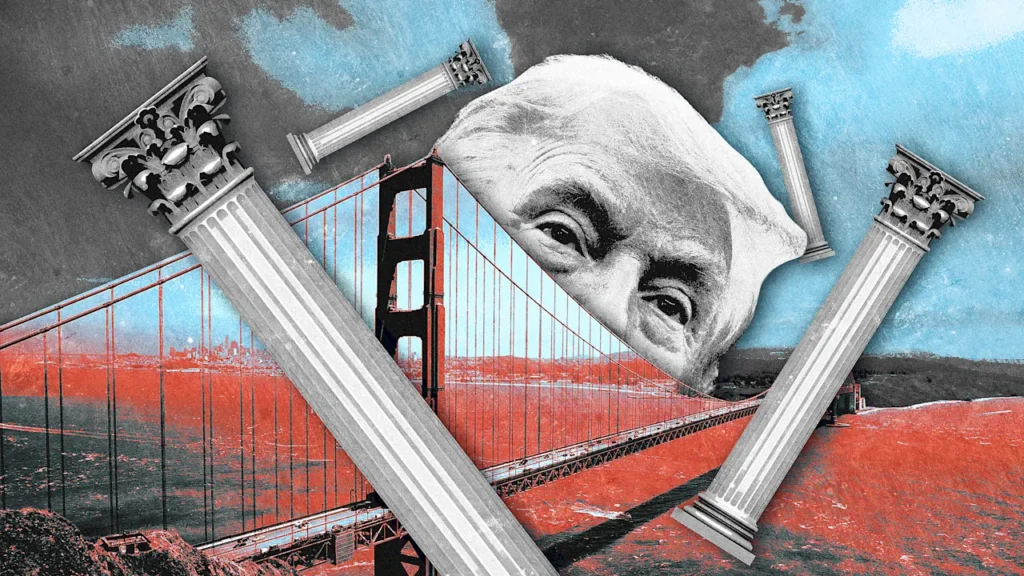
Shubow has cited projects like San Francisco’s Golden Gate Bridge and Cincinnati’s Union Terminal as exemplars of the kinds of designs the council might encourage. But council members also spent time talking about a wider range of aesthetic approaches to transportation design, including the importance of artistic lighting under bridges and the use of regionally appropriate wildflowers along highways.
One member, Bryan Jones, mid-Atlantic division president of the engineering and construction firm HNTB, pointed to one of his firm’s recent projects, the swooping Sixth Street Viaduct in Los Angeles, a decidedly modern structure.
Official and unofficial timelines
Timelines for the design competition and guidebook have not been set. The council will have its next public meeting in the summer, and will meet in private subcommittees in the meantime.
As Trump engages in a range of rebuilding and construction efforts in Washington, D.C., the work of the council may already be starting, if unofficially.
Duffy was on hand to kick off the council’s inaugural session, but had to leave early to go to the White House. He had another meeting with Trump to discuss the potential redesign of Dulles International Airport, “a beautiful project that he wants to look at,” to “revamp in a great way,” Duffy said.