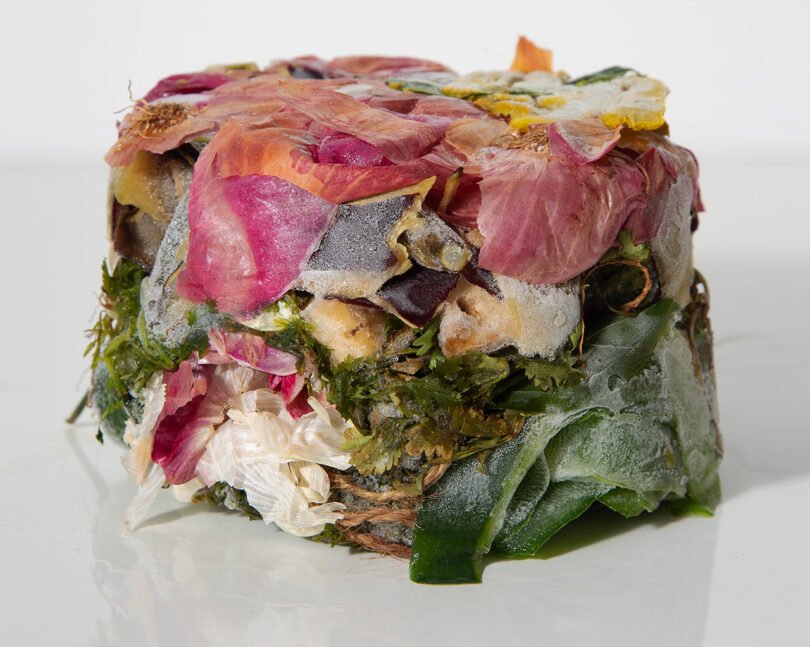
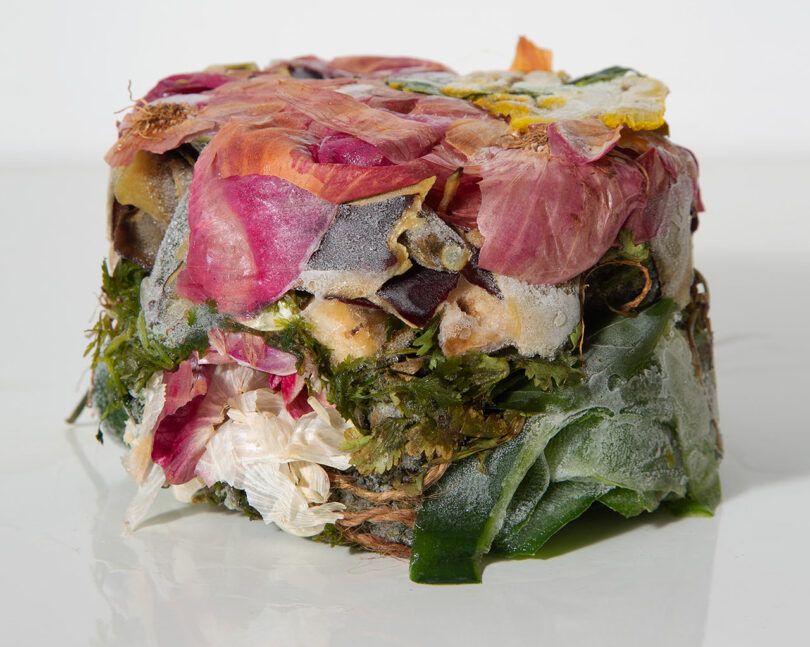
When I first came across Rhea Gupte’s striking images of frozen compost, I couldn’t help but feel a sense of familiarity. As someone who habitually tosses future broth-making scraps into the freezer, a cube of frozen kitchen remnants is something I’ve grown accustomed to creating. But Gupte’s brilliant instinct to document this practice in her photographic art series, COMPOST, opens a broader conversation, one about creating something out of nothing and about finding beauty in the mundane. Her layered blocks of frozen waste, accumulated over time, become a visual record of daily life.

Gupte began the COMPOST series at home in Goa, amid the pandemic. Photographing portraits of her household’s frozen waste not only made her more mindful of consumption, but it also offered a way to produce artwork from what already existed in her freezer without extracting new resources or generating additional waste. In doing so, she asks the art world an essential question: can what we so easily dismiss as waste be worthy to hold space on a wall, as art?


Most recently, the series was on view in London at BLEUR Gallery. The gallery’s founder, Aurelia Islimye, planted the initial seed to host a zero-waste supper club alongside the exhibition. Since many of the COMPOST images are rooted in ingredients commonly found in Indian kitchens, Gupte insisted on collaborating with a South Asian chef. The result was a partnership with Bengali chef and seasoned supper-club host Sohini Banerjee of Smoke and Lime. A community experience unfolded around tamarind, chili and cumin-spiced confit potatoes, winter pea bhorta, and flaky puff pastry.

The recent Bleur showcase, arriving five years after the idea was first conceived, marked Rhea Gupte’s debut solo exhibit in the UK. It was an exhibition beyond art on the walls, but where learning happened around the table, through food and conversation.

COMPOST is ultimately a series about circularity. It challenges the notion of food waste and invites us to reconsider how we use the resources given to us, and what we might create if we approached those resources more consciously. From growing and access to distribution and disposal, food is political. Rhea Gupte’s work reminds us that it can also be art, a truth made evident in the way she captures the colors, textures, and careful compositions of each week’s collection.

Unlike my days in a Brooklyn walk-up without a yard—where kitchen scraps lived in the freezer—my compost now sits on the counter and makes its way every other day to the garden heap. That said, I still selectively curate future broth bits at sub-zero temperatures. Once my bag is full, I bring the bits to a boil on the stovetop, filling the house with aromatic nostalgia. There’s nothing quite like a midweek flex of elevating a pantry meal with a sauce that tastes like it took hours, thanks to a single frozen cube of homemade stock.

In many ways, broth-making mirrors Gupte’s work. Both ask us to slow down, to look again, and to honor what we already have. In a time when sustainability is often framed as sacrifice, practices like freezing scraps or making broth feel refreshingly accessible. They live somewhere between necessity and ritual. Like COMPOST, they remind us that meaningful change doesn’t always need to be front and center. It can begin quietly in the underbellies of the freezer.

Below is my extremely forgiving Frozen Compost Chicken Broth recipe. Use what you have, skip what you don’t.
FROZEN COMPOST CHICKEN BROTH
Yield: About 2–3 quarts
Cook Time: 2–4 hours
Ingredients \
– 1 onion, roughly chopped
– 2–3 cloves garlic, smashed
– Olive oil + a knob of butter
– Assorted chicken bones and scraps (carcass, wings, skin), frozen or fresh
– Vegetable scraps, as available:
Carrot
Parsnip
Leek
– Fresh herbs (whatever you have on hand):
Parsley
Thyme
Bay Leaf
Sea salt
Freshly ground black pepper
– Water (enough to fill the pot)
Equipment \
– Large stock pot
– Cheesecloth + kitchen twine
– Fine mesh strainer
– Containers or ice cube trays for storage
Instructions \
1. Start the base
In a large stock pot, sauté the onion and garlic in olive oil and butter over medium heat until soft and fragrant.
2. Add vegetable and bone scraps with herbs
Gather your frozen chicken bones and vegetable bits. If your veggie scraps are light, add a carrot, parsnip, and leek. Add herbs, fresh or dried, like parsley, thyme, bay leaf, or whatever you have. Tie everything into a cheesecloth bundle with kitchen twine and place it into the pot.
3. Fill & season
Fill the pot with water almost to the top. Add a generous handful of sea salt and black or white peppercorns.
4. Bring to a boil
Cover and bring to a boil. Let boil for 15–25 minutes, then stir.
5. Simmer
Reduce heat to low and keep covered. Simmer gently for 2–4 hours (or longer if you have the time).
6. Taste & strain
When the broth has reduced by 25%, taste and adjust seasoning with more salt if needed. Remove the cheesecloth bundle and strain the broth.
7. Cool & store
Let cool, then pour into containers or ice cube trays for future recipes or pour yourself a bowl right away.

India-based, multi-disciplinary artist Rhea Gupte
To see this and other works by the multi-hyphenate creative, visit rheagupte.com.
COMPOST photography by Rhea Gupte.