Despite its misleading name, Tesla’s Full Self Driving adaptive driver assistance suite has not cracked fully autonomous driving—at least not yet.
The system is classified as a Level 2 ADAS as it requires active, continuous human supervision from the driver’s seat, with the driver prepared to take control at any time. While Tesla hasn’t achieved Level 3 or Level 4 autonomy in production vehicles yet—Waymo’s robotaxis are classified as SAE Level 4—its FSD system is becoming better by the day as it encounters pretty much every driving scenario imaginable and “learns” from it.
415 Miles Without Touching the Steering Wheel or the Pedals
If you’re curious of the progress Tesla’s FSD system has made so far and the level it’s currently at, the following video shared by a Tesla Model Y driver on X.com offers a pretty good idea.
FSD V14.2.2.5 takes me 415 miles from Raleigh, North Carolina to Philadelphia, Pennsylvania in my Tesla Model Y. Zero interventions. Zero input of any kind to the steering wheel or pedals for this entire day-long drive.
When I left, it was 58F and raining. When I arrived home,… pic.twitter.com/uHu7zLPiUs
— Mike P (@mikepat711) February 27, 2026
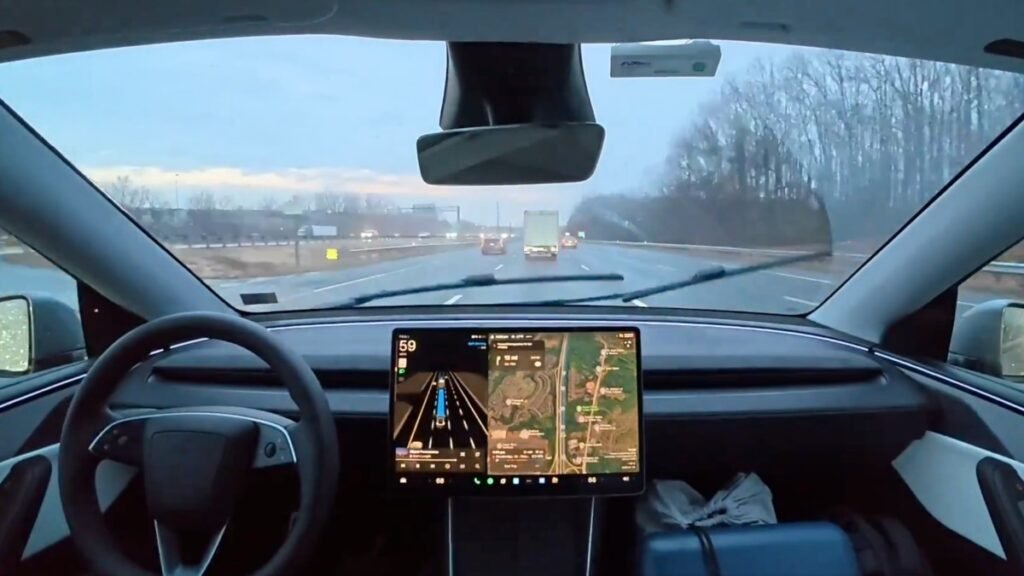
User Mark P (@mikepat711) whose car features the latest version of FSD— V14.2.2.5—took a 415-mile trip from Raleigh, North Carolina to Philadelphia, Pennsylvania in his Tesla Model Y, and filmed it from start to finish, although the sped-up version of the footage compresses approximately seven hours of driving in 18 minutes.
“FSD V14.2.2.5 takes me 415 miles from Raleigh, North Carolina to Philadelphia, Pennsylvania in my Tesla Model Y. Zero interventions. Zero input of any kind to the steering wheel or pedals for this entire day-long drive,” Mark wrote in his post.
This is quite remarkable considering the length of the drive and the variety of driving scenarios the system had to navigate, not just in terms of road infrastructure but also traffic and weather. On top of that, the drive started during the day and ended at night, adding another layer of complexity for Tesla’s robot.
“When I left, it was 58F and raining. When I arrived home, it was 35F, with snow on the ground. FSD handled heavy rain, light rain, day, night, declining temps, heavy traffic, construction, etc. All flawlessly,” the Model Y driver noted.
Tesla’s Full Self Driving Is Available as a $99 Monthly Subscription
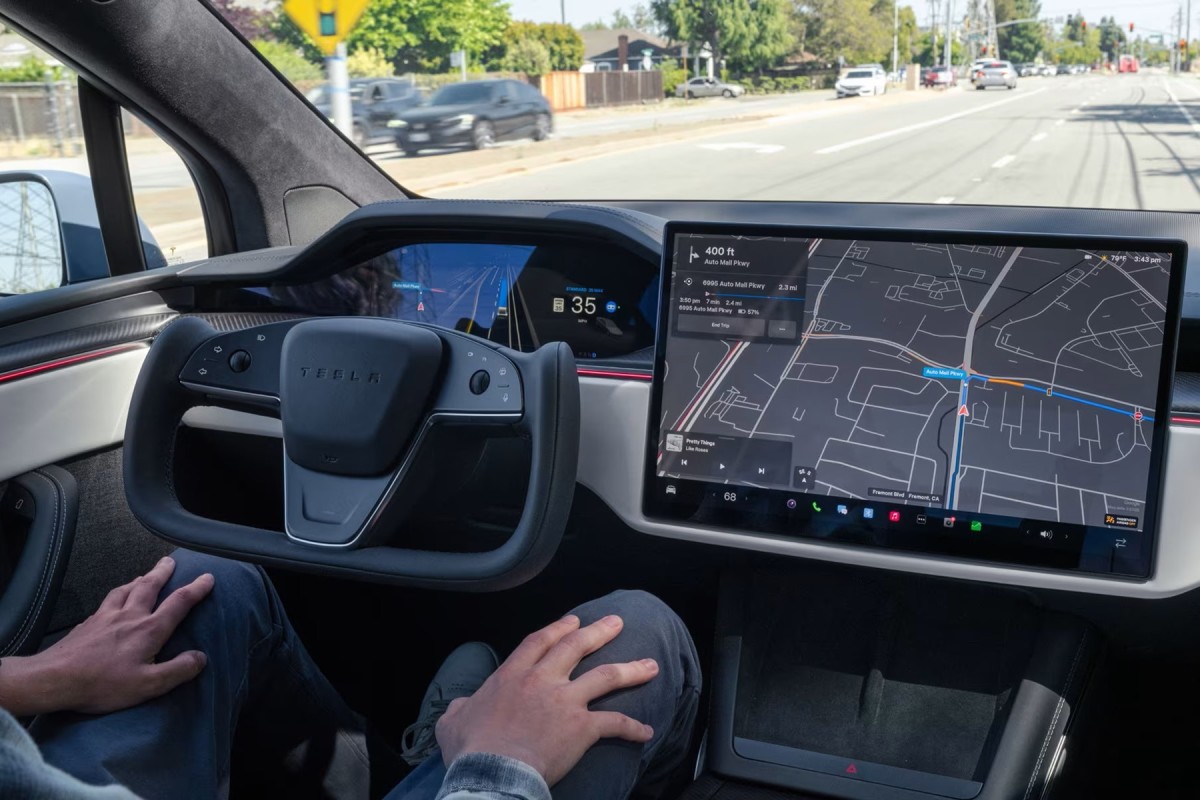
The video is really impressive and highlights the capability of Tesla’s FSD, which relies solely on cameras for perception—the so-called Tesla Vision.
For comparison’s sake, Waymo’s sixth-generation autonomous driving system utilizes a high-resolution camera, short-range LiDAR, and a radar suite for 360-degree vision. The Tesla Model Y driver calls FSD V14.2 “the most mind-blowing consumer AI of any kind by far” and a “game-changing experience.”
Those are big words, but the system’s capability is undeniable. Not once does the driver touch the steering wheel or the pedals during the drive, although he can be seen placing the index finger on the infotainment display several times, for example when pulling up at Tesla Supercharger stations to confirm charging and when leaving the stations to resume the drive. Speaking of charging, he stopped three times to replenish the battery, with each session taking 10-15 minutes.
As a reminder, Tesla offers FSD (Supervised) as an optional $99 monthly subscription on all its vehicles with a camera-based system and FSD Computer 3.0 or higher. The feature was previously available as a one-time purchase option, but the company has transitioned to a subscription-only model starting in February 2026.