Editors’ Highlights are summaries of recent papers by AGU’s journal editors.
Source: Earth and Space Science
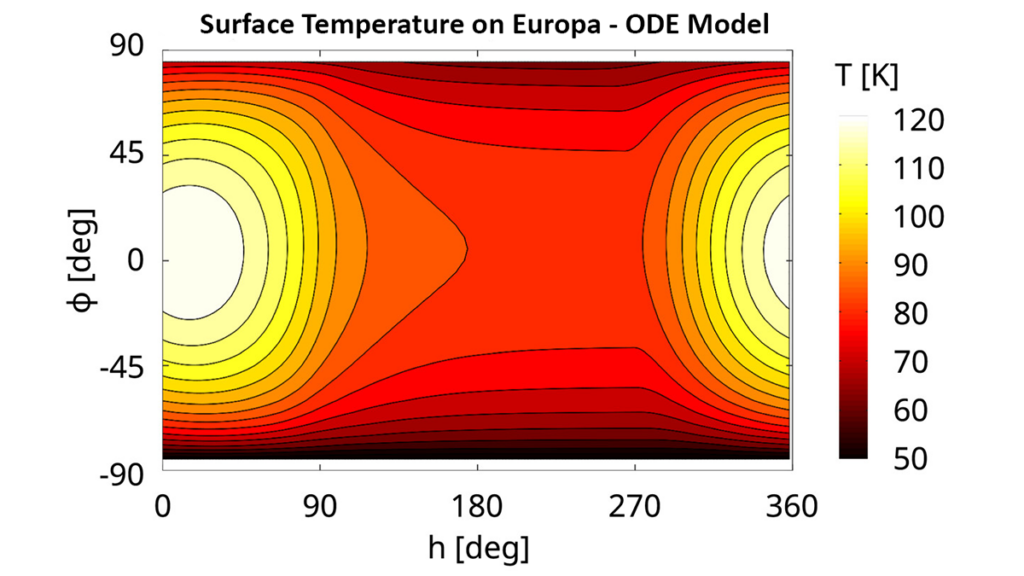
The surface temperatures of airless planetary bodies depend on incoming solar energy, radiated thermal flux, energy flowing towards the interior of the planet, and internal heat. Calculations of the noon-temperatures of planets are thus extremely complex.
Standard models of surface temperatures are usually based on solving 1-D partial differential equations (PDE) and require hours of computation. Boccelli et al. [2026] build models from solutions of a simpler ordinary differential equation (ODE), thus delivering dramatic speed-ups over the standard models. The ODE model calculations are physically correct and provide robust solutions within minutes. Furthermore, the authors develop a linearized analytical form of the ODE that can be applied to fast-rotators for on-the-fly surface temperature calculations. In the paper, the authors publish the script that can be adapted to a variety of situations by changing key parameters.
This new method provides a clear route to efficiently calculate the surface temperatures of airless bodies, opening up new avenues of planetary investigations.
Citation: Boccelli, S., Tucker, O. J., & Noviello, J. L. (2026). A simplified ordinary differential equation for the surface temperature of airless bodies. Earth and Space Science, 13, e2025EA004563. https://doi.org/10.1029/2025EA004563
—Graziella Caprarelli, Editor-in-Chief, Earth and Space Science
Text © 2026. The authors. CC BY-NC-ND 3.0
Except where otherwise noted, images are subject to copyright. Any reuse without express permission from the copyright owner is prohibited.