For the first time in South America and only the sixth time in history, researchers have identified a field of tektites. Tektites, nicknamed space glass, are created when the intense heat generated by a cosmic collision with a meteorite melts silica-rich rocks on Earth’s surface. As the molten droplets cool down and fall back to the ground, they solidify into small pieces of glass.
Finding tektites is uncommon, but uncovering entire fields of these objects is even rarer. Up until now, such spots had been detected in only Australasia, central Europe, the Ivory Coast, North America, and, more recently, Belize. Some isolated glasses have also been found in the Atacama Desert in Chile and in Uruguay, but they were not recognized as fields.
“Tektites are extremely rare. They form under very specific conditions and do not survive long in the geological record. So it was a total surprise.”
“It is an interesting finding that adds probably the second additional tektite strewn field—besides the Belize one—to the four ‘classical’ fields that have been known for more than 100 years,” said Universität Wien impact researcher and geologist Christian Köberl, who did not take part in the study.
The discovery, described in the journal Geology, happened by chance when a resident of the Brazilian state of Minas Gerais reached out to scientists interested in meteorites to identify an unusual glass-like object he had found on his property. The object was sent to geologist Álvaro Penteado Crósta of Universidade Estadual de Campinas in São Paulo, who was initially skeptical that it could be a tektite.
“Tektites are extremely rare,” Crósta said. “They form under very specific conditions and do not survive long in the geological record. So it was a total surprise.”
Mounting Evidence
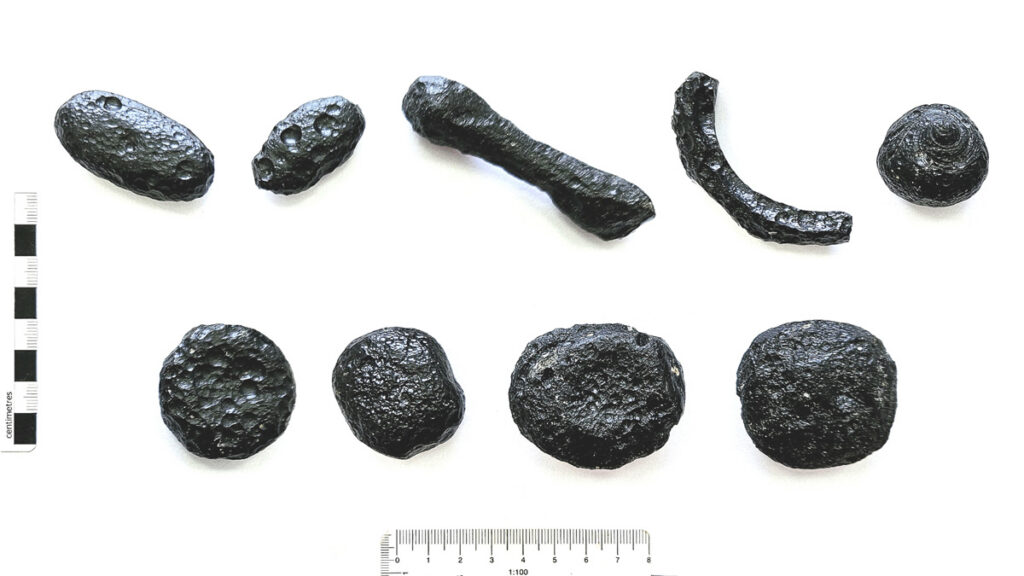
After he determined the piece was a tektite, Crósta received other specimens found dozens of kilometers away. That is when he decided to launch field trips to investigate further. In this effort, with the help of local residents, scientists collected around 500 glass pieces ranging in size from 1 to 6 centimeters and varying in shape from spherical to droplet shaped to twisted.
Although they appear black and opaque at first sight, the objects become translucent and display a grayish-green color under intense light.
Initially, the researchers identified a strewn field of tektites spanning a strip about 90 kilometers long in Minas Gerais, which is reported in the new paper. But after the study was submitted, new finds were identified in the states of Bahia and Piauí, extending the field across more than 900 kilometers.
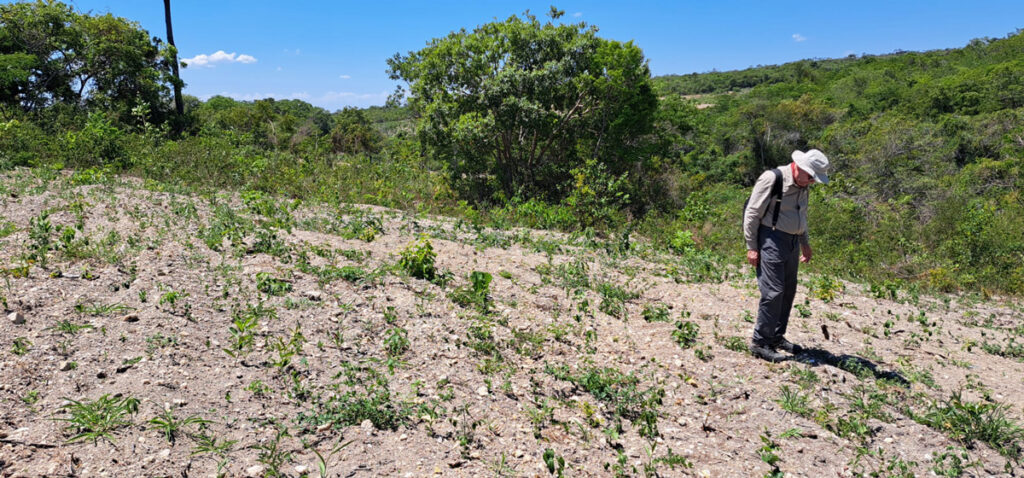
According to Crósta, this puts the Brazilian tektite field in the midsize range: much smaller than the field in Australasia, which covers more than 10% of Earth’s surface, but similar in size to the field in western Belize.
But he thinks the Brazilian field could be even larger. “Now that the news is being spread, we might get contacted by more people with new samples,” said Crósta, adding that the new findings suggest that tektites may not be as rare as previously thought.
Isotopic analysis of the samples dated the Brazilian tektites, informally known as “geraisites” after the region where they were discovered, to 6.3 million years ago—relatively recent in geological terms.
Glassed from the Past
The new tektite findings can provide clues for scientists seeking to reconstruct the history of asteroid impacts on Earth. “The Earth was bombarded just like Mars,” Crósta said. “But here we do not see the craters as easily because our planet is very dynamic, with plate tectonics and erosion. To study this history, we must search for traces, and tektites are one of them.”
“This discovery adds important new observations and data to our understanding of tektites, but more analyses will be necessary.”
No crater associated with the impact that formed the Brazilian tektites has yet been found. Crósta thinks the crater could be buried and has begun searching for it using satellite imagery, geophysical data, and mathematical models. These tools, combined with paleomagnetic, geochemical, and isotope data, could help predict the location of the impact point. Currently, only nine meteorite craters have been recorded in Brazil, despite the country’s vast geography.
Köberl noted that it will be important to identify a possible source crater and determine how far the strewn field really extends to better understand the formation of tektites in general. “Six occurrences of different tektites worldwide are a rather small number,” he said. “This discovery adds important new observations and data to our understanding of tektites, but more analyses will be necessary.”
—Sofia Moutinho (@sofiamoutinho.bsky.social), Science Writer
Citation: Moutinho, S. (2026), Scientists discover South America’s first space glass fields, in Brazil, Eos, 107, https://doi.org/10.1029/2026EO260088. Published on 17 March 2026.
Text © 2026. The authors. CC BY-NC-ND 3.0
Except where otherwise noted, images are subject to copyright. Any reuse without express permission from the copyright owner is prohibited.