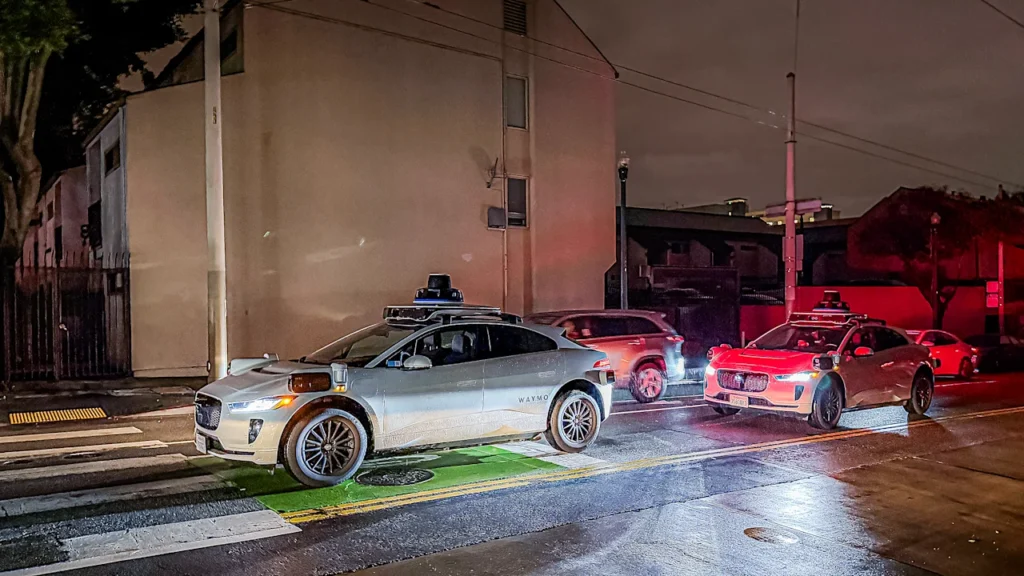
When a major power outage left tens of thousands of San Francisco residents in the dark weekend, the city’s fleet of high tech self-driving vehicles went offline too.
Videos circulating on social media showed Waymo robotaxis clogging up intersections, addled by the sudden absence of guidance from traffic lights. In one video posted to TikTok, a Waymo robotaxi sporting its telltale rooftop cluster of sensors blocks a busy intersection as human drivers stream around it on both sides. “This car did not move for 10+ min – it only left when the passengers ditched the car,” the TikTok user who caught the footage wrote in the caption.
In another widely circulated video, at least five of the self-driving cars blocked a neighborhood road, flashing their hazards in confusion. The outage also took chunks of San Francisco’s public transportation system offline and disrupted local businesses during one of the busiest shopping weekends of the year.
In light of the chaos, Waymo temporarily paused its service to San Francisco on Saturday evening. “While the failure of the utility infrastructure was significant, we are committed to ensuring our technology adjusts to traffic flow during such events,” a Waymo spokesperson said in a statement provided to Fast Company, adding that Waymo would prioritize “rapidly integrating” lessons learned from the weekend outage.
Because self-driving cars rely on a complex array of sensors rather than human judgment, unusual or unexpected events can cause them to behave unpredictably or shut down altogether. Even within normal traffic patterns, self-driving cars like those in Waymo’s fleet sometimes break traffic laws and endanger other drivers and pedestrians.
Earlier this year, the National Highway Traffic Safety Administration opened a probe into Waymo following reports that the company’s autonomous vehicles were zooming around stopped school buses, endangering children exiting the bus. An Austin school district reported that the self-driving cars continued to pass its stopped school buses, even after Waymo said it pushed a software fix.
San Francisco’s power outage isn’t the first time that Waymo’s fleet has terrorized the city, which regularly serves as a testing ground for new technologies developed nearby – whether residents like it or not. In late October, a Waymo self-driving car struck and killed a beloved bodega cat in the Mission, leading to a public outpouring of feline love and anti-AI ire.
San Francisco goes dark
More than 120,000 people in San Francisco lost power in the weekend’s outage, leading to strange scenes of a mostly dim Bay Area skyline on Saturday night. By Sunday morning, around 24,000 homes were without power as PG&E worked to get the city back online. By Monday morning, a handful of blocks near Golden Gate Park and around the Civic Center remained affected, with PG&E promising to restore power to those areas by 2 p.m. Pacific Time.
According to PG&E, a fire in one of the power company’s substations caused “significant and extensive ” damage, plunging parts of the major West Coast city into darkness for multiple days. “This is a very complex work plan and will require the highest amount of safety focus to ensure safe work actions,” PG&E wrote in an update on its website. The utility company, one of the largest in the U.S., reported no injuries to its workers or city residents related to the outage.
The San Francisco outage is the latest black eye for PG&E, which has faced criticism, bankruptcy and even criminal charges in the course of providing power for major swaths of the West Coast. In 2020, the utility pleaded guilty to over 80 counts of manslaughter for the 2018 Camp fire, which leveled the Northern California town of Paradise, destroying 11,000 homes and most buildings. “Our equipment started the fire. Those are the facts, and with this plea agreement we accept responsibility for our role in the fire,” then PG&E President Bill Johnson said at the time, acknowledging that the company’s badly maintained equipment ignited the deadly blaze and erased a rural California town from the map.