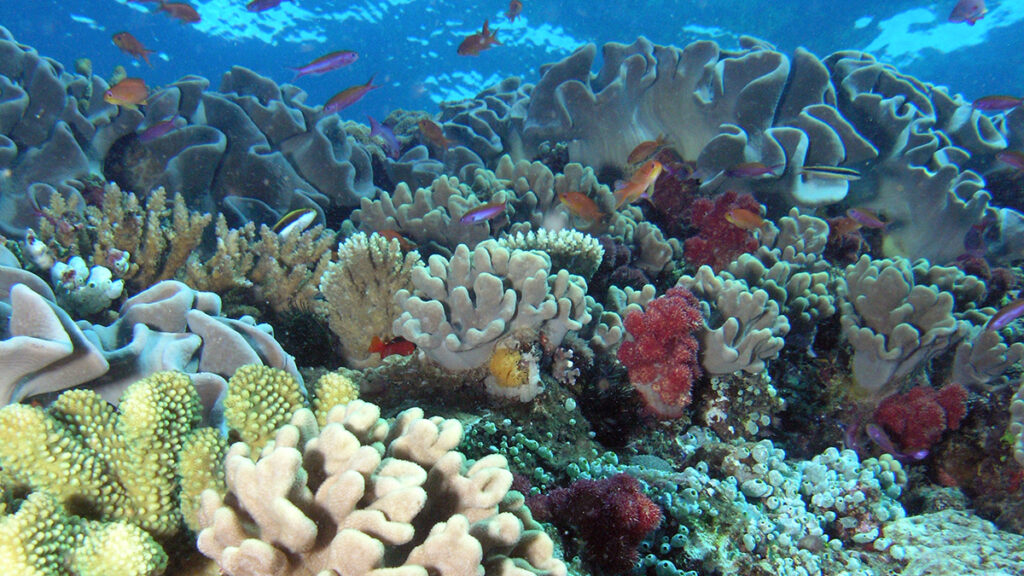
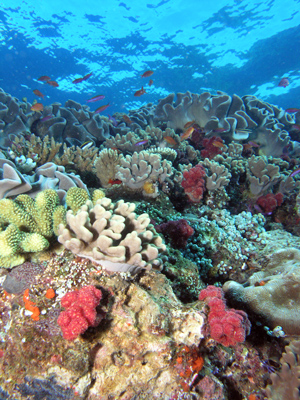
Coral reefs are proxies for past climates, as well as archives for the future. Beneath their dazzling colors and displays are “rocklike skeletal structures containing annual bands, similar to tree rings.” And like tree rings, coral cores offer valuable insights “into past environmental conditions because coral growth can respond sensitively to climate variability.”
That accessible explanation comes from scientist-authors Avi Strange, Oliwia Jasnos, Lauren T. Toth, Nancy G. Prouty, and Thomas M. DeCarlo, as they introduce readers to CoralCT, an innovative repository of coral images taken with X-ray and computed tomography technology. The result is “A Coral Core Archive Designed for Transparency and Accessibility”—and a resource documenting years, centuries, and sometimes millennia of climate change and ecosystem adaptation.
The CoralCT archive contains images from around the world—the Great Barrier Reef, the Caribbean, the Red Sea. The scientists studying how “Coral Cores Pinpoint the Onset of Industrial Deforestation” have a more narrow focus: just three reefs in the South China Sea off Malaysian Borneo. The changing ocean chemistry preserved by these coral cores serves as a record of excess erosion, a known consequence of deforestation.
Rapidly rising sea levels, increasing ocean temperatures, and acidifying waters are threatening coral reefs and their contribution to the climate record. As the ocean becomes increasingly inhospitable, researchers are turning to both geoengineering and cryopreservation to save hundreds of coral species. Some researchers are exploring the prospects for stratospheric aerosol injection to help save corals from bleaching, while others have established a cooperative cryobank network for the Coral Triangle.
This month’s thematic collection shares how coral reefs are more than just pretty polyps. They are vital resources for scientists studying the history of Earth’s climate and documenting its present state.
—Caryl-Sue Micalizio, Editor in Chief
Citation: Micalizio, C.-S. (2026), Preserving corals to study the past and document the present, Eos, 107, https://doi.org/10.1029/2026EO260008. Published on 1 January 2026.
Text © 2026. The authors. CC BY-NC-ND 3.0
Except where otherwise noted, images are subject to copyright. Any reuse without express permission from the copyright owner is prohibited.