
The delicate vertices of a spider’s web––all carefully placed, one by one, delineating a network of connection by its creator. We find ourselves as humans in a web of our own making, our era increasingly defined by the scale and speed of our impact on the Earth. Scientists now refer to this moment as the “Anthropocene,” a geological period marked by human activity drastically altering the planet’s systems. The materials we create––plastics, metals, pigments, construction debris–– have become so widespread that they now exist as a permanent layer within the environment itself.

Nature, however, is not passive. Over time it absorbs, transforms, and recomposes these materials, producing strange new conglomerations where the boundaries between human invention and natural process begin to blur. Researchers have begun referring to these remnants of our technological age as “techno relics”–– fragments of the built world that persist within geological and ecological cycles.

It is within this context that Plote + Prov, new works from Sumer Singh of MTHARU, take shape. Drawing from both historical craft traditions and contemporary material research, the pieces explore how discarded materials might be reabsorbed into new forms of design. Singh’s work reflects a growing movement among architects and designers who are reconsidering how fabrication, computation, and material experimentation can respond to the environmental realities of the Anthropocene.

The project builds upon a centuries-old technique: Scagliola, developed in Renaissance Italy. Derived from the Italian word “scaglia,” meaning “chips,” the method was originally devised to imitate marble inlay. By combining plaster of Paris, glue, and pigments, artisans could produce convincing stone-like surfaces for columns, sculptures, and architectural elements without the immense labor of quarrying and carving marble.

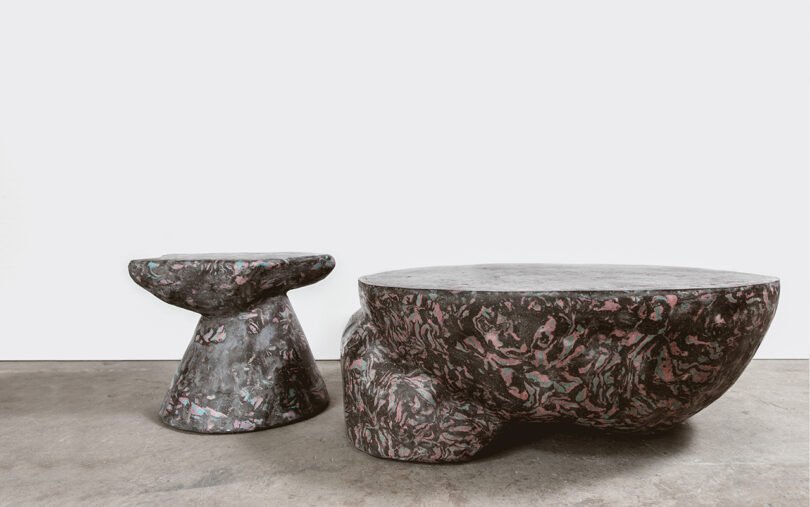
Singh reinterprets this craft through what he calls Neo-Scagliola. Rather than traditional plaster and animal glue, the mixture replaces those ingredients with cement, basalt fibers, and leftover latex paint collected from construction sites. In doing so, the technique absorbs materials that might otherwise be discarded, embedding fragments of contemporary building culture directly into the work itself. The resulting surfaces carry subtle traces of their origins – layers of pigment, flecks of color, and suspended fragments that recall the geological compositions they echo.

The Plote Side Table explores this process through form. A conical base rises upward before resolving into a hexagonal plane, the geometry shifting gently as if shaped by gradual forces. Beneath the satin-polished surface, tiny chromatic flecks reveal the presence of reclaimed pigments and paint, suggesting the hidden material histories encased within.
By contrast, the Prov Coffee Table adopts a quieter posture. A half-sphere intersects with the structural clarity of a cylinder, creating a profile that feels grounded yet sculptural. The polished surface reveals subtle striations and tonal depth within the material itself, giving the impression of a geological cross-section – layers of time compressed into a single object.

Together, the pieces function as both furniture and material experiments. They demonstrate how historical craft processes can be reinterpreted through contemporary fabrication methods, including digitally milled molds and CNC fabrication techniques that allow complex forms to emerge with precision.
Ultimately, Plote and Prov ask a larger question: what happens when designers treat waste not as an endpoint, but as a raw material for future creation? As architecture and design increasingly grapple with sustainability, the most compelling solutions may come from those willing to reexamine forgotten techniques and merge them with modern technology.
To learn more about Plote and Prov by Sumer Singh of MTHARU, visit mtharu.com.
Photography courtesy of Sumer Singh.