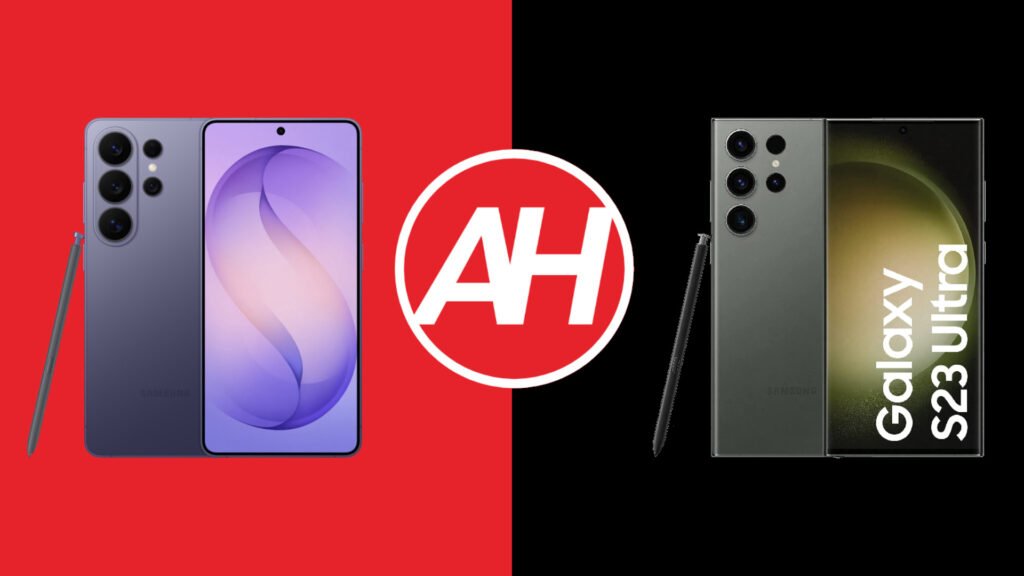

The Samsung Galaxy S26 Ultra is the company’s latest flagship. It was announced last month, and some of you are probably wondering whether it’s worth upgrading from older Ultra devices from the company. We’ve already compared it to both the Galaxy S25 Ultra and Galaxy S24 Ultra, it’s time to go even further into the past. In this article, we’ll compare the Samsung Galaxy S26 Ultra vs Samsung Galaxy S23 Ultra.
The Galaxy S23 Ultra was announced back in February 2023. So, it is over three years old at this point. What’s interesting is that some things did not change all that much over the span of those three years, spec-wise, like the camera setup, for example. We’ll first list the specs of both phones, and will then move to compare them across a number of other categories. This will hopefully help you make a purchasing decision. You can check out our Galaxy S26 Ultra review as well.
Specs

Samsung Galaxy S26 Ultra

Samsung Galaxy S23 Ultra
| Samsung Galaxy S26 Ultra | Samsung Galaxy S23 Ultra | |
|---|---|---|
| Dimensions | 163.6 x 78.1 x 7.9 mm | 163.4 x 78.1 x 8.9 mm |
| Weight | 214 grams | 234 grams |
| Display | 6.9-inch Dynamic AMOLED 2X display | 6.8 Dynamic AMOLED 2X |
| Refresh rate | 1-120Hz (adaptive) | 120Hz |
| Resolution | 3120 x 1440 | 3088 x 1440 |
| Chipset | Qualcomm Snapdragon 8 Elite Gen 5 | Qualcomm Snapdragon 8 Gen 2 |
| RAM | 12GB/16GB (LPDDR5X) | 8GB/12GB |
| Storage | 256GB/512GB/1TB | 256GB/512GB/1TB (UFS 4.0), non-expandable |
| Main camera | 200MP (wide, f/1.4 aperture, 1/1.3-inch sensor size, OIS, multi-directional PDAF) | 200MP (f/1.7 aperture, 1/2.55-inch sensor size, OIS) |
| Ultra-wide camera | 50MP (f/1.9 aperture, 120-degree FoV, dual pixel PDAF) | 12MP (f/2.2 aperture, 1/2.55-inch sensor size, 120-degree FoV) |
| Telephoto camera | 10MP (f/2.4 aperture, 1/3.94-inch sensor size, 1.12um pixel size, PDAF, OIS, 3x optical zoom) | 10MP (f/2.4 aperture, 1/3.52-inch sensor size, 3x optical zoom, OIS) |
| Periscope telephoto camera | 50MP (f/2.9 aperture, 1/2.52-inch sensor size, 0.7um pixel size, PDAF, OIS, 5x optical zoom) | 10MP (f/4.9 aperture, 1/3.52-inch sensor size, 10x optical zoom, OIS) |
| Selfie camera | 12MP (f/2.2 aperture, 1/3.2-inch sensor size, 1.12um pixel size) | 12MP (f/2.2 aperture, 1/3.2-inch sensor size, 1.12um pixel size) |
| Battery size | 5,000m,Ah | 5,000mAh |
| Charging | 60W wired, 25W wireless (charger not included) | 45W wired, 15W wireless, 4.5 reverse wireless |
| Colors | Black, Cobalt Violet, Pink Gold, Silver Shadow, Sky Blue, White | Phantom Black, Green, Cream, Lavender, Graphite, Sky Blue, Lime, Red, BMW M Edition |
Samsung Galaxy S26 Ultra vs Samsung Galaxy S23 Ultra: Design
When it comes to design, you can see these two phones are related, but things have changed a bit. The Galaxy S23 Ultra has a slightly curved display, compared to the Galaxy S26 Ultra’s flat panel. Both devices have a centered display camera hole up top. The Galaxy S23 Ultra’s corners are sharp, while the Galaxy S26 Ultra’s are rounded. The newer phone has a flat frame all around, while the Galaxy S23 Ultra’s is flat at the top and bottom, but the sides are rounded.
The button positioning is basically the same. They sit on the right-hand side of both devices. The power/lock button is placed below the volume up and down keys. Both phones have an S Pen silo, which is accessible from the bottom. Both of them also have frames made out of aluminum, with glass placed on their backs.
Speaking of which, the Galaxy S26 Ultra’s backplate is flat, while the Galaxy S23 Ultra’s is curved towards the sides. The two phones have a similar camera positioning on the back, with five distinct cutouts. The Galaxy S26 Ultra also has a dedicated camera bump for three of its cameras, while all of the bumps on the Galaxy S23 Ultra’s back protrude directly from the backplate.
Both of these phones are quite slippery in the hand, which is not surprising. Both of them are also IP68 certified for water and dust resistance. The Galaxy S26 Ultra has a slightly bigger display, and it’s slightly taller, while they have the exact same width. The newer phone is slightly thinner and noticeably lighter, 20 grams lighter.
Samsung Galaxy S26 Ultra vs Samsung Galaxy S23 Ultra: Display
The Samsung Galaxy S26 Ultra features a 6.9-inch Dynamic LTPO AMOLED 2X display. That panel is flat, and it has a refresh rate of up to 120Hz. HDR10+ content is supported, while the peak brightness is 2,600 nits. The screen-to-body ratio here is around 91%, while the resolution is 3120 x 1440 pixels. This phone offers a display aspect ratio if 19.5:9, and the display is protected by the Gorilla Armor 2.

The Samsung Galaxy S23 Ultra, on the other hand, has a 6.8-inch Dynamic AMOLED 2X panel. That display is slightly curved, and its refresh rate is 120Hz. HDR10+ content is supported, while the peak brightness is 1,750 nits. The screen-to-body ratio is around 90%, while the display aspect ratio is 19.3:9. This display has a resolution of 3088 x 1440, and it’s protected by the Gorilla Glass Victus 2.
Now, both of these displays are very good. They’re sharp, have great viewing angles, and are very vivid. The Galaxy S26 Ultra does have some advantages in comparison, though. Most people will likely prefer its flatness, not to mention that it does get brighter in comparison. On top of that, a feature like Privacy Display is a great selling point, while that display also fights off glare a lot better thanks to Gorilla Armor 2.
Samsung Galaxy S26 Ultra vs Samsung Galaxy S23 Ultra: Performance
The Galaxy S26 Ultra is fueled by the Snapdragon 8 Elite Gen 5 for Galaxy processor from Qualcomm. That is an overclocked variant of the Snapdragon 8 Elite Gen 5. It’s a 3nm chip, and it’s paired with 12GB or 16GB of LPDDR5X RAM inside this phone. The device also offers UFS 4.0 flash storage. It does not offer storage expansion, though.
The Galaxy S23 Ultra, on the other hand, is fueled by the Snapdragon 8 Gen 2 chip from Qualcomm. That is a 4nm processor, and inside this phone, it’s paired with 8GB or 12GB of storage, depending on the region and your choice. That is also boosted by UFS 4.0 flash storage, but this phone also doesn’t support storage expansion.
Needless to say, at this point in time, the Galaxy S26 Ultra is a notably more powerful device, mainly due to its chip. The Galaxy S23 Ultra still performs fine, but when you compare the two phones side-by-side, you start noticing differences. The Galaxy S26 Ultra is snappier without a doubt, in basically every way. On top of that, that phone is the better option for gaming, as it will handle more demanding titles with ease.
Samsung Galaxy S26 Ultra vs Samsung Galaxy S23 Ultra: Battery
The Samsung Galaxy S26 Ultra features a 5,000mAh battery, just like the Galaxy S23 Ultra. Both phones actually have a Li-Ion battery, in case that means anything to you. Samsung still didn’t switch to silicon-carbon tech. Despite the fact the two devices have the same battery capacity, the Galaxy S26 Ultra offers better battery life. Even if the Galaxy S23 Ultra had a new battery, that’s the case.
Samsung’s new flagship has great battery life, actually, considering that its battery capacity didn’t rise. It can provide you with at least an hour extra of screen-on-time compared to the Galaxy S23 Ultra, but in our usage, it was more than that. We just hope that Samsung doesn’t mess that up moving forward. The Galaxy S25 Ultra’s battery life got notably worse several months after the phone’s release.
The newer phone also supports faster charging. The device supports 60W wired, 25W wireless, and 4.5W reverse wireless charging. The Galaxy S23 Ultra, on the flip side, supports 45W wired, 15W wireless, and 4.5W reverse wireless charging. The newer phones can be fully charged in around 45 minutes, while it will take the Galaxy S23 Ultra about an hour to get there. Do note that you’ll need a compatible charger, as neither of these phones ships with one.
Samsung Galaxy S26 Ultra vs Samsung Galaxy S23 Ultra: Cameras
The Samsung Galaxy S26 Ultra features four cameras on the back. A 200-megapixel main camera (1/1.3-inch sensor size, f/1.4 aperture) is backed by a 50-megapixel ultrawide snapper (1/2.5-inch sensor size, 120-degree FoV, f/1.9 aperture). A 10-megapixel telephoto unit (1/3.94-inch sensor size, 3x optical zoom, f/2.4 aperture) is also included, as is a 50-megapixel periscope telephoto camera (1/2.52-inch sensor size, f/2.9 aperture, 5x optical zoom).

The Galaxy S23 Ultra, on the other hand, has a 200-megapixel main camera (1/1.3-inch sensor size, f/1.7 aperture) as well, but its aperture is not as wide. A 12-megapixel ultrawide camera (1/2.55-inch sensor size, 120-degree FoV, f/2.2 aperture) is also included, as is a 10-megapixel telephoto snapper (1/3.52-inch sensor size, 3x optical zoom, f/2.4 aperture). The last camera on the back of this phone is a 10-megapixel periscope telephoto unit (1/3.52-inch sensor size, 10x optical zoom, f/4.9 aperture).
The Galaxy S26 Ultra does have a better camera setup, and it does provide better results. Its main camera can provide brighter images, which are also better in terms of overall balance and colors. Something similar can be said for the ultrawide camera, while the telephoto camera is bad on both phones, in all honesty, especially considering the price tags. The periscope telephoto camera does a much better job on the Galaxy S26 Ultra, in all aspects.
Audio
You will find stereo speakers on both of these phones. The speakers on the Galaxy S23 Ultra are actually a bit louder, though the difference is not that big at all. The sound quality output is good from both phones.
There is no audio jack on either of these two smartphones. You can utilize their Type-C ports to connect your wired headphones. Alternatively, the Galaxy S26 Ultra is equipped with Bluetooth 6.0, while the Galaxy S23 Ultra offers Bluetooth 5.3 for wireless connectivity.
The post Phone Comparisons: Samsung Galaxy S26 Ultra vs Samsung Galaxy S23 Ultra appeared first on Android Headlines.