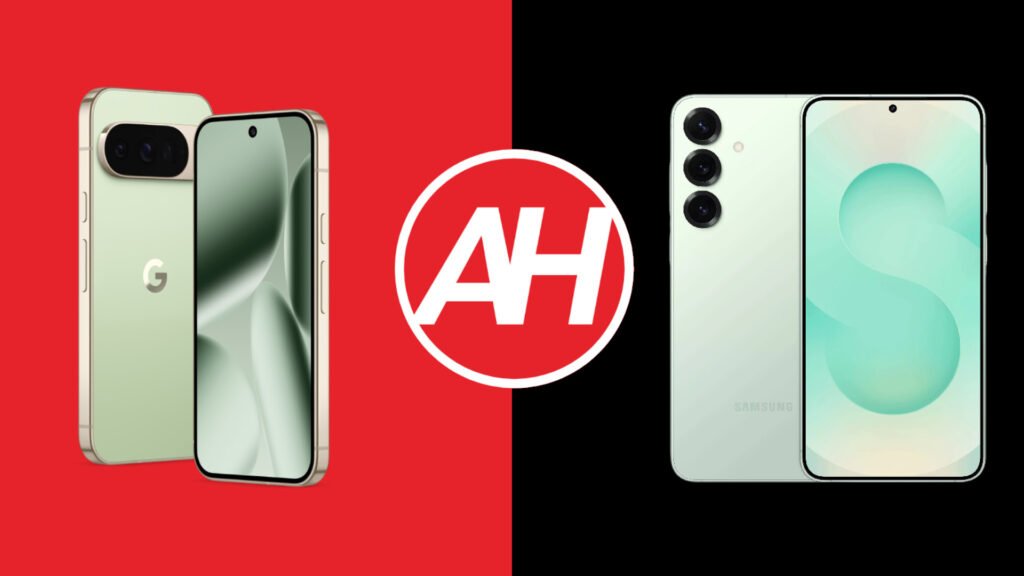

The two phones we’ll compare in this article are both members of the flagship lineups from their respective companies. It’s a Google Pixel 10 Pro vs Samsung Galaxy S25+ comparison. The Galaxy S26 series is right around the corner, but until the devices arrive next month, the Galaxy S25+ is still a high-end device from the company. The Pixel 10 Pro, on the other hand, is the most powerful compact smartphone Google has to offer.
With that being said, we’ll first list the specifications of both smartphones. Following that, we’ll compare them across a number of other categories. Those include design, display, performance, battery, cameras, and audio. These two phones are actually quite different, so this should be interesting.
Specs

Google Pixel 10 Pro

Samsung Galaxy S25+
| Google Pixel 10 Pro | Samsung Galaxy S25+ | |
|---|---|---|
| Dimensions | 152.8 x 72 x 8.6 mm | 158.4 x 75.8 x 7.3 mm |
| Weight | 207 grams | 190 grams |
| Display | 6.3-inch Super Actual LTPO OLED display | 6.7-inch Dynamic LTPO AMOLED 2X |
| Refresh rate | Smooth Display (1-120Hz) | 1-120Hz (adaptive) |
| Resolution | 2856 x 1280 | 3120 x 1440 |
| Chipset | Google Tensor G5 | Qualcomm Snapdragon 8 Elite for Galaxy |
| RAM | 16GB (LPDDR5X) | 12GB LPDDR5X |
| Storage | 128GB/256GB/512GB/1TB (UFS 4.0) | 256GB/512GB (UFS 4.0) |
| Main camera | 50MP (f/1.68 aperture, 1/1.3-inch sensor size, 82-degree FoV) | 50MP (wide, f/1.8 aperture, 1/1.56-inch sensor size, 1.0um pixel size, dual pixel PDAF, OIS) |
| Ultra-wide camera | 48MP (f/1.7 aperture, 1/2.55-inch sensor size, 123-degree FoV) | 12MP (f/2.2 aperture, 1/2.55-inch sensor size, 120-degree FoV, 1.4um pixel size) |
| Telephoto camera | N/A | 10MP (f/2.4 aperture, 1/3.94-inch sensor size, 1.0um pixel size, PDAF, OIS, 3x optical zoom) |
| Periscope telephoto camera | 48MP (f/2.8 aperture, 1/2.55-inch sensor size, 5x optical zoom, 22-degree FoV) | N/A |
| Selfie camera | 42MP (f/2.2 aperture, 103-degree FoV) | 12MP (f/2.2 aperture, 1/3.2-inch sensor size, 1.12um pixel size) |
| Battery size | 4.870mAh | 4,900mAh |
| Charging | 30W wired, 15W Qi2 wireless (charger not included) | 45W wired, 15W wireless (Qi2 Ready), 4.5W reverse wireless (charger not included) |
| Colors | Moonstone, Jade, Porcelain, Obsidian | Icy Blue, Mint, Navy, Silver Shadow, Pink Gold, Coral Red, Blue Black |
Google Pixel 10 Pro vs Samsung Galaxy S25+: Design
When you look at the two phones from the front, they do have a similar shape. The Galaxy S25+ has a larger frame, but the corner curvature is similar. Both phones also include flat displays with a centered display camera hole up top. That camera hole is bigger on the Pixel 10 Pro, though, and the bezels around the displays are also thicker on that device. The bezels are uniform on both phones, though.
Both of these devices have a frame made out of aluminum, while their backplates are made out of glass. Both phones also include physical buttons on the right-hand side, though the layout is different. The Pixel 10 Pro has its power/lock button above the volume up and down keys. It’s the other way around on the Galaxy S25+. Those are the only buttons on the two phones, though.
If we flip them around, you’ll notice that both devices have flat backplates. Their camera setups are notably different, though. The Pixel 10 Pro has a camera visor on the back. A horizontal one, at the top of its backplate. The Galaxy S25+ has three separate protrusions in the top-left corner, and they’re vertically-aligned. Both phones do have three cameras on the back, by the way.
Both of these phones come with an IP68 certification for water and dust resistance. The Pixel 10 Pro is the smaller phone of the two, as it has a notably more compact display. Both devices are quite slippery, though, so keep that in mind.
Google Pixel 10 Pro vs Samsung Galaxy S25+: Display
The Google Pixel 10 Pro features a 6.3-inch LTPO OLED display. That panel is flat, and its refresh rate goes from 1 to 120Hz. The peak brightness here is 3,300 nits, while the display supports HDR10+ content. The screen-to-body ratio is at around 88%, while the display aspect ratio is 20:9. The resolution on offer here is 2856 x 1280 pixels, while the display is protected by the Gorilla Glass Victus 2.

The Samsung Galaxy S25+, on the other hand, has a 6.7-inch Dynamic LTPO AMOLED 2X display. This display’s resolution is 3120 x 1440, and it’s also a flat panel. The refresh rate goes from 1 to 120Hz on this panel too, and the peak brightness is 2,600 nits. The screen-to-body ratio is at around 92%, while the display aspect ratio is 19.5:9. Corning’s Gorilla Glass Victus 2 protects this panel.
Both of these displays are really good, no doubt about that. They’re both vivid, sharp, and have great viewing angles. Both of them are also bright enough and very smooth. Yes, the Pixel 10 Pro’s panel does technically get brighter, but the difference is not that big, in all honesty. Not many people will have brightness complaints on either panel. Both of them also offer good display protection.
Google Pixel 10 Pro vs Samsung Galaxy S25+: Performance
The Google Pixel 10 Pro is fueled by the Google Tensor G5 processor, a 3nm chip. That is the first TSMC-made Tensor chip, and it’s paired with 16GB of LPDDR5X RAM and either UFS 3.1 or UFS 4.0 flash storage. Only the 128GB storage model comes with UFS 3.1 flash storage, by the way.
The Samsung Galaxy S25+, on the other hand, is fueled by the Snapdragon 8 Elite processor from Qualcomm. That is also a 3nm processor made by TSMC. That chip is paired with 12GB of LPDDR5X RAM and UFS 4.0 flash storage. Neither of these two phones offers storage expansion via a microSD card, by the way.
Both smartphones do deliver in the performance department. They’re very fluid in day-to-day use, and it’s difficult ot get either one to slow down. The Snapdragon 8 Elite inside the Galaxy S25+ is the more powerful chip, but the Tensor G5 is made for Pixels, and Google did a great job optimizing it for the Pixel 10 Pro. Everything is fluid on both phones.
When it comes to gaming, both smartphones can handle basically any game. When it comes to more graphically intensive games, however, the Galaxy S25+ is the better choice.
Google Pixel 10 Pro vs Samsung Galaxy S25+: Battery
You’ll find a 4,870mAh battery inside the Pixel 10 Pro. The Samsung Galaxy S25+, on the flip side, includes a 4,900mAh unit. The Pixel 10 Pro’s battery is only slightly smaller, and yet the display is quite a bit smaller. Does it offer better battery life, though? Well, no, it does not. The Galaxy S25+ offered more in terms of battery life, at least based on what we’ve seen. The difference is not huge, though.
We’ve been able to get around 15-20% more battery life from the Galaxy S25+, based on screen-on time. That’s not a huge difference, but it is one worth noting. Neither one of these two phones will break records in terms of battery life, but both of them will offer enough juice for the vast majority of people. The battery life is good, but it’s not outstanding, like it is on some phones that include much larger silicon-carbon batteries.
The Google Pixel 10 Pro supports 30W wired, 15W wireless (Qi2), and reverse wired charging. That phone also has magnets for proper Qi2 charging and accessories support. The Galaxy S25+, on the other hand, supports 45W wired, 15W wireless (Qi2 Ready), and 4.5W reverse wireless charging. Neither phone comes with a charger. It takes the Pixel 10 Pro around an hour and a half to fully charge, while the Galaxy S25+ can get there in an hour with a compatible charger.
Google Pixel 10 Pro vs Samsung Galaxy S25+: Cameras
Both of these phones include three cameras on the back. The Pixel 10 Pro has a 50-megapixel main camera (1/1.31-inch sensor size), along with a 48-megapixel ultrawide snapper (1/2.55-inch sensor size, 123-degree FoV). The third camera on the back is a 48-megapixel periscope telephoto camera (1/2.55-inch sensor size, 5x optical zoom).

The Samsung Galaxy S25+, on the other hand, has a 50-megapixel main camera (1/1.56-inch sensor size), along with a 12-megapixel ultrawide camera (1/2.55-inch sensor size, 120-degree FoV), and a 10-megapixel telephoto snapper (1/3.94-inch sensor size, 3x optical zoom). They both do a good job, but the results are different. Also, both of them could use better camera hardware, in all honesty, especially the Galaxy S25+. Samsung started to fall behind in that regard.
The Pixel 10 Pro loves to provide contrasty images that are not exactly color accurate, but they look great, and people seem to love that processed look. The phone does a solid job in both good and low light. The Galaxy S25+ does a good job in all conditions, especially with the main camera. The phone does tend to use saturation a bit too much in certain conditions, and it is inferior to the Pixel 10 Pro’s camera performance for the most part. That telephoto camera is also very poor in low light, and it’s not exactly great overall either.
Audio
You will find stereo speakers on both of these phones. The loudness is very similar across them; you probably won’t even notice the difference, even though the Galaxy S25+ technically has slightly louder speakers. The audio output quality is very good on both.
There is no audio jack on either one of these phones. You can connect your headphones to their Type-C ports, though, if you want. The Pixel 10 Pro supports Bluetooth 6.0, while the Galaxy S25+ comes with Bluetooth 5.4 support.
The post Phone Comparisons: Google Pixel 10 Pro vs Samsung Galaxy S25+ appeared first on Android Headlines.