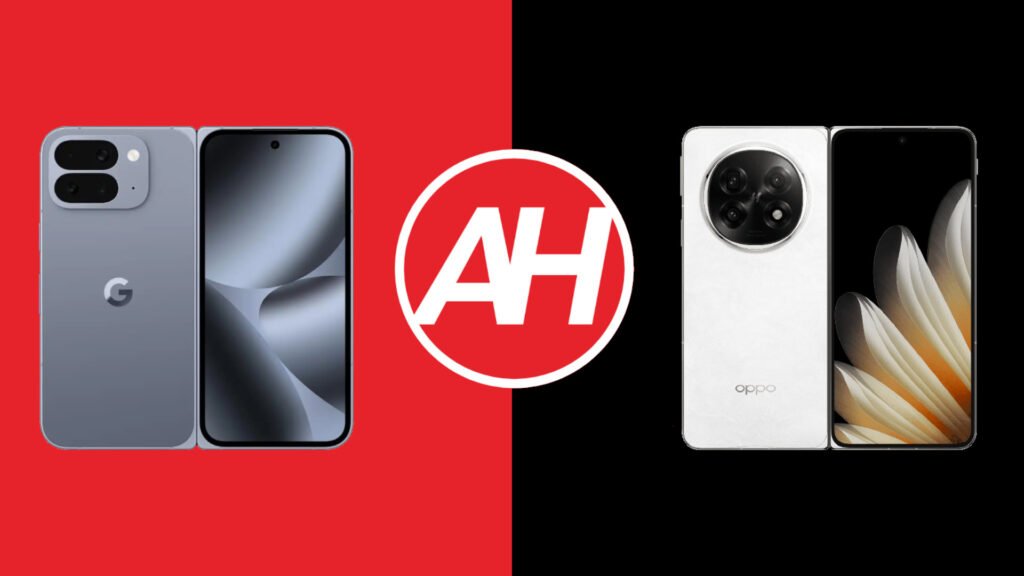

This time around, we’ll be comparing two foldable smartphones. We’ll compare the very best foldable Google and OPPO have to offer at this point. OPPO’s new book-style foldable is expected to arrive in the near future, but until that happens, the OPPO Find N5 is still the top dog. In this article, we’ll compare the Google Pixel 10 Pro Fold vs OPPO Find N5. Both of these phones are big format book-style foldables.
Despite the fact that they’re the same form factor, essentially, there are quite a few differences here. That not only goes for their internals, but the outside look as well. We will first list the specifications of both smartphones, and following that we’ll compare their designs, displays, performance, battery life, cameras, and audio output.
Specs

Google Pixel 10 Pro Fold

OPPO Find N5
| Google Pixel 10 Pro Fold | OPPO Find N5 | |
|---|---|---|
| Dimensions (unfolded/folded) | 155.2 x 150.4 x 5.2 mm / 155.2 x 76.3 x 10.8 mm | 160.9 x 145.6 x 4.2 mm / 160.9 x 74.4 x 8.9 mm |
| Weight | 258 grams | 229 grams |
| Main display | 8-inch Foldable LTPO OLED (1-120Hz) | 8.12-inch Foldable LTPO OLED (1-120Hz) |
| Cover display | 6.4-inch OLED (120Hz) | 6.62-inch Foldalbe LTPO OLED (1-120Hz) |
| Resolution | 2076 x 2152 / 2364 x 1080 | 2480 x 2248 / 2626 x 1140 |
| Chipset | Google Tensor G5 | Qualcomm Snapdragon 8 Elite (7-core) |
| RAM | 16GB (LPDDR5X) | 16GB of RAM (LPDDR5X) |
| Storage | 256GB/512GB/1TB (UFS) | 256GB/512GB/1TB (UFS 4.0) |
| Main camera | 48MP (f/1.7 aperture, 1/2.0-inch sensor size, 0.8um pixel size, dual pixel PDAF, OIS | 50MP (f/1.9 aperture, 1/1.56-inch sensor size, PDAF, OIS) |
| Ultra-wide camera | 10.5MP (f/2.2 aperture, 1/3.4-inch sensor size, 127-degree FoV, PDAF) | 8MP (f/2.2 aperture, 1/4.0-inch sensor size, 116-degree FoV, 1.12um pixel size) |
| (Periscope) telephoto camera | 10.8MP (telephoto, f/3.1 aperture, 1/3.2-inch sensor size, dual pixel PDAF, OIS, 5x optical zoom) | 50MP (periscope telephoto, f/2.7 aperture, 1/2.75-inch sensor size, PDAF, 3x optical zoom, 10cm macro) |
| Selfie camera | 10MP (f/2.2 aperture, 1/3.94-inch sensor size, PDAF) x2 | 8MP (f/2.4 aperture, 1/4.0-inch sensor size, 1.12um pixel size) x2 |
| Battery size | 5,015mAh | 5,600mAh |
| Charging | 30W wired, 15W wireless (Qi2), Bypass charging (charger not included) | 80W wired, 50W wireless (charger not included) |
| Colors | Moonstone, Jade | Cosmic Black, Misty White, Dusk Purple |
Google Pixel 10 Pro Fold vs OPPO Find N5: Design
The moment you lay your eyes on the two phones, you’ll notice how different they are. They look the most similar when you look at their cover displays from the front. Those are similar. Both have curved top-right and top-left corners, and a centered display camera hole. The bezels are thin and uniform on both. If you rotate them to the side, you’ll notice that the OPPO Find N5 is the thinner of the two.
That phone measures only 8.9mm when folded, compared to the Pixel 10 Pro Fold’s 10.8mm. That may not sound as much, but you can easily feel it when you’re using the two devices. The Pixel 10 Pro Fold is also considerably heavier at 258 grams compared to 229 grams. Both phones have a frame made out of aluminum. The Pixel 10 Pro Fold’s backplate is made out of glass, while the OPPO Find N5’s is made out of plastic, but you’d never guess it’s plastic. There is also an eco leather back variant in China.
Main displays on both phones have a display camera hole in the top-right corner as well. The Pixel 10 Pro Fold is shorter and wider when folded. If we flip them around, you’ll notice notably different camera setups on the back. The Pixel 10 Pro Fold has a squarish camera island in the top-left corner, with two horizontal pill-shaped cutouts. The OPPO Find N5, on the other hand, has a circular camera module on the back, which is centered in the upper portion of the phone’s backplate.
The Google Pixel 10 Pro Fold has better ingress protection with an IP68 certification. The OPPO Find N5, on the other hand, is IPX8 and IPX9 certified. Both devices are quite slippery, though the OPPO Find N5 less so, plus that camera module on the back serves as a great finger anchor to hold the phone.
Google Pixel 10 Pro Fold vs OPPO Find N5: Display
The Google Pixel 10 Pro Fold features an 8-inch Foldable LTPO OLED display. That display has an adaptive refresh rate of up to 120Hz, while it supports HDR10+ content. The peak brightness is 3,000 nits. The screen-to-body ratio is at around 88%, while the resolution is 2076 x 2152 pixels with a near 1:1 ratio. The cover display measures 6.4 inches, and the resolution is 2364 x 1080 pixels. The peak brightness is 3,000 nits, while this is also an OLED display. The refresh rate is 120Hz, HDR is supported, while the panel is protected by the Gorilla Glass Victus 2.

The OPPO Find N5, on the other hand, has an 8.12-inch Foldable LTPO OLED main display. It can show up to 1 billion colors, while Dolby Vision and HDR10+ are supported, and the same goes for HDR Vivid. Its refresh rate goes up to 120Hz, while the peak brightness is 2,100 nits. The screen-to-body ratio is around 90%, while the resolution is 2248 x 2480 pixels. The cover display measures 6.62 inches, while this is an LTPO OLED panel. It can also show up to 1 billion colors, while Dolby Vision, HDR10+, and HDR Vivid are supported. Its refresh rate goes up to 120Hz, while the peak brightness is 2,450 nits. The resolution is 2616 x 1140 pixels, and this panel is protected by the Nanocrystal Glass.
All four of these displays are really good, actually. They are vivid, have great viewing angles, and they’re more than sharp enough. The OPPO Find N5 has a less noticeable crease on the main display, while it has several other, slight advantages, including stylus support for both screens (sold separately). The touch response is good on all displays.
Google Pixel 10 Pro Fold vs OPPO Find N5: Performance
The Google Pixel 10 Pro Fold is fueled by the Google Tensor G5 processor. That is Google’s new 3nm chip, and it’s the first Tensor chip made by TSMC. It is paired with 16GB of LPDDR5X RAM and UFS storage. This smartphone does not support storage expansion via a microSD card.
The OPPO Find N5, on the other hand, is fueled by the Snapdragon 8 Elite processor, its 7-core version. That is a 3nm processor as well, and it’s more powerful than the Tensor G5. It is paired with up to 16GB of LPDDR5X RAM inside the OPPO Find N5, while the company used UFS 4.1 flash storage here. This phone also doesn’t support a microSD card storage expansion.
Both smartphones do deliver in the performance department, however. They are very fluid during day-to-day use. That goes for basically anything you can throw at them. The OPPO Find N5 is a bit snappier, we’ve noticed, but the difference is not that big at all. OPPO’s smartphone is the better choice for gaming, due to its processor, mostly, though neither of these two phones is a gaming phone per se. They can both handle basically any game you throw at them. We did not notice issues in that regard.
Google Pixel 10 Pro Fold vs OPPO Find N5: Battery
There is a 5,015mAh battery included inside the Google Pixel 10 Pro Fold. The OPPO Find N5, on the other hand, has a 5,600mAh battery on the inside. Unlike the Pixel 10 Pro Fold, OPPO’s phone uses a silicone-carbon battery, which made things easier for OPPO. That’s what allowed the phone to be notably thinner as well. The OPPO Find N5 also offers better battery life than the Google Pixel 10 Pro Fold.
The difference in battery life is not that small, actually. We’ve managed to get around 20-25% better battery life on the OPPO Find N5, at times even higher than that. That translates to 1-2 hours of extra screen-on time on average, depending on your use. The Pixel 10 Pro Fold is not bad in that regard, but it’s not good either. If you’re a power user, you’ll easily need a charge before the end of the day.
The Google Pixel 10 Pro Fold supports 30W wired, 15W wireless (Qi2), and Bypass charging. The OPPO Find N5, on the flip side, supports 80W wired, 50W wireless, and reverse wired charging. OPPO’s handset easily wins the charging contest, and that goes for both wired and wireless charging. It charges much faster than the Pixel 10 Pro Fold, over half an hour faster, actually. It’s also worth noting that neither phone ships with a charger in the box.
Google Pixel 10 Pro Fold vs OPPO Find N5: Cameras
You’ll find three cameras on the back of the Google Pixel 10 Pro Fold. A 48-megapixel main camera (1/2.0-inch sensor size) is backed by a 10.5-megapixel ultrawide snapper (1/3.4-inch sensor size, 127-degree FoV). The third camera on the back of the phone is a 10.8-megapixel periscope telephoto unit (1/3.2-inch sensor size, 5x optical zoom).

The OPPO Find N5, on the other hand, has three cameras on the back as well. Its setup is different, though. A 50-megapixel main camera (1/1.56-inch sensor size) is backed by an 8-megapixel ultrawide snapper (1/4.0-inch sensor size, 116-degree FoV). The third camera is a 50-megapixel periscope telephoto unit (1/2.75-inch sensor size, 3x optical zoom).
The OPPO Find N5 has better main and periscope telephoto cameras, while the Pixel 10 Pro Fold wins in the ultrawide sector, hardware-wise. When you look at the actual images, both phones do a great job. Pixel photos are more contrasty, though we preferred the colors of the OPPO Find N5 more often than not. We also preferred the photos that the OPPO Find N5 provided more often than not, with the exception of its ultrawide camera. The FoV is simply not wide enough, while the shots were far from impressive. That ultrawide camera is simply not good enough.
Audio
You’ll find stereo speakers on both of these smartphones. The ones on the Pixel 10 Pro Fold are a bit louder, while both sets are loud enough. The sound quality is great from both smartphones, so no problem there.
There is no audio jack on either one of these two phones. You can use their Type-C ports to connect your wired headphones, if you want. Alternatively, the Pixel 10 Pro Fold supports Bluetooth 6.0, while the OPPO Find N5 supports Bluetooth 5.4.
The post Phone Comparisons: Google Pixel 10 Pro Fold vs OPPO Find N5 appeared first on Android Headlines.