Designing in the shadow of a master requires a particular kind of restraint and discipline––not deference so literal that it becomes mimicry, nor ambition so forceful that it erases lineage altogether. It demands something quieter, more exacting. With JOSEPH, his first Wittmann collaboration, French designer Philippe Nigro finds that balance, creating an armchair that reads as a contemporary work shaped by the discipline, geometry, and craft tenets that defined Josef Hoffmann’s original pieces.

At Wittmann’s Lower Austrian manufactory, this lineage is not theoretical, it is practiced. For generations, the company has built its identity around the idea that furniture is composed rather than assembled, each piece passing through the hands of specialists who understand material as both constraint and opportunity. JOSEPH emerges from this environment as the result of many: woodworkers, metal fabricators, seamstresses, and upholsterers working in concert, refining a form until construction, comfort, and clarity align.

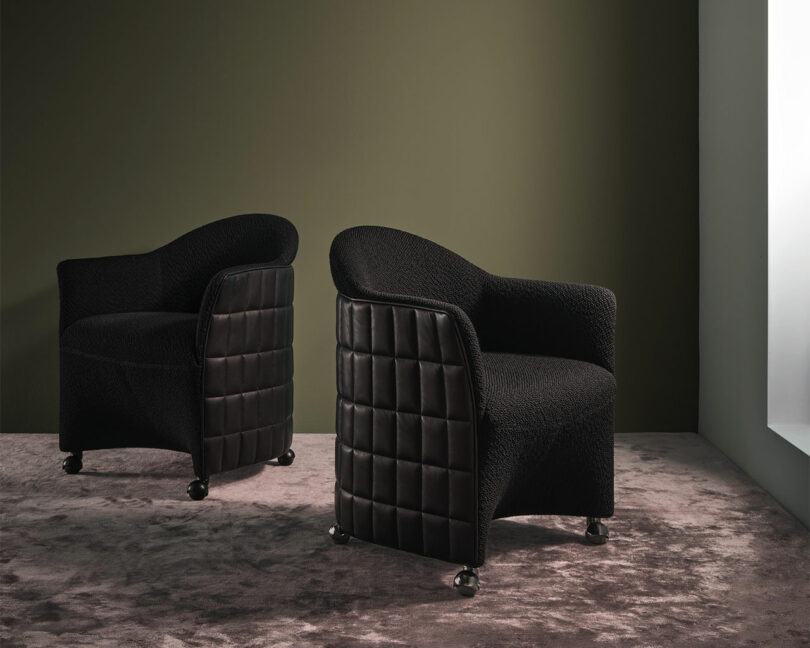
Nigro’s reference to Hoffmann is deliberately indirect. Rather than quoting the ornamental tendencies of Viennese Art Nouveau, JOSEPH channels its underlying logic—precision, proportion, and a commitment to legibility. Hoffmann’s barrel armchairs, with their enveloping curvature, and the rigorously gridded Kubus chair both quietly echo here: the former in JOSEPH’s continuous, wrapping silhouette, the latter in its quilted outer shell, where geometry becomes structure rather than surface decoration.

That exterior is perhaps the chair’s most immediate expression of craft. A grid of meticulously upholstered squares wraps the back and arms, each seam placed with millimetric accuracy. It is an unforgiving detail—any deviation becomes instantly visible—requiring not just experience, but a kind of anticipatory thinking from the upholsterer. The interior, by contrast, softens. Smooth upholstery lines the seat and backrest, creating a subtle inversion: precision outwardly expressed, comfort inwardly reserved.

This duality—structure and softness—extends through every layer of the chair. Beneath the surface, a complex assembly of pocket springs and multi-layered foam is calibrated to support a posture that sits somewhere between upright and relaxed. JOSEPH is intentionally hybridized: neither strictly a dining chair nor a lounge piece, but a form that accommodates both modes of sitting. The slightly inclined backrest and carefully balanced proportions allow it to shift contexts, from residential interiors to workspaces, without losing its composure.

Materially, the chair operates as a site of negotiation. Wittmann’s expertise with upholstery allows for combinations of leather and fabric across interior and exterior surfaces, each pairing requiring careful calibration in cutting, tension, and visual weight. No two materials behave alike; elasticity, thickness, and grain all influence how a seam holds or a curve resolves. The result is beyond aesthetic, demonstrating JOSEPH’s ability to harmonize difference into a single, coherent object.

Despite its clean execution, the construction still carries the imprint of human handwork. The curved metal detail at the backrest is welded in-house, “amid flying sparks,” rather than standardized, which allows each chair to be subtly adjusted as needed. The wooden base, shaped through tensioned straps, introduces both structural resilience and ergonomic nuance. In summation, each chair a discrete resolution of similar sets of challenges.

And, in a final gesture that brings authorship back into the workshop, each finished piece bears a small plaque signed by the upholsterer responsible for its making. In this way, JOSEPH resists the anonymity of contemporary production or an object to be optimized for replication. Wittmann frames this approach as sustainability not through material innovation alone, but through longevity: furniture designed to endure, to be used, repaired, and ultimately passed on.


To shop this and other products from the storied brand, visit wittmann.at.
Photography by Lea Sonderegger courtesy of Wittmann.