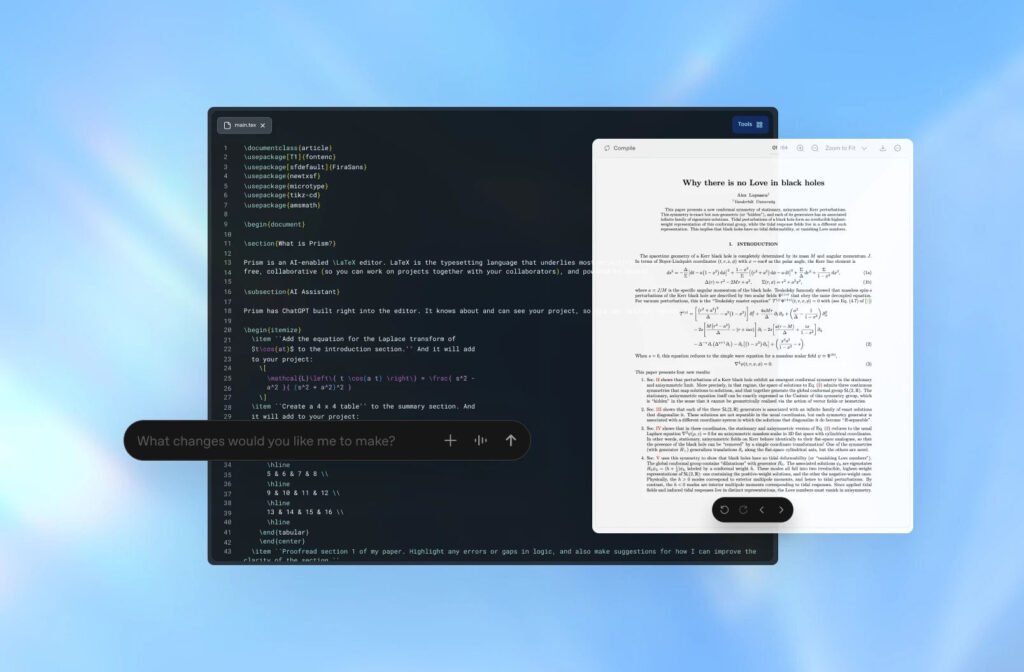

Coding can seem daunting. There’s a lot of syntax involved, and this can vary from programming language to language. If you ever felt put off by this, you’re not alone. But that’s where AI tools like Claude Code and OpenAI’s Codex come in. It allows users to use AI to write, edit, test, and debug code for them. Now, OpenAI is back with a new tool called Prism, but this time it isn’t for coding. Instead, Prism is basically the “Claude Code” for scientists.
OpenAI Prism, an AI tool for scientists
Scientists typically juggle a bunch of different tools when writing research papers. They need one app to write the text, another to manage their sources, another to format complex math equations, and then keep ChatGPT open in another window for help. It can get messy, especially if the topic at hand is particularly complex or complicated.
Prism basically puts everything in one place. It’s powered by GPT-5.2, OpenAI’s latest AI model that’s good at understanding math and science. The AI works right inside your paper instead of being a separate chat window. So it can help you write, revise your arguments, format equations properly, and even find relevant research papers to cite.
One cool feature is that you can take a photo of math equations written on a whiteboard, and Prism will convert them into properly formatted text. The AI also understands how everything in your paper connects, so when you ask it for help, it knows what you’re talking about based on what you’ve already written.
In a demo, OpenAI showed how Prism can automatically search for relevant scientific studies and add them to your paper with proper citations. It can also create things like lesson plans for university courses or generate practice problems for students.
The best part is it’s free…for now
OpenAI Prism is completely free if you have a ChatGPT account. You can work on unlimited projects and invite as many people as you want to collaborate, which is helpful for research teams. The company plans to offer versions for businesses and universities later. But for now, anyone can use it for free.
This is actually a big deal. Software designed specifically for science writing can get pricey. This puts it out of reach for students or researchers just starting out. By making Prism free, at least for now, OpenAI has essentially removed the barrier to entry. That being said, as with all AI tools, you should approach Prism with caution.
AI doesn’t always get everything right. There are times it hallucinates, generating completely false and made-up answers. However, presumably a scientist using Prism might be able to spot those errors. Either way, think of it more as a tool and less as a replacement for the profession.
The post OpenAI’s Prism Takes on Claude AI for Scientists & Coders appeared first on Android Headlines.