Editors’ Highlights are summaries of recent papers by AGU’s journal editors.
Source: AGU Advances
River terraces are archives of past environmental and climate change as they form when rivers erode into alluvial plains, leaving behind an elevated flat surface. A sequence of terraces can take tens to hundreds of thousands of years to develop, thus they potentially hold important information over the period of formation. This is the case for the extensive terraces in southern Patagonia.
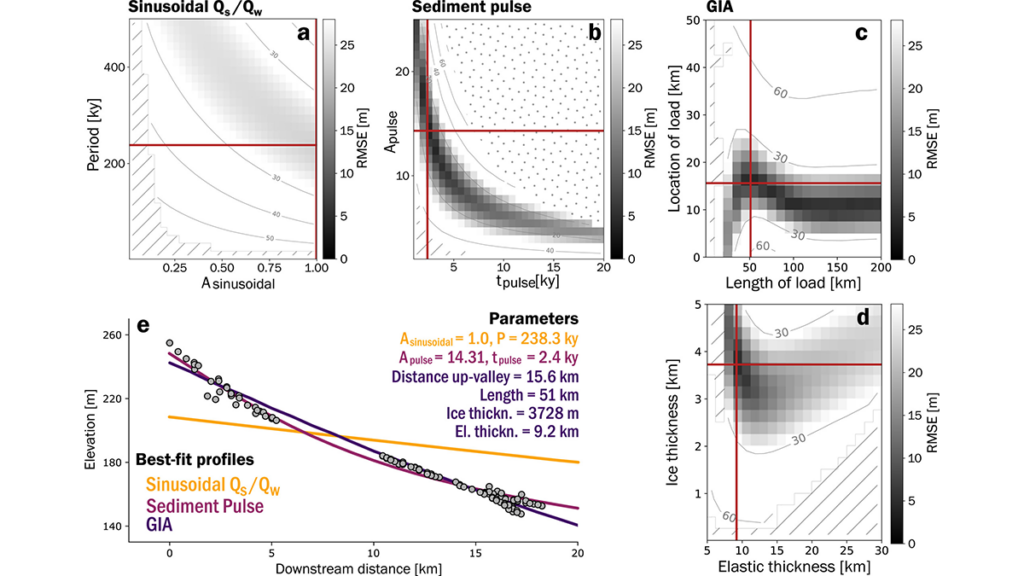
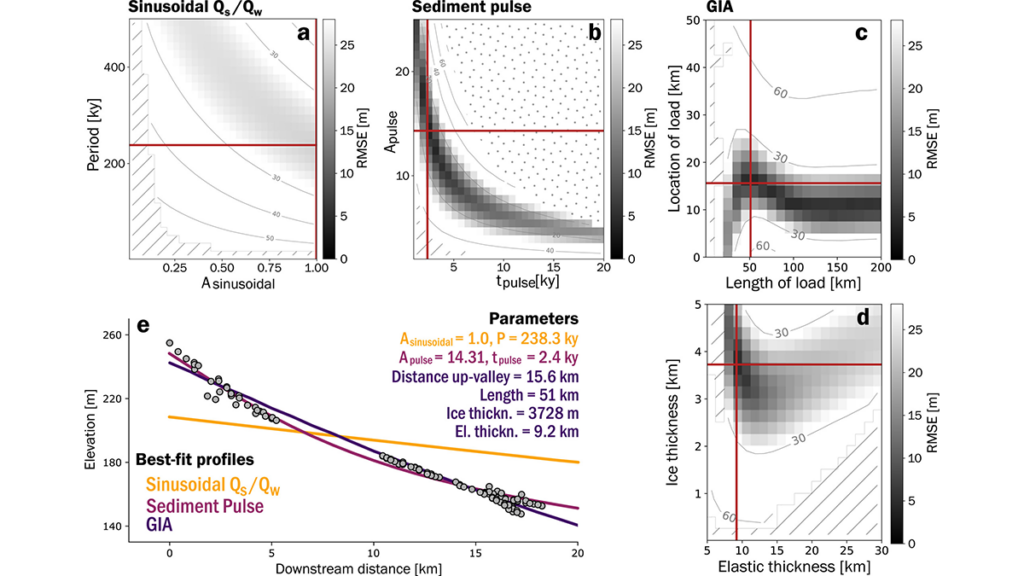
Through mechanistic models of terrace formation, Ruby et al. [2026] both isolate and combine the key drivers of terrace formation and connect them with the observed terrace shapes. Some terrace shapes were shown to form only under a specific combination of model parameters. This opens a new quantitative way to reveal past tectonic, climatic, and environmental conditions and how these have changed using terraces.
Citation: Ruby, A., McNab, F., Schildgen, T. F., Wickert, A. D., & Fernandes, V. M. (2026). How sediment supply, sea-level, and glacial isostatic oscillations drive alluvial river long-profile evolution and terrace formation. AGU Advances, 7, e2025AV002035. https://doi.org/10.1029/2025AV002035
—M. Bayani Cardenas, Editor, AGU Advances
Text © 2026. The authors. CC BY-NC-ND 3.0
Except where otherwise noted, images are subject to copyright. Any reuse without express permission from the copyright owner is prohibited.