Source: Global Biogeochemical Cycles
A critical part of Earth’s carbon cycle is the sinking of particulate organic material from the ocean’s surface to its depths. Much of that material is classified as “marine snow,” which is primarily made of snow-sized (>0.5 mm) detrital organic matter and phytoplankton.
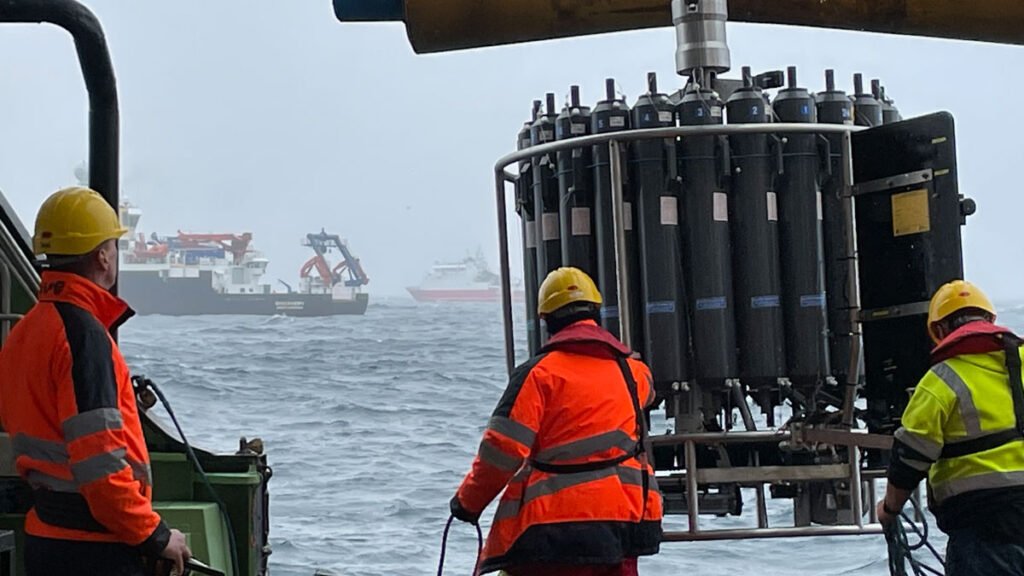
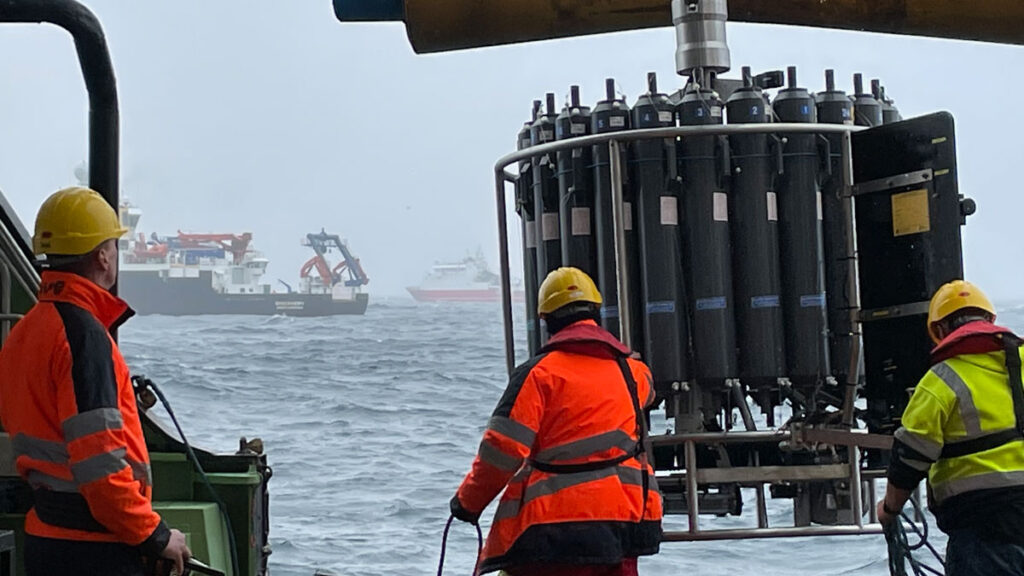
Siegel et al. participated in a field campaign in the northeast Atlantic Ocean during the demise of the spring phytoplankton bloom during May 2021. They set out to observe how both physical processes, such as turbulence created by storms, and biological processes, such as consumption by animals and microbes, affected marine snow dynamics. The researchers used three research vessels, three instrumented gliders, a Lagrangian float, and 10 water-following surface drifters to measure the size distribution and characteristics of marine snow particles in the upper 500 meters of the water column.
The researchers found that near the ocean’s surface, turbulence induced by intense storms caused the breakdown of marine snow particles that later aggregated during calmer conditions. The succession of multiple storm events helped to foster the downward movement of marine snow through the water column. Below a depth of 200 meters, consumption by zooplankton and other organisms drove the removal of the snow particles and their breakdown into smaller ones. The combination of these processes affected how quickly particles sank through the water column and therefore the timescales over which the sinking organic carbon was sequestered from the atmosphere.
Over the course of the experiment, the researchers found that the marine snow particles became fluffier, larger, and more porous, and more marine snow appeared in the water column overall. Additionally, the average particle sinking velocity above 200 meters of depth increased from roughly 17 meters per day to almost 100 meters per day, likely attributable to the increase in the particle size of the marine snow aggregates.
The results highlight how both abiotic and biotic processes affect how marine snow moves through the water column. That understanding could have implications for how scientists quantify the effects of the ocean’s biological pump within the planet’s carbon cycle, the researchers say. (Global Biogeochemical Cycles, https://doi.org/10.1029/2025GB008676, 2025)
—Madeline Reinsel, Science Writer

Citation: Reinsel, M. (2026), Marine snow grows faster and fluffier as it sinks, Eos, 107, https://doi.org/10.1029/2026EO260030. Published on 16 January 2026.
Text © 2026. AGU. CC BY-NC-ND 3.0
Except where otherwise noted, images are subject to copyright. Any reuse without express permission from the copyright owner is prohibited.