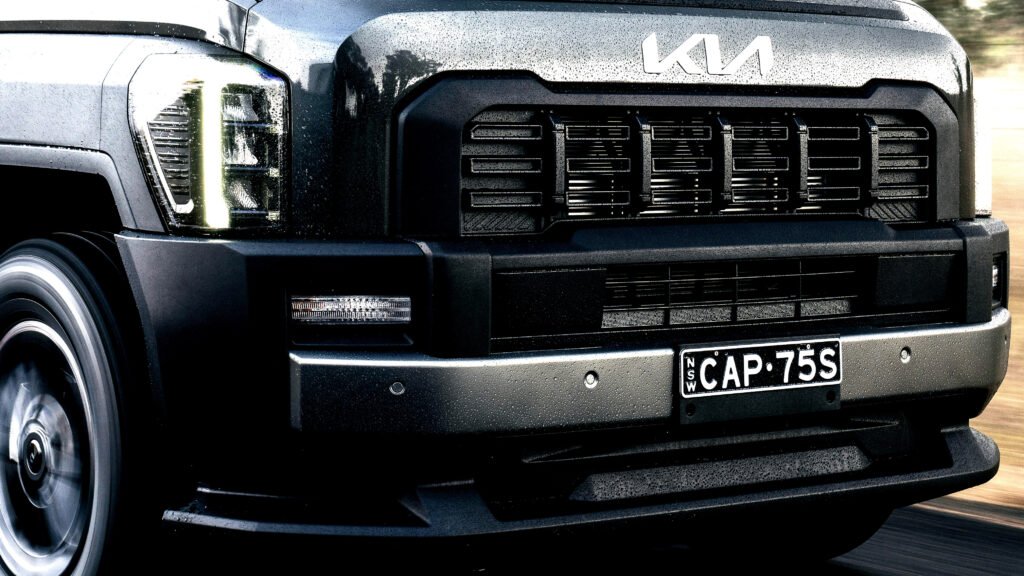

- Tasman is tracking at half of Kia’s original Aussie forecast.
- Entry-level fleet-focused trims aren’t gaining enough traction.
- Kia cites competition and scattered demand as key obstacles.
Kia’s move into the midsize pickup market hasn’t unfolded quite as the company envisioned. Ambitions were high, with talk of 20,000 Tasman units in the first year on Australian roads. Yet reality has proven far more modest, and the Tasman’s early months have been anything but smooth sailing.
According to figures reported by GoAuto, only 3,716 Tasmans have found homes in Australia since the model’s debut around five months ago. Between July and September, just 2,262 were registered, a number that suggests the brand’s optimism may have outpaced demand.
Review: New Kia Tasman X-Pro Is Great, But Its Biggest Flaw Is Hard To Miss
At the current pace, annual sales would total roughly 11,148 units, about half of the original projection. That represents just 19% of Kia’s planned production output in South Korea, set at 60,000 units. CarExpertreports that the Tasman currently holds a modest 1 to 1.8% share of Australia’s midsize pickup market, a segment dominated by seasoned competition.
Fleet-Focused Trims Are the Weak Link
During a recent media briefing, Dennis Piccoli, Chief Operating Officer of Kia Australia, acknowledged where the company is falling short.
“We can see where we’re missing out,” he said, explaining that while high-spec X-Line and X-Pro variants are “going relatively well,” the lower trims aren’t attracting their expected share of buyers. This gap is especially notable in the entry-level, fleet-heavy end of the market, where rivals thrive on volume.

The COO added, “On Tasman, our goals were always quite ambitious. The reality is, that the dual-cab ute segment has become far more fragmented. Whether it’s powertrains – whether it’s hybrid or diesel – the number of brands that are in there that are so heavily reliant on their product, and just the general level of aggressiveness in market… it’s extremely competitive.”
More: Kia’s New Concept Sparks Questions About A Stinger GT Return
Competition isn’t easing up either. The next year looks challenging as Toyota rolls out its new Hilux, Nissan brings an updated Navara, and Ford keeps refining its best-selling Ranger. The Tasman will have to fight hard to be noticed.
What Is The Solution?
Still, Kia believes there’s a path forward. Piccoli remains confident that sales will pick up in early 2026, largely through upcoming fleet agreements. “At the moment, we are sitting on some orders with larger fleets and there are quite a few organisations, both corporate and government, that are trialling the Tasman, and the feedback has been quite favourable,” he said.
In order to make it more appealing to buyers, Kia is currently offering an AU$2,000 deposit contribution on the S, SX, and SX+ trims of the Tasman, climbing to AU$4,000 for the X-Line and X-Pro. Furthermore, Australian dealers are reportedly offering discounts of over 10% on their inventory.
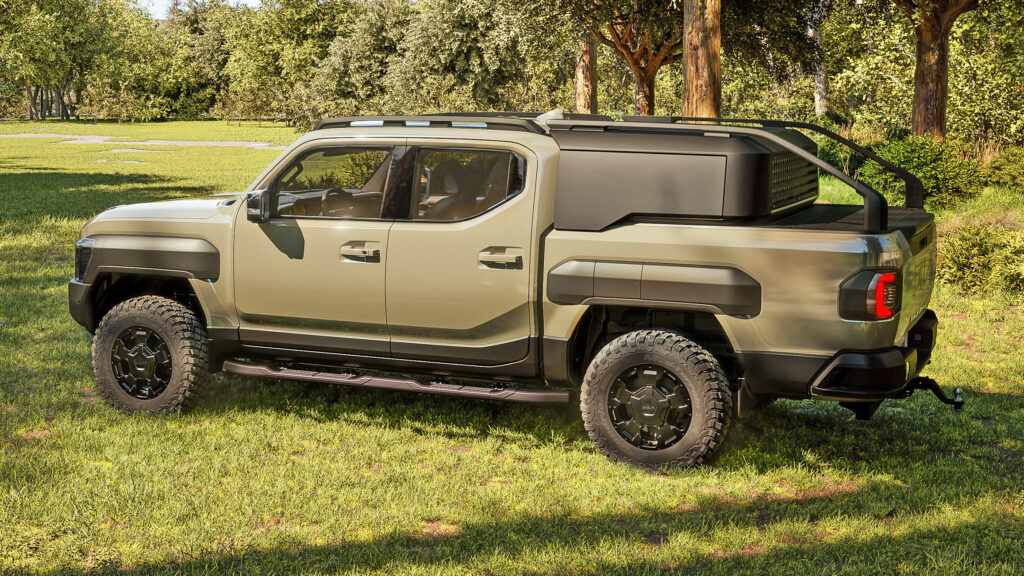
While acknowledging the inability to meet the initial target as fast as they had hoped for, Piccoli said, “We are working towards that, but our growth plan at this stage to achieve 20,000 units may take more than 12 months. Could we do 20,000? Without a shadow of a doubt, yes we can. Do we want to enter the fray, and do what needs to be done in order to do it? That’s a big question mark”.
More: Kia’s Smallest SUV Is About To Grow Up In Every Possible Way
The COO also downplayed the importance of Tasman sales for Kia as a whole: “We are not the Tasman car company, nor do we want to be a Carnival car company. We want a good split of cars, and we need the right mix that makes good business sense for us.”
Upcoming Changes

According to Roland Rivero, General Manager of Product Planning at Kia Australia, the Tasman has a complex range structure that might need to be streamlined based on sales mix instead of adding new trims.
Also: Kia’s New Tasman Is Already In Trouble After Just Three Months
Fleet-oriented versions of the truck are scheduled to arrive between January and March, including more affordable single-cab variants. It remains uncertain whether these will be accompanied by deeper discounts.
During an earlier interview, Rivero revealed that the Tasman will see a number of upgrades along a lengthy lifespan. Those are expected to include the addition of a hybrid powertrain, a potential facelift, and the introduction of a rugged trim inspired by the Weekender concept.