
Most Android users never think about where their tablet is allowed to operate. In everyday environments, there are virtually no restrictions. Offices, warehouses, retail stores and even outdoor worksites generally pose no regulatory issues for consumer electronics.
However, in certain industrial environments, the situation is completely different. In oil refineries, chemical plants, offshore platforms, battery facilities, and pharmaceutical production areas, standard electronics cannot simply be powered on. These locations fall under what is known as ATEX regulation.
For readers unfamiliar with the term, ATEX refers to European rules governing equipment used in explosive atmospheres. The word comes from “ATmosphères EXplosibles.” In practical terms, ATEX exists because flammable gases, vapor,s or combustible dust may be present in certain environments. When mixed with air under the right conditions, these substances can ignite. The ignition source does not need to be dramatic. A small electrical spark, a hot surface, or an internal fault inside a device can be sufficient.

Modern tablets contain several potential ignition sources:
– Power management circuits
– Charging interfaces
– Internal heat generation
– Connectors that may arc under fault conditions
Because of this, even a rugged Android tablet is not automatically safe or legal to use inside classified hazardous areas. Devices must either be specially designed or integrated into certified systems that prevent ignition risk under defined fault conditions.
This is where enterprise mobility becomes more complex.
Why Android Tablets Are Used in Industrial Operations
Despite regulatory challenges, Android tablets are widely used across industrial sectors. Outside classified zones, they are often the preferred choice for operational digitalization.
There are clear reasons for this.
Android offers a broad hardware ecosystem, competitive pricing, and strong compatibility with enterprise mobility management systems. Companies can standardize applications across multiple device tiers while retaining flexibility in procurement. Hardware refresh cycles are predictable and frequent, allowing IT departments to maintain performance without locking into long industrial development timelines.
Devices such as the Samsung Galaxy Tab S11 demonstrate how powerful mainstream Android tablets have become.
For inspection teams, maintenance engineers, and field supervisors, tablets are used for digital permits, documentation, asset management, and reporting systems. The functionality is already there. The barrier is regulatory compliance inside hazardous zones.
The Certification Bottleneck
Traditionally, companies needing tablets in Zone 2 or Zone 22 environments had limited options.
They could purchase fully integrated explosion-certified tablets that are built and certified as a single closed unit. These devices are safe but expensive, and when the internal hardware becomes outdated, the entire certified product must be replaced.
Alternatively, companies could use tablet-specific ATEX housings designed for one particular model. While this offers some flexibility, it still ties certification to a single generation of hardware. When the tablet model changes, the housing often must be replaced as well.
This creates friction between consumer hardware evolution and industrial certification cycles. Android tablets evolve quickly. Certification frameworks do not.
A Modular Explosion-Protected Approach
A newer concept addresses this mismatch by separating certification from the tablet itself.
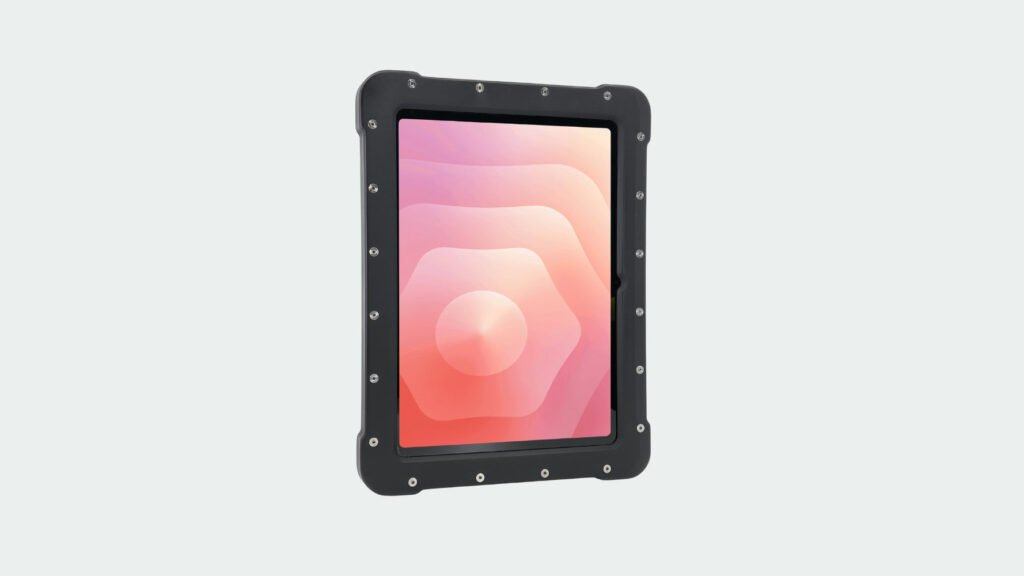
Instead of certifying a single integrated device, the certified element becomes the enclosure platform. Through a modular explosion-proof tablet enclosure system, one universal housing can support multiple 10 to 11-inch tablets.

The concept works through precisely engineered device-specific corner inlays. Each supported tablet uses four inlays designed to match its geometry. This configuration ensures:
– Stable positioning inside the enclosure
– Resistance to vibration
– Impact protection
– Full access to buttons, cameras, audio, and USB-C connectivity
The enclosure itself carries ATEX and IECEx certification for Zone 2 and Zone 22 environments. When a tablet is upgraded, only the internal inlays need to be replaced. The certified housing remains in service.
This separation significantly reduces long-term ownership cost. Certification does not need to be repeated with every hardware refresh. Downtime is minimized, and procurement becomes more aligned with typical enterprise IT cycles.
Relevance for Android Deployments
For Android-focused fleets, this approach aligns well with the platform’s flexibility. Companies are no longer forced to choose between certification compliance and hardware choice.
Supported devices include models such as the Galaxy Tab S11, Galaxy Tab S10 FE, and other 10 to 11-inch tablets. This means organizations can select performance levels appropriate for their workload without compromising compliance.
If a new generation tablet offers better battery efficiency, processing power, or display quality, migration does not require a complete replacement of certified hardware. The enclosure remains constant while the internal adaptation changes.
This model resembles how enterprise infrastructure is typically managed. Modular systems allow selective upgrades rather than full system replacement.
Industrial Mobility Is Evolving
Enterprise hardware strategies increasingly favor modularity and lifecycle control. Servers, networking systems, and industrial automation platforms are designed around replaceable components rather than sealed units.
Applying the same philosophy to explosion-protected mobility introduces flexibility without reducing safety. Certification integrity remains intact while hardware evolution becomes manageable.
For Android tablets, this represents an important shift. Instead of being excluded from hazardous areas or replaced entirely with each generation, mainstream devices can now integrate into certified environments through a modular protective platform.
ATEX may not be widely discussed in consumer tech circles, but for industries operating in explosive atmospheres, it defines the boundaries of digital transformation. Bridging consumer hardware performance with regulatory compliance requires structural design changes.
By moving certification to the enclosure rather than locking it to a single tablet model, the industry takes a step toward more sustainable and adaptable explosion-protected mobility.
The post How One Enclosure Turns Any 10–11” Android Tablet Into an ATEX Certified Device appeared first on Android Headlines.