Editors’ Vox is a blog from AGU’s Publications Department.
Frozen soil covers about 20% of the Earth’s land surface, and acts like a seasonal or long-term underground dam that controls how water moves and how carbon is stored. A new article in Reviews of Geophysics explores recent advances in the physics, observation, and modeling of frozen soil hydrology. Here, we asked the lead author to give an overview of frozen soil, how climate change is expected to influence it, and directions for future research.
Approximately how much of the Earth’s surface is comprised of frozen soil and where does it occur?
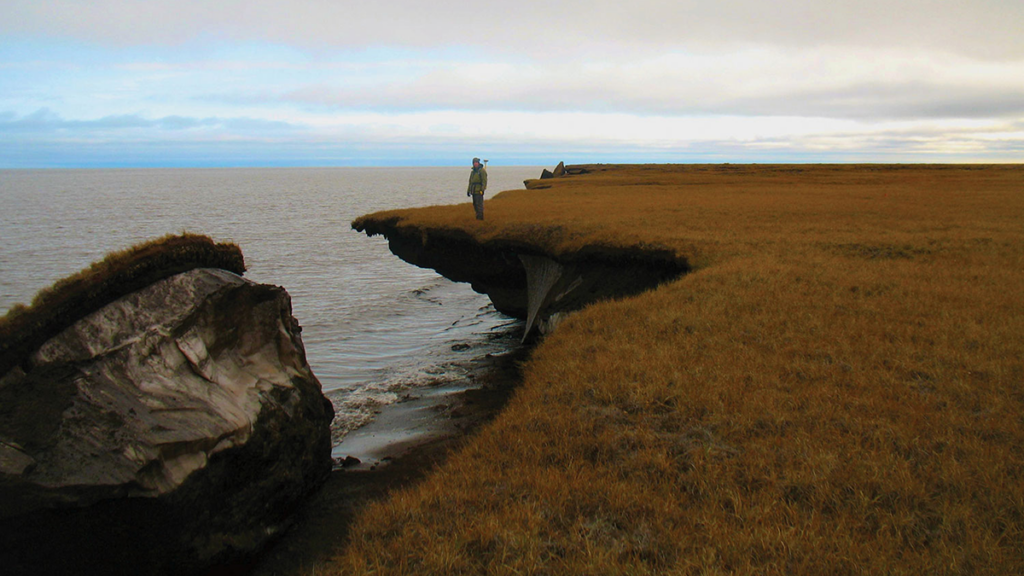
Frozen soil includes both permafrost, which remains frozen for at least two consecutive years, and seasonally frozen ground, which freezes and thaws each year. Together, these frozen landscapes affect roughly one-fifth of Earth’s land surface and much of the Northern Hemisphere. Permafrost is common in Arctic and sub-Arctic regions such as Alaska, northern Canada, Siberia, and Greenland, and it also occurs in high mountain and plateau regions, including the Qinghai-Tibet Plateau. Seasonally frozen ground extends much farther south into temperate regions. Although frozen ground is often associated with remote tundra, it also occurs in places where people live, work, farm, and build infrastructure, making it important far beyond the Arctic.
Why is it important to understand the hydrology of frozen soil?
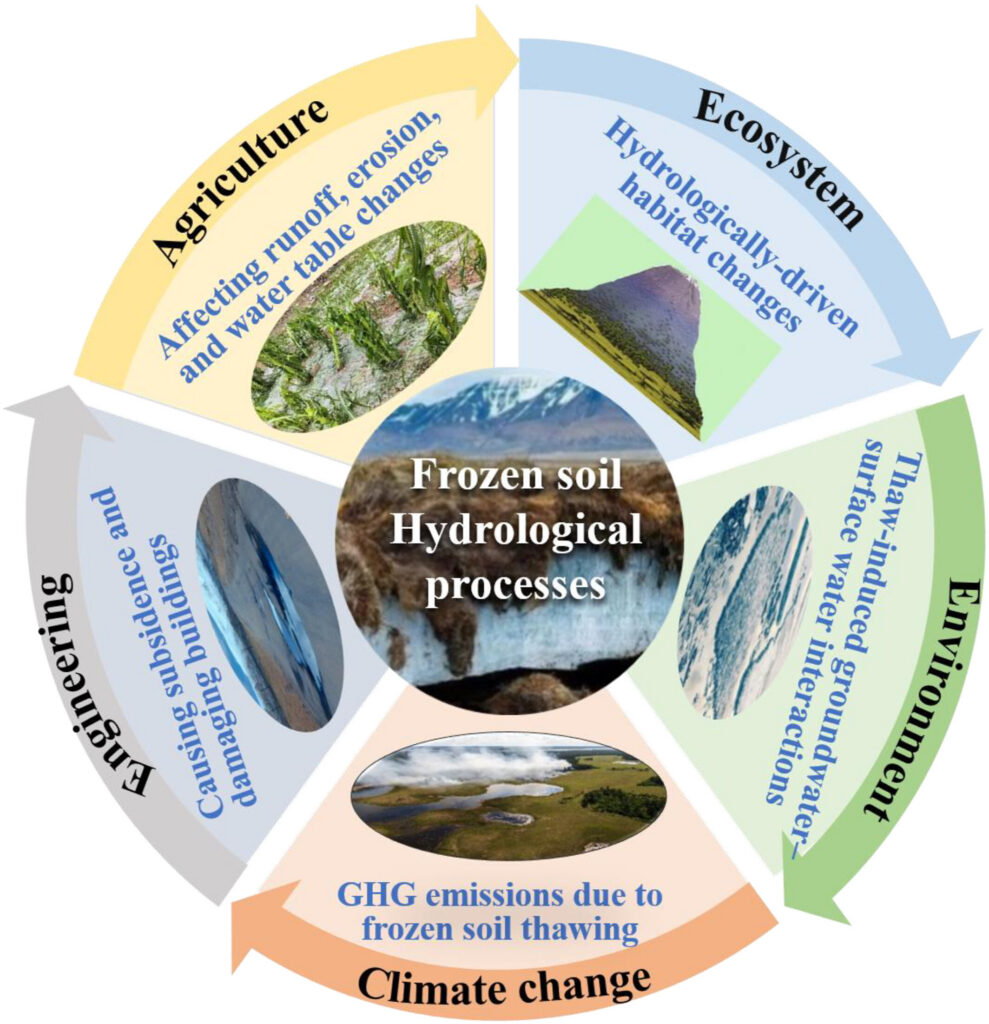
Frozen ground strongly controls how water moves, where it is stored, and when it is released. In many cold regions, it behaves like a seasonal or long-term underground dam. When soils are frozen, ice can block pores, limit infiltration, and force meltwater to move laterally across the surface, which can increase spring runoff, erosion, and flooding. When thaw deepens, new pathways can open, allowing more recharge, stronger groundwater connectivity, and higher cold-season baseflow. These changes affect rivers, lakes, wetlands, water quality, ecosystems, and infrastructure. Understanding frozen-soil hydrology is therefore essential for predicting water resources and environmental change in cold regions under continued warming.
Why is it necessary to study frozen soil with an interdisciplinary approach?
Frozen-soil hydrology cannot be understood through hydrology alone. Whether water infiltrates, runs off, or moves through the subsurface depends on interactions among soil physics, heat transfer, vegetation, snow, groundwater, geochemistry, ecology, and engineering. Thaw can alter not only streamflow and groundwater recharge, but also carbon release, nutrient transport, wetland development, and infrastructure stability. Observations therefore need to combine field measurements, geophysics, remote sensing, and modeling across scales. An interdisciplinary approach helps link pore-scale freeze-thaw processes to landscape and watershed responses, while also connecting hydrologic change to broader impacts on ecosystems, climate feedbacks, and society.
How is climate change expected to influence frozen soil in the coming years?
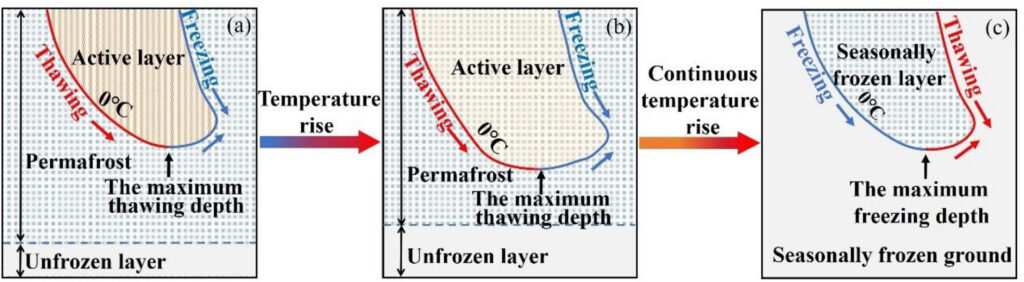
Climate warming is already reducing the extent and duration of frozen ground in many regions. In permafrost areas, the active layer is becoming thicker and, in some places, year-round unfrozen zones known as taliks are forming beneath lakes, rivers, and thawed soils. In seasonally frozen regions, freezing periods are becoming shorter and less stable. These changes can either wet or dry landscapes, depending on topography, ground-ice content, and subsurface connectivity. In some Arctic lowlands, thaw promotes ponding, wetland expansion, and stronger winter flow. In other regions, especially some upland and plateau settings, deeper thaw can increase drainage and reduce near-surface soil moisture. The hydrologic response is therefore widespread but highly variable.
What are some recent advances that have improved our understanding of frozen soil hydrology?
Recent advances have greatly improved our understanding of frozen-soil hydrology. In the field, better sensors now measure soil temperature, moisture, thaw depth, and gas fluxes at higher resolution, while fiber-optic systems, drones, and geophysical methods help extend those observations across larger areas. Satellite products now capture freeze-thaw transitions, surface water changes, and land deformation associated with thaw. At the same time, models have improved their representation of phase change, unfrozen water, preferential flow, groundwater-permafrost interactions, and abrupt thaw. These advances are allowing researchers to connect small-scale freeze-thaw physics with broader watershed and regional responses, which is essential for predicting future cold-region hydrology under climate change.
What are some of the future directions for research identified in your review article?
Our review identifies several priorities for future research. First, we need stronger links between process studies, observations, and models so that pore-scale freeze-thaw physics can be represented more realistically at watershed and Earth-system scales. Second, more work is needed on threshold behavior, abrupt thaw, groundwater connectivity, and the changing seasonality of streamflow. Third, frozen-soil hydrology must be integrated more closely with carbon cycling, ecology, and infrastructure risk, because thaw affects all of these at the same time. Better long-term monitoring networks, shared datasets, and multi-method approaches that combine field measurements, geophysics, remote sensing, and modeling will be essential for reducing uncertainty and improving prediction.
—Ying Zhao (yzhaosoils@gmail.com;  0000-0003-0346-5631), Ludong University, China

Editor’s Note: It is the policy of AGU Publications to invite the authors of articles published in Reviews of Geophysics to write a summary for Eos Editors’ Vox.
Citation: Zhao, Y. (2026), How frozen ground controls water in a warming world, Eos, 107, https://doi.org/10.1029/2026EO265010. Published on 17 March 2026.
This article does not represent the opinion of AGU, Eos, or any of its affiliates. It is solely the opinion of the author(s).
Text © 2026. The authors. CC BY-NC-ND 3.0
Except where otherwise noted, images are subject to copyright. Any reuse without express permission from the copyright owner is prohibited.