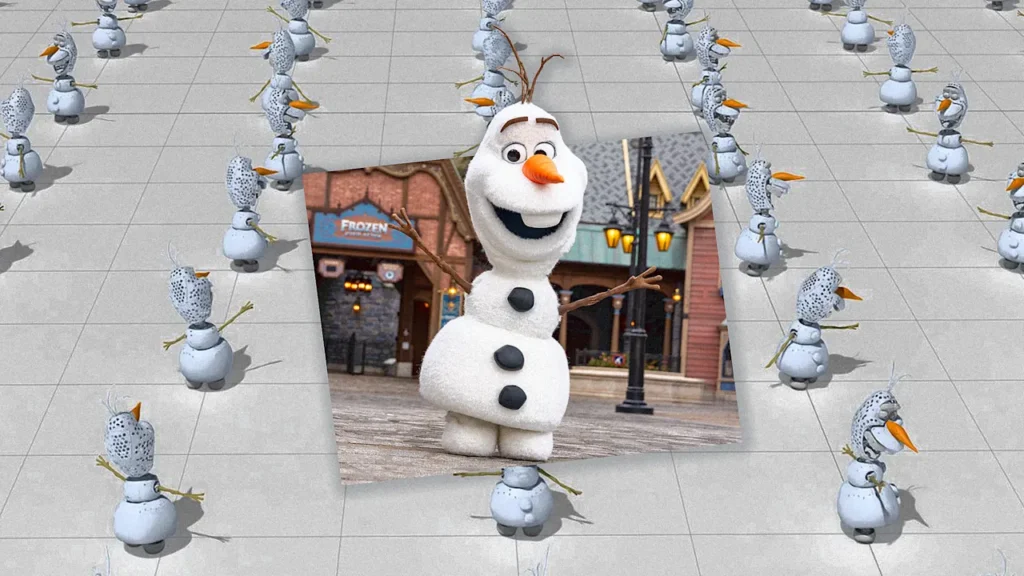
Walt Disney Imagineering has revealed the inner workings of its latest creation: a real-life 3D version of Olaf, the funny snowman from Frozen, complete with a detachable carrot nose that kids can steal.
According to Disney Parks, creating the snowman was a far greater challenge than standard bipedal humanoids, which rely on symmetrical weight distribution to stay upright. Olaf is a physical anomaly: He has a massive, heavy head perched on a remarkably slim neck, with two floating snowballs for feet and arms as thin as literal tree branches. This introduced equilibrium, mechanical, and thermal problems that the team had to solve.
Adding to these design and technological difficulties, the robot also had to capture its soul through motion, which is one of the biggest challenges that roboticists face today. As David Müller and his team from Walt Disney Imagineering reveal in a newly published research paper about Olaf: “This isn’t just about replicating the animation; it’s about emulating the creators’ intent.”
To bridge the gap between a CGI (computer-generated image) snowman and reality, the team had to invent new technologies in the field of legged robotics—cramming a bizarre skeleton into an incredibly tight space—and rely on deep reinforcement learning so the machine didn’t face-plant or literally melt its own hardware.
Announced back in November 2025, Olaf will interact with guests when the World of Frozen officially opens at Disneyland Paris on March 29.
Backwards anatomy
Robo-Olaf is a 34.9-inch-tall, 32.8-pound machine, featuring a custom exterior made with iridescent fibers to mimic the animated Olaf’s “snow-like shimmer that catches the light just like fresh snow” in the real world. The most complex mechanical problem was hiding the machine’s legs. In the films, Olaf’s feet just glide under his body like slick snowballs. To replicate that effect in our three-dimensional reality, Disney engineers had to dump traditional robot design entirely.
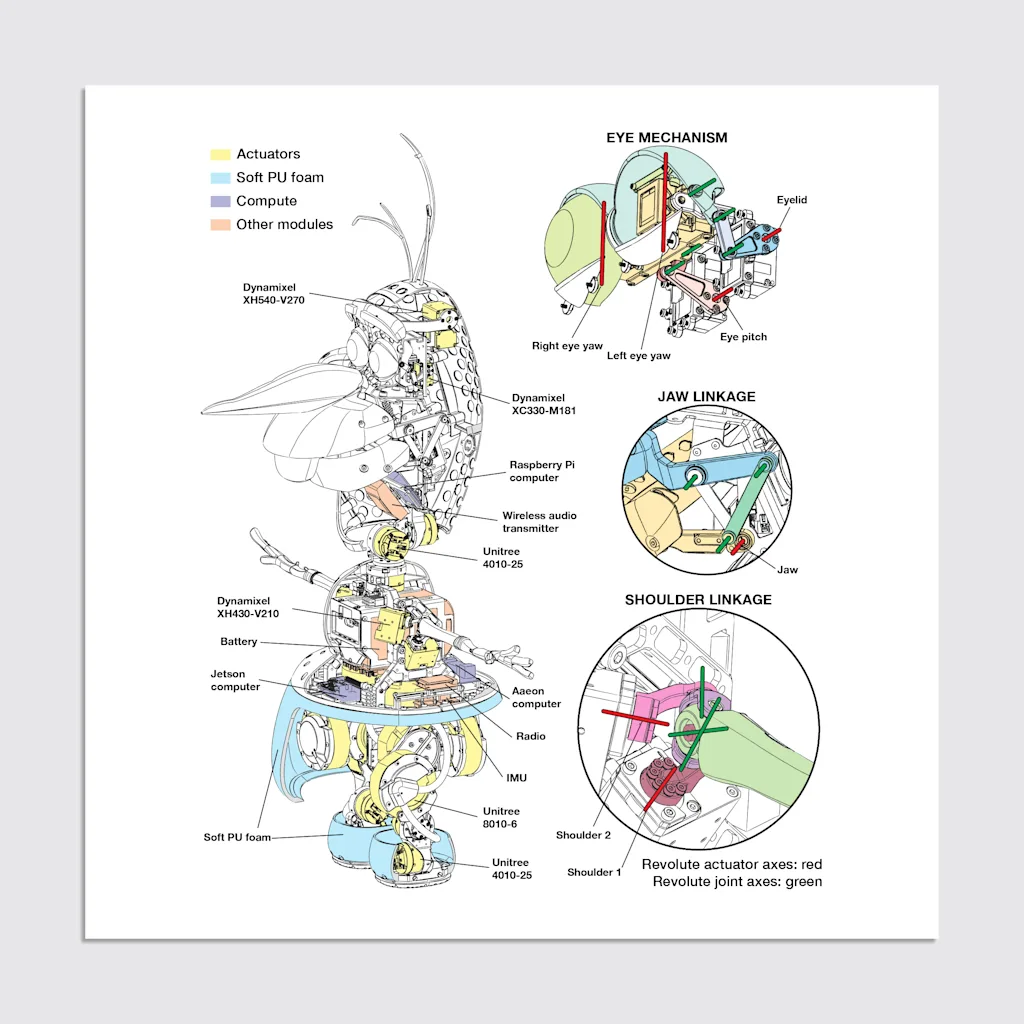
Instead, according to their research paper, they engineered “a novel asymmetric six-degrees-of-freedom leg design.” Essentially, they built the legs backwards to each other. The left leg features a backward-facing hip motor and a forward knee, while the right leg uses a forward hip motor and a backward knee. This bizarre layout ensures the metal joints don’t collide inside the snowman’s constrained lower body when it walks.
All that internal machinery is masked by a flexible polyurethane foam skirt that looks like a snowball but deflects enough to allow the robot to take wide, stumbling recovery steps if it loses its balance. Space inside the torso was so tight that engineers couldn’t even fit motors inside the shoulder joints. As one of the robot’s inventors explained in the presentation: “Since there is not enough space for actuators at the joint, we place them inside the torso and drive the arms using a spherical five-bar linkage.”
The rest of his features—arms, eyebrows, hair, and that iconic carrot nose—are attached with magnets, allowing them to snap off during a fall in order to prevent damage (and be used for some great jokes).
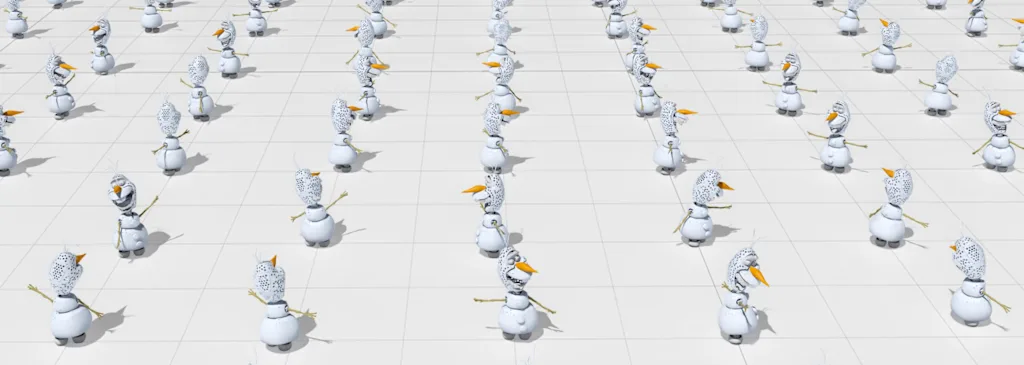
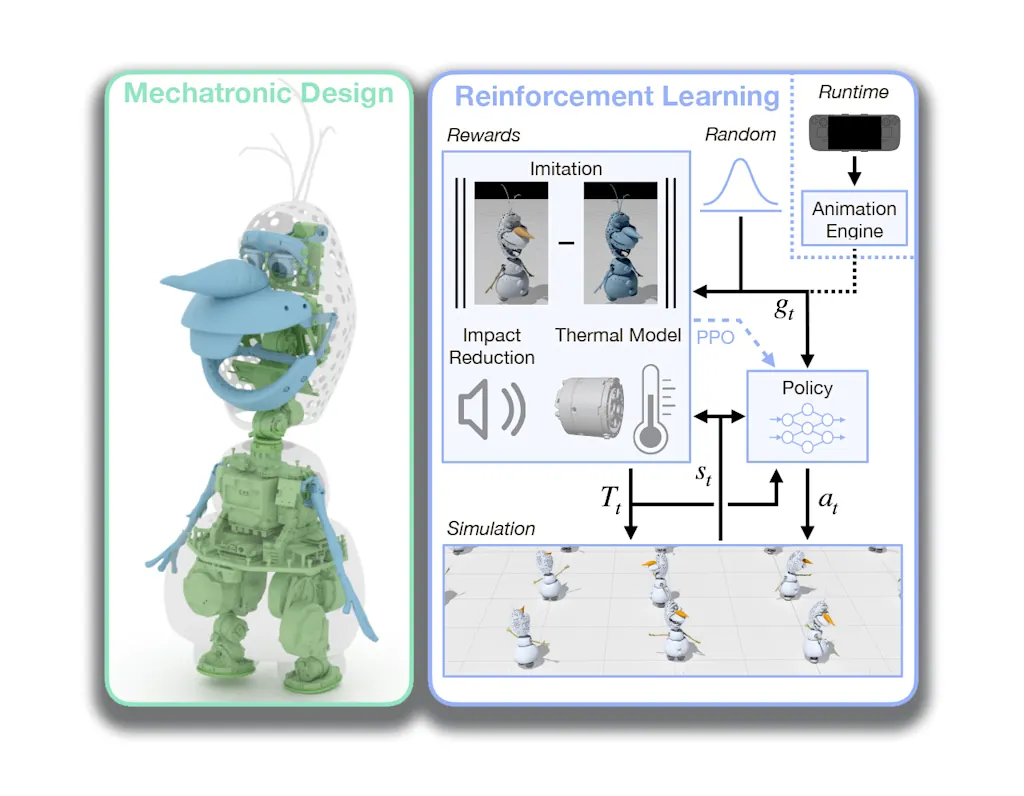
But building a weird skeleton is useless if it can’t walk. To nail the specific, goofy gait of the character, human coding simply wasn’t enough. Disney turned to reinforcement learning, an artificial intelligence technique that works like an evolutionary sandbox. In a virtual simulation, the software was fed the exact animation files from Walt Disney Animation Studios and tasked with figuring out how to fire the motors to balance the heavy head and match those movements without real-world Olaf face-planting every few steps. Through relentless trial and error, the AI discovered the precise mathematical inputs needed.
That AI training also saved the robot from destroying itself. Olaf’s massive head is controlled by tiny motors packed inside a narrow, heavily insulated costume neck. The large head, driven by small actuators, creates a high risk of overheating, Müller says in the video introducing Olaf’s robotic guts. So they augmented the motion and talking AI model simulation with an additional thermal model.
That model tracked the temperature of each part, feeding the resulting actuator temperatures into the AI motion engine. The neural engine then got a reward whenever it achieved a motion that kept the temperature within safe parameters, effectively mitigating heat buildup. If the neck motors approach their 176-degree Fahrenheit limit, the AI subtly adjusts Olaf’s posture on the fly, reducing the torque required to hold his head up and letting the hardware cool down without breaking character.
Silencing the machine
When the engineers first translated the Olaf’s CGI walk into physical motion, they realized that the footfalls sounded too loud. Walking robots naturally hit the floor hard in order to stabilize themselves, but the sound of heavy robotic footsteps would immediately shatter the idea of a weightless snowman gliding across a room.
To solve this, Disney’s team returned to the AI simulation and coded an impact reduction reward. Müller and his team essentially taught the software to prioritize putting its feet down gently, forcing the algorithm to dramatically decelerate the mechanical feet right before they struck the floor. The research data proves that this single algorithm tweak drops the footstep noise by 13.5 decibels, making Olaf walk much more quietly while still maintaining the character’s signature heel-toe strut. It’s not silent, like the animated version, but it’s also not like the Terminator is coming to kill a bunch of kids.
While AI controls the robot itself, the actual performance is “puppeteered via a remote interface.” An operator offstage triggers a specific gesture or a line of dialogue, and the AI seamlessly blends that commanded animation into its active balancing calculations.
The result of all this mechanical and cleverly engineered AI is the most realistic and lively robot I’ve ever seen. The thing feels so amazingly alive that I want to go party with the little guy, and I don’t even like Frozen.