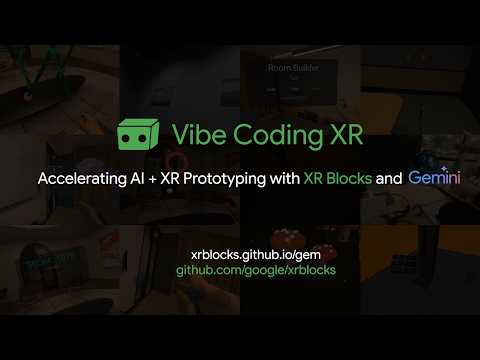
Traditionally, building a simple VR app typically requires a deep dive into game engines like Unity, a grasp of 3D physics, and hours of debugging. Google is now attempting to bypass this steep learning curve with Vibe Coding XR, an experimental workflow that turns text prompts into fully functional spatial experiences in under a minute.
The concept is part of a growing trend called “vibe coding.” That is, artificial intelligence translating human intent—rather than strict lines of code—into working software. The combo of Gemini AI models and the open-source framework XR Blocks allows anyone to describe a scene and see it come to life instantly.
Vibe coding hits VR: How Google is making XR development instant
The magic behind the curtain isn’t just raw code generation. According to Google Research, the system uses XR Blocks as a foundation. Think of these as high-tech LEGO pieces—pre-built modules for physics, hand interactions, and spatial UI. Instead of writing a script for how a ball bounces, Gemini simply assembles the right blocks based on your “vibe.”
In practical tests, the results are surprisingly diverse. Prompts have generated everything from a physics lab where you balance scales to a playable 3D version of the classic Chrome Dino game. One of the more complex examples includes a Schrödinger’s Cat simulation, where a simple “pinch” gesture allows users to interact with quantum states in a mixed-reality box.
A new playground for Android XR
While the technology is impressive, it currently lives within a very specific ecosystem. Vibe Coding XR is designed for Android XR, and for now, the most seamless way to experience it is on the Samsung Galaxy XR headset. However, Google hasn’t left everyone else out; they’ve included a “simulated reality” environment for desktop Chrome. This allows developers to test their “vibe-coded” creations without needing a headset immediately.
Interestingly, Google’s internal evaluations (using a dataset called VCXR60) suggest that while the faster Gemini Flash model can whip up a prototype in 20 seconds, Gemini Pro is the preferred choice for complex tasks. The Pro model is significantly better at following intricate instructions and avoiding “hallucinations”—those moments where the AI invents code that doesn’t actually exist.
A tool assistant, not a replacement for developers
It’s important to manage expectations: Vibe Coding XR isn’t meant to replace professional developers. The tech by itself is also not going to build the next blockbuster VR game. Instead, it serves as a high-speed prototyping tool. It allows educators to create instant 3D diagrams and developers to validate a UI concept in minutes rather than days. It is also useful as an assistant tool for XR software developers.
Google is preparing to showcase Vibe Coding XR at ACM CHI 2026 (from April 13 to April 17).
The post Google Brings Vibe Coding to XR: Build VR Apps in Under a Minute appeared first on Android Headlines.