The number of fatal landslides in 2026 to the end of February was considerably above both the long term mean and the year with the highest total, 2024.

To bring everything back up to date, I am providing an update on fatal landslides for both January and February 2026. As usual, this data has been collected in line with the methodology described in Froude and Petley (2018) and in Petley (2012). References are listed below – please cite these articles if you use this analysis. Data presented in these updates should be treated as being provisional.
The headline figures are as follows:
- January 2026: 38 fatal landslides causing 656 fatalities;
- February 2026: 53 fatal landslides causing 169 fatalities.
The most useful way to present this data as a time history is to use pentads (five day blocks) – in this case, Pentad 12 ended on 1 March 2026.
Below is the cumulative total number of fatal landslides to the end of Pentad 12, with the long term mean (2004 to 2016) and the exceptional year of 2024 plotted to provide a comparison:-
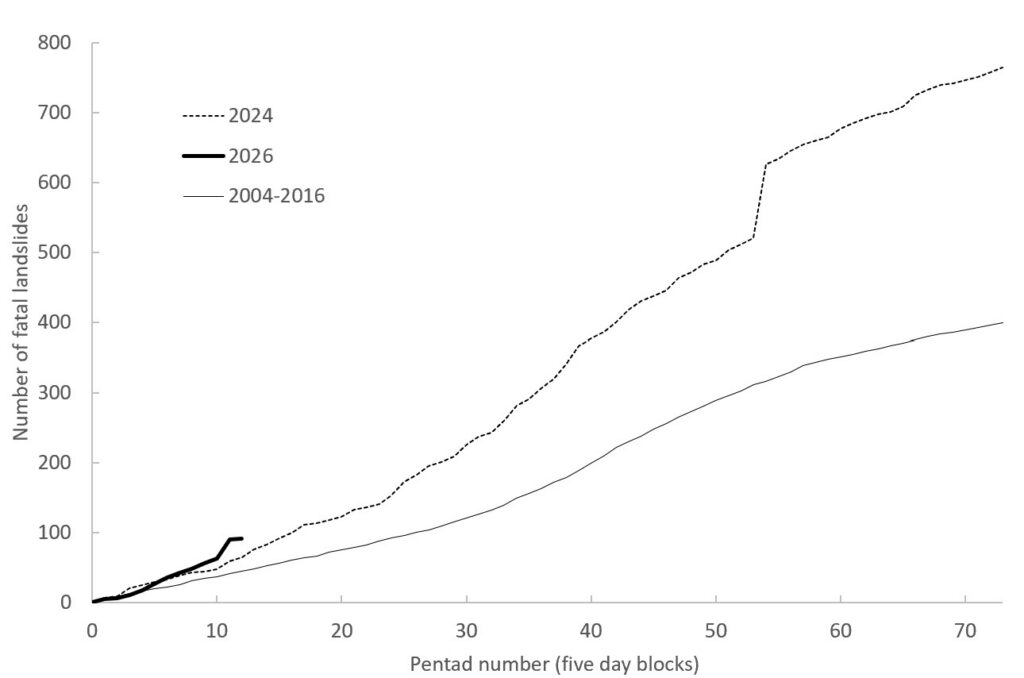
The data shows that, surprisingly, to the end of February, the number of fatal landslides in 2026 was considerably above both the long term mean and the year with the highest total, 2024.
This is a surprising outcome. It is driven primarily by an unusually large number of landslides in February, with multiple fatal landslides on about 23 to 24 February 2026 in the Juiz da Fora area of Brazil being a key factor. This was triggered by an unusual rainfall event – World Weather Attribution has a very nice article about it. They note that the rainfall was a one in a several centuries event, but they also highlight the key role of high levels of vulnerability:-
The severity of the disaster, however, was driven by the high exposure and social vulnerability. Risk assessments by Brazil’s National Center for Monitoring and Early Warning of Natural Disasters (Cemaden) had previously identified around 130,000 residents living in high-risk zones, placing Juiz de Fora among the 10 cities in Brazil with the highest proportion of people living in such risky areas.
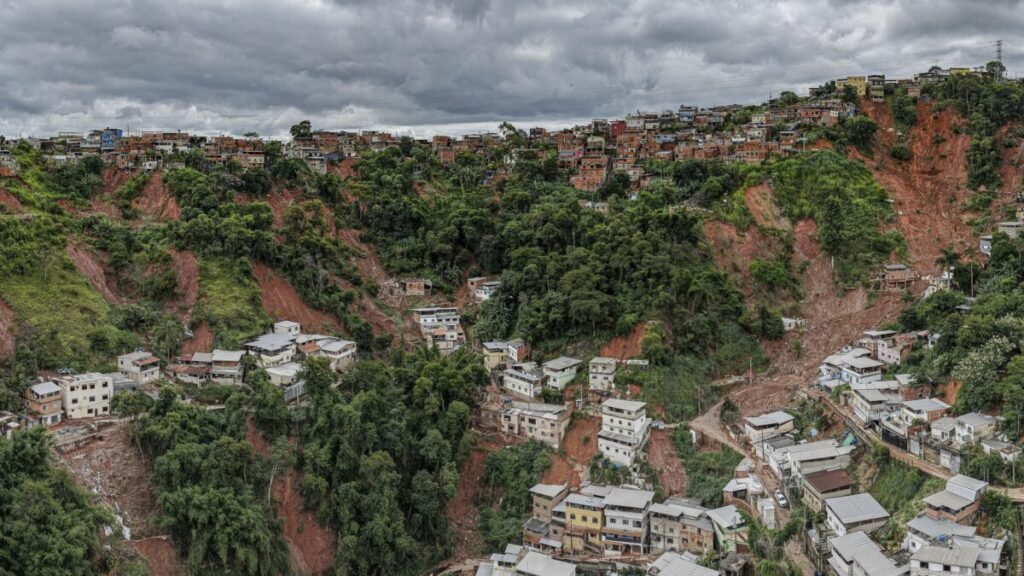
Their article includes this image, released under a Creative Commons licence, showing the aftermath of the landslides the Juiz de Fora area:-
Note the multiple shallow landslides on steep slopes, but also the extreme vulnerability of many of the structures. There is emblematic of the vulnerability to landslides in many urban locations.
The number of fatal landslides in January and February – lower occurrence months overall – is not a reliable predictor of what will happen later in the year. But we are probably heading into another El Nino event. It is likely that El Nino was a key factor in the large occurrence of fatal landslides in 2024.
References
Froude, M. and Petley, D.N. 2018. Global fatal landslide occurrence from 2004 to 2016. Natural Hazards and Earth System Sciences 18, 2161-2181.
Petley, D.N. 2012. Global patterns of loss of life from landslides. Geology 40 (10), 927-930.
Text © 2026. The authors. CC BY-NC-ND 3.0
Except where otherwise noted, images are subject to copyright. Any reuse without express permission from the copyright owner is prohibited.