
When Palantir CEO Alex Karp called for a suite of new recruitment programs to spot raw young talent and prioritize aptitude over experience, the team moved quickly. Within a week, the idea became an actual fellowship.
“We did a speed run from April to June,” says Jordan Hirsch, a senior counselor at the defense tech contractor. “We designed the curriculum, recruited faculty, reviewed applications, brought on the fellows, and arranged housing.”
The inaugural four-month Meritocracy Fellowship drew over 500 applicants for 22 salaried spots. Fellows completed intensive training, used Palantir’s software, and worked alongside full-time employees, and undertook a four-week crash course in the foundations of Western civilization. “We cover what the West is, what makes it different and special, and why we’re devoted to it, through the eyes of Palantir,” Hirsch tells Fast Company. A significant share of participants have already been offered further internships.
Palantir has long invested in early-career talent and converted internship candidates into permanent employees—many of whom go on to start their own companies (Fast Company counted 335 alumni founders to date). Yet even for Palantir, the latest push is aggressive: three new fellowships, plus the Valley Forge Grant, which pays high schoolers $10,000 to spend the summer using Palantir tools to solve a problem that “most inspires them.”
Recent and soon-to-be graduates find the current job market to be nightmarish: Junior job postings are shrinking, the number of applications per posting is swelling, and roles that once trained young people up now demand years of experience. Hiring freezes, AI-driven efficiency pushes, and cost-cutting have made the bottom rung of the career ladder even more slippery.
But Palantir is not the only company going big to net juniors. As some firms boast about AI gains and scale back on entry-level hiring, others across the US and Europe are courting the very best entry-level employees using a variety of tactics: outlandish ad campaigns, grassroots movements, and free skilling programs. In short: hiring this group has become a marketing flex—and a transformative development within a workforce that’s already being upended in real time.
How did entry-level hiring get here? And how are companies padding their pipeline for not just the next five years—but the next 20?
Hiring sprees and reneging on all-out AI
Unfortunately, there’s a fair amount of data to substantiate the entry-level job doom loop. While hiring for mid- and senior-level roles rebounded last year after the mass layoffs of 2023, entry-level hiring continued to decline. Before the pandemic, new grads made up about 15% of hires at Big Tech companies; today, that figure has fallen to 7%. Across all sectors, unemployment among recent college graduates sits at 5.6%, which widens the gap with the overall adult unemployment rate of 4.2% to a record high. Early 2026 LinkedIn data shows that 65% of people say landing a job has become more challenging, citing competition as the main hurdle, followed by uncertainty about their fit for the role and skills gaps.
Yet the majority of recruiters say it’s been harder to find staff over the last year, with 39% facing growing pressure to uncover ‘hidden gem’ candidates. It’s a paradoxical pickle: companies claim they can’t find workers, while graduates struggle to find a way in.
But, against that backdrop, a raft of companies is heading in the opposite direction by expanding—not shrinking—their junior pipelines.
After realising that having AI-native early career staff is a far better bet than replacing them with AI, IBM is tripling job openings for Gen Zers, including in teams such as software development and HR. Meanwhile, Dropbox unveiled plans to expand its summer internship and new grad programs by 25%. And Cognizant has been vocal about its plans to hire 25,000 college freshmen to ‘expand the bottom of the pyramid’ in the year to come. Their chief human resources officer said that everyone else cutting these roles aren’t actually saving money in the long run, since it creates a middle management vacuum down the line that requires poaching, which is expensive.
LinkedIn is another company prioritizing entry-level hiring. “As well as growing our entry-level engineering internships by 40%, we’re rethinking how we develop them once they’re here,” Erin Scruggs, vice president and head of global talent acquisition at LinkedIn, tells Fast Company. “The generation entering the workforce right now is AI-natives with builder mindsets, and pulling back on investing in them is short-sighted.”
Winning over that generation, however, requires far more than just posting a job ad and seeing what comes in—no matter how desperate for a job they might be.
Creativity and bravura as prerequisites
Christoph Klink, a partner at global early-stage VC firm Antler, pushes back on the idea that entry-level jobs are disappearing—but agrees the market is rough for both sides. As roles evolve at breakneck speed, the most sought-after applicants aren’t necessarily the most experienced, they’re the most adaptable. “Competition for the really good candidates who are strong generalists and willing to go all in, particularly with AI firms, is very hot,” he says.
So to navigate the landscape, firms are getting creative.
AI recruiting platform Metaview made its internal Slack public, a behind-the-scenes tactic to entice prospective applicants, and Eli Lilly worked with indie ad agency Wieden+Kennedy Portland for its Seeking campaign, which appeared at the NBA Draft and on billboards in Times Square and LA. The short film showcases the drugmaker’s values and functions as both a brand-building exercise and an actual recruitment campaign. (The ad’s final shot is a list of open jobs.)
Following its $21 million Series A funding round, the Berlin-headquartered AI search analytics platform Peec AI made a tongue-in-cheek announcement video in the hope of reaching hires outside the trad tech circles. In the video sketch, they parody grandiose sizzle reels of rockets launching or the Berlin Wall falling, when the company behind it is “just another B2B SaaS platform.”
“All the Y-Combinator launch videos are the exact same: cinematic and totally overblown,” explains co-founder Marius Meiners, who’s just moved to New York to establish Peec AI’s US arm. “But not everyone is saving lives—sometimes it’s just a software product to help people do their jobs better, and we wanted to pitch honestly.” The candor paid off, and job applications skyrocketed.
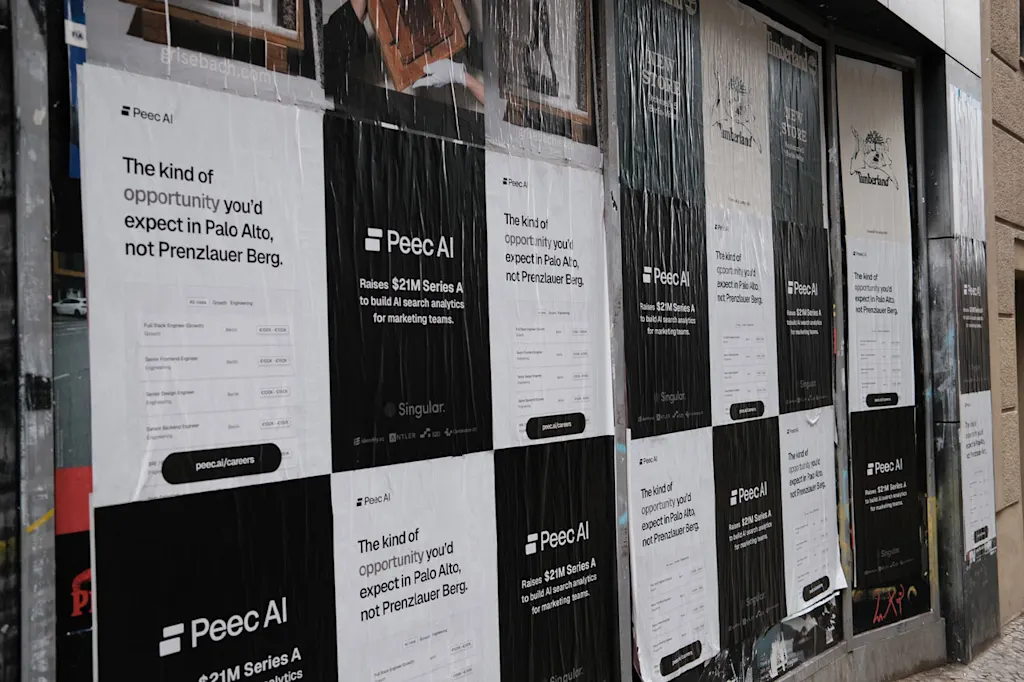
At the same time, Peec AI launched an ad campaign in public spaces, posting striking monochrome posters and sidewalk stickers around the city. “We wanted to have this big moment where everything you could see was about us,” says Meiners. “We were threatened with a fine from the city if we didn’t remove the stickers, but we happily took that problem on.” They removed them soon after, but the short, sharp activation continues to have an impact.

Across its growth, sales, customer success, and customer experience teams, junior applicants have been quite literally showing up at Peec AI’s door since the campaign. “They’ve brought boxes of donuts, distributed handmade pitch booklets, or even put a QR code on the office door that links to their CV,” says Meiners. The company has hired some of these out-of-the-box thinkers. But Meiners says the bigger win is that candidates arrive already understanding what Peec AI does and what it stands for.
Trust still speaks the loudest
Up against a “jobs apocalypse,” trust has dropped off a cliff. Among US job seekers surveyed by recruiting software firm Greenhouse, nearly half say their trust in the hiring process has declined over the past year. For Gen Z entry-level candidates, that jumps to 62%. Of those who’ve lost confidence, just under half point directly to AI, while over a third believe algorithms think AI has shifted bias over to algorithms. Layer in mass layoffs, ghost jobs, and a volatile economy, and it’s no surprise that candidates are increasingly wary of whom they put their faith in.
So companies that have maintained intern and graduate programs through the warp and weft of the last five years have an edge. According to jobs platform Handshake, 60% of male students, 75% of female students, and 75% of other-gender students now rank employer reputation as their top priority when considering roles. Building such trust, however, is harder than it used to be.
Brittany Mitlo, director of talent acquisition at Duolingo, says she’s seen a noticeable shift over her nine years working with trainees. “Whenever I speak to interns and new grads, there’s a broad unease about the job market and hiring,” she says. “Some of that confidence is starting to rebuild, but it’s taken a hit.”
On average, Duolingo has increased its early talent hires by 20% year-over-year, and has seen applications climb accordingly. Last year, though, leaders realized they wanted more engineers and product managers in particular, which demanded a quicker ramp-up than they’d ever done before. “Because we’d been consistently hiring, we’d built up a lot of trust with school, organizations and our intern network, all of which we tapped into in a personalized way to fill those positions,” says Mitlo.
For Gen Z, trust doesn’t come from titles, but instead comes from people who feel like them, finds the Edelman Trust Barometer. So peer-to-peer sharing is another ace up Duolingo’s sleeve: About half of their former interns, 40 in total, serve as on-campus ambassadors who host events and share opportunities with their networks.
“We ask that they host one event associated with an organization of their choice,” explains Mitlo. “We give them guidance on what they can share and provide a slide deck, but ultimately, they’re sharing their own internship experience.” Mitlo notes that their firsthand stories go far further than anything a recruiter could.
Seeding an ecosystem?
Among the employers doubling down on new-gen pipelines, a common belief is emerging: universities aren’t keeping up with the realities of modern work—and they can’t afford to wait.
Palantir has taken the most hardline stance and has been outspoken about higher education’s failure to prepare students for real-world careers. “Admissions are opaque, curricula are unmoored,” says Hirsch. “And somehow, the longer many students stay in the system, the less they know how to ask the right questions and pursue the truth.” Its Meritocracy Fellowship was launched with the slogan: “Skip the debt. Skip the indoctrination. Get the Palantir degree.”
Cognizant is taking a similarly long-term approach by building a pipeline that starts years before graduation. The company runs three programs targeting freshmen, sophomores, and seniors, the latter culminating in an in-person internship. “It’s our way of making a whole group of entry-level talent more effective much faster because of all the tooling they have,” says chief people officer Kathryn Diaz.
Rather than relying on universities, both companies are building their own ecosystems—training students in the skills they believe matter, whether or not those participants ultimately join them.
“We believe in seeding a broader ecosystem of talent and watching people go off and do fantastic things,” says Margaret York, Palantir’s head of talent. “Fellows who don’t convert go on to lead innovation efforts at defense contractors, industrial manufacturers, and companies we work with every day—which, for us, is the better story.”
Not everyone sees such efforts as purely altruistic. Marketing expert Marcus Collins, professor at the University of Michigan’s Ross School of Business and author of For the Culture, is skeptical.
“I can’t help but think this is a way to bake a tool into people’s work early on to make it all they know,” he tells Fast Company. “If the job market is shutting itself off to this broad band of people, and a company is subversive enough to go, ‘Hey, come rock with us,’ they’ll get talent running their way—or at least get people consuming their products.”
Collins compares the dynamic to the recent rollback of DEI initiatives. While many companies stepped back, those that redoubled their efforts became more distinctive—and attractive. “It not only hangs a banner on the door, but signals to the marketplace: spend your dollars with us,” he says. “There’s always a front stage and a backstage to corporate messaging.”
Self-serving or not, in a labor market defined by contradictions, consistency is absolutely what matters the most to those climbing the ranks.
As Diaz puts it: “People see the relentless pace of change—and employers that keep investing in people are going to be the winners.”