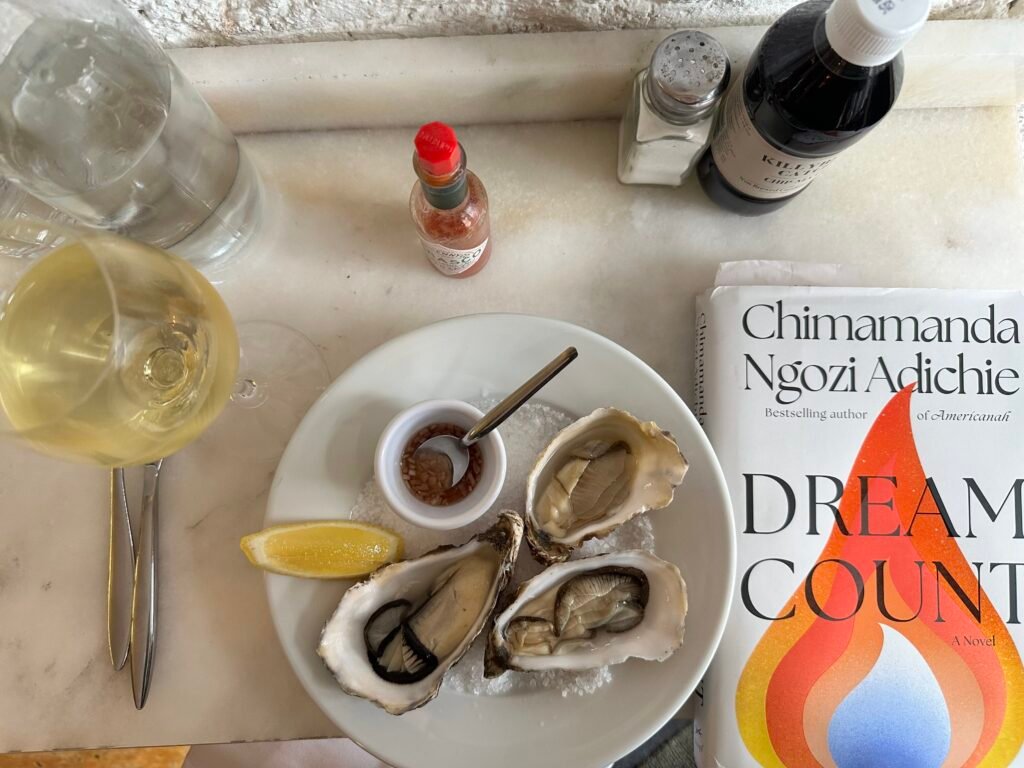
As a travel writer (among other things), I’ve become reliant on books to keep me company through delays and quiet moments. I always, always have a book with me on my journeys. This fall was no exception, and the fantastic Dream Count by Chimamanda Ngozi Adichie made for excellent company.
Set against the backdrop of global movement and cultural negotiation, Dream Count explores the fierce, fragile bonds of female friendship and the compromises women make in search of identity and belonging. It’s about travel and culture—but also about the quiet work of loyalty, advocacy, and becoming a fierce protector of the women who become your found family.

There’s a moment in the book that struck me especially hard:
“She was asking if I would think about it and let her know, and I said yes, of course, and I hung up quickly before my tears betrayed me. In the shortest moment, self-doubt can swoop down and swallow you whole, leaving nothing behind. It was pointless, all of this.”
This passage encapsulates the aching vulnerability so many women carry—especially those navigating life across cultures, across borders, across expectations. The book dives into the tension between ambition and doubt. For one character, it’s the disbelief that anyone would publish a travel memoir by a wealthy Black Nigerian woman who has no trauma to monetize, only joy to share. The pressure to justify her story through struggle is as suffocating as any passport restriction. Her confidence, ounce by ounce, evaporates. She cries, stops, and starts again.
I’ve read two of Adichie’s other books—Americanah (2013) and Half of a Yellow Sun (2006)—and remain dazzled by her voice. I admit that the early pages of Dream Count had me thinking it was nonfiction or memoir. The main character’s name is Chiamaka (Chia), and I wondered if that was a nickname for Chimamanda. I quickly realized this is a novel drawn from truth—fictional, yes, but emotionally exacting.
The story references the real-life 2011 scandal involving Dominique Strauss-Kahn, former head of the International Monetary Fund (IMF), who was accused of sexually assaulting Nafissatou Diallo, a Guinean hotel housekeeper in New York. That case drew global media attention and ignited conversations around race, class, power, and belief. Dream Count reimagines that moment from the perspectives of women who watch, feel, and sometimes judge from the sidelines.
We meet four women, all connected to Africa: Chiamaka (Chia), Zikora, Omelogor, and Kadiatou. They each come to the United States in pursuit of reinvention. Some fall for the country’s quirks and freedoms. Others find American smugness intolerable and retreat home. Adichie critiques the U.S. immigration system with subtle precision—it’s a place that welcomes the wealthy but rarely allows outsiders into the real conversation unless they’re willing to assimilate completely.
Three of the four women are linked by Nigeria and class privilege. The fourth, Kadiatou, is a housekeeper and stands apart. Her immigrant status is far more precarious. She cannot flit between continents; she doesn’t have the luxury of existential crises. Her access to the U.S. came through a rare moment of compassion, but once here, her life improves only marginally. As in Africa, she’s still vulnerable to sexual violence—but perhaps the betrayal feels sharper in a country that promises justice. In Nigeria, no one pretends that systems protect the weak. In the U.S., we expect better. So when those systems fail, it hurts more.
I was most drawn to two of the women. First, Chia, the travel writer. Her desire to be both outsider and insider—critical yet connected—hit close to home. She travels the world seeking beauty and insight, partly to avoid reckoning with her patterns in love. She has a gift for finding emotionally unavailable men, and she seems to fool herself into believing she wants a partner and children, even as her choices suggest otherwise. One line made me laugh out loud:
“Darnell loved Paris because of James Baldwin; Heaven forbid he should love it for any of the conventional reasons. For him, a thing had value simply by being obscure; a man of the people who hated what the people liked.”
But my favorite character was Omelogor, a Nigerian banker who devotes her time to providing microloans to women in her community. Watching her maneuver through Nigeria’s corrupt financial system is fascinating. She finds a way to reconcile her participation in a flawed system with her desire to create meaningful change. Like Chia, she contemplates family life—but unlike Chia, Omelogor is clear-eyed about her love of independence.
“I am mistress of all I survey. Actually, Aunty Jane, I do like my life. I fail for meaning sometimes, maybe too often, but it is a full life, and a life I own. I have learned this of myself, that I cannot do without people and I cannot do without stretches of sustained isolation. To be alone is not always to be lonely.”
The writing is gorgeous. The themes are timely. Midlife novels about women are so rich and impossible for a reader like me—54 and well past many of these life decisions—to ignore. Beyond the insights on friendship, the cultural critique is a zinger. While I feel incredibly lucky to be an American, I’m not blind to the cracks in the system. Sometimes it takes an outsider, someone unafraid to tell the truth, to remind us what we’ve grown too comfortable accepting.
Adichie doesn’t idealize any one place. Nigeria is rife with corruption and instability, yet the draw “home” is strong—family, food, and the comfort of understanding how the system works. The U.S. offers promises that often fail to materialize. The system here is just as rigged, only more subtly. I’m grateful for writers like Chimamanda Ngozi Adichie, who shine a light without flinching—and I look forward to whatever comes next, especially if it includes women navigating the complicated truths of life after 50.
Listen on Audible:
https://amzn.to/48rx7qm
One line summary: This richly personal book explores themes of friendship, migration, and midlife identity through the eyes of a travel writer.
For fans of: Americanah
Where I read it: Started in Scotland and finished in Morocco when in the Atlas Mountains.
Get the full list of books from 2025 here.

The post Dream Count by Chimamanda Ngozi Adichie: A Bold Meditation on Friendship, Power, and the Meaning of Home appeared first on Mom Trends.