As COP30 unfolds in Belém, the world’s attention is fixed on a city that sits at the gateway to the Amazon rainforest. For decades, the Amazon has been discussed from afar, but in 2025, the global climate community brought the negotiations to its very doorstep. With over 17% of its forest cover gone and its ecosystems under mounting pressure from mining, agriculture, wildfires, and expanding human presence, Belém is an urgent reminder that protecting nature, forests, oceans, and biodiversity matters more for planetary stability than any negotiated document. With high-level negotiations intensifying and protests erupting outside the venue, Belém has become the stage where climate ambition, political tension, and justice demands collide, and perhaps a preview of what a new era of climate action could look like.
A New Climate Finance Era Takes Shape
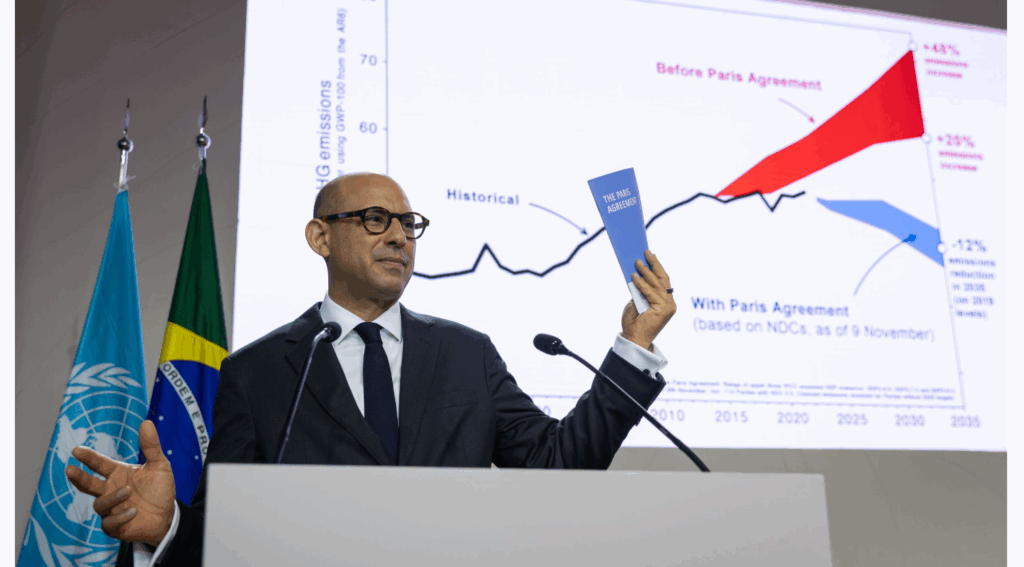
A single, unifying demand defining this year’s summit is finance. Delegates repeatedly echo the words of UN Climate Change Executive Secretary Simon Steil, “When finance flows, ambition grows.” COP30 has embraced this idea as its organising principle to the utmost.
The $1.3 Trillion Vision
Brazil’s presidency of COP30 has centred on a bold finance goal: mobilising US$1.3 trillion per year by 2035 to support climate action, particularly for developing countries. This would be the world’s largest coordinated investment in climate action, included in a broader ‘Baku-to-Belém Roadmap’, dwarfing past commitments and signalling a pivot from incremental reform to systematic transformation.
Dedicated Amazon & Biodiversity Funding
One of COP30’s signature initiatives is a US$25 billion commitment for Amazon and biodiversity protection. The package focuses on forest conservation, ecosystem restoration, and sustainable livelihoods, especially for Indigenous and traditional communities. Unlike past pledges, this agenda aims to create long-term financing pipelines that deliver predictable resources directly into forest territories and local conservation economies. Civil society groups have emphasised that the effectiveness of this commitment will depend on whether funds reach the people who protect the Amazon on the ground.
US$100 Billion for Global Market-Based Climate Solutions
Brazil aims to harness capital markets, not replace them, by leveraging global capital markets to raise US$100 billion for nature-based solutions, forest bonds, and other sustainable investment products. Unlike earlier models that relied on donor grants, this approach aims to embed forest protection into mainstream financial systems. If agreed upon, it could mark one of the most significant structural changes since the Paris Agreement.

Local Governments Claim Their Space in Global Climate Action
One of the most transformative aspects of COP30 is the visible rise of subnational leadership. Governors, mayors, and municipal coalitions are shaping the agenda with unprecedented influence.
Amazon States & Ecosystem Services
A key announcement came from the nine states of Brazil’s Legal Amazon, which, in partnership with NatureFinance, launched the Full Protection Environmental Assets initiative. This mechanism recognises forests as ecological assets and links financial incentives to the provision of ecosystem services, offering new revenue streams that reward conservation.
Subnational REDD+ and JREDD+
A Scaling JREDD+ Coalition was launched mid-conference, bringing together tropical forest nations, local governments, indigenous organisations, and investors. Rather than supporting isolated projects, this jurisdictional approach rewards entire states or provinces for reducing deforestation, aligning large-scale finance with systemic forest protection.
Local Access to Finance
Throughout COP30, conversations have emphasised the importance of direct access to climate finance for cities, regions, and local communities. This shift reflects a broader re-orientation of finance architecture away from highly centralised models and towards more participatory, decentralised governance.

Creator – Fernando Llano
Copyright – Copyright 2025 The Associated Press
Brazil’s Roadmap: Ambition, Accountability, and the Amazon
As the host nation, Brazil is under global scrutiny. Its Amazon roadmap focuses on halting deforestation, accelerating forest restoration, and building a sustainable, forest-based economy. Satellite surveillance and rapid-response enforcement have intensified, and the government has emphasised not only stopping illegal deforestation but reversing past damage through ecological recovery and land regularization.
Ethics, Indigenous Rights, and Social Justice
Because COP30 is taking place in the Amazon, indigenous voices are central, not peripheral. Parallel to the official negotiations, a vibrant People’s Summit is being held at the Federal University of Pará, where Indigenous leaders from across the region are sharing perspectives and advancing political demands. A regional declaration from Amazonian Indigenous peoples states clearly, “We are not responsible for the climate crisis; we are the solution.” It calls for respect for territorial rights, recognition of ancestral knowledge, and meaningful participation in climate governance.
At the same time, tensions have surfaced. Protests over land rights and resource governance have escalated outside the official venue, raising difficult questions about whether a global climate summit can meaningfully centre justice while social and economic inequalities remain unresolved.
Progress Amid Deep Divides
As COP30 moves forward, several themes dominate the negotiation rooms:
- Adaptation finance: Developing nations are pushing for at least US$120 billion per year to address rising climate impacts.
- Loss and damage fund operations: Disputes persist over who pays, how much, and through what mechanisms.
- Forest finance alignment: Countries are debating how to harmonise carbon markets with anti-deforestation safeguards.
- Global stocktake follow-up: Nations are under pressure to align Nationally Determined Contributions (NDCs) with a 1.5°C pathway.

Belém’s Legacy Hinges on Action, Not Announcements
COP30 is more than a climate summit; it is a test of global integrity. If the commitments emerging from Belém translate into measurable change, they could mark the beginning of a new climate era: one grounded in finance, fairness, and the protection of Earth’s largest rainforest. But if promises remain unmet, COP30 will join the long list of summits remembered for rhetoric rather than results. For now, the world watches Belém with cautious hope, and the Amazon waits for answers.
Written by – Arya Jagdish Sawant
Edited by – Shiv Talesara
The post COP30: The Amazon Waits for Answers appeared first on The Economic Transcript.