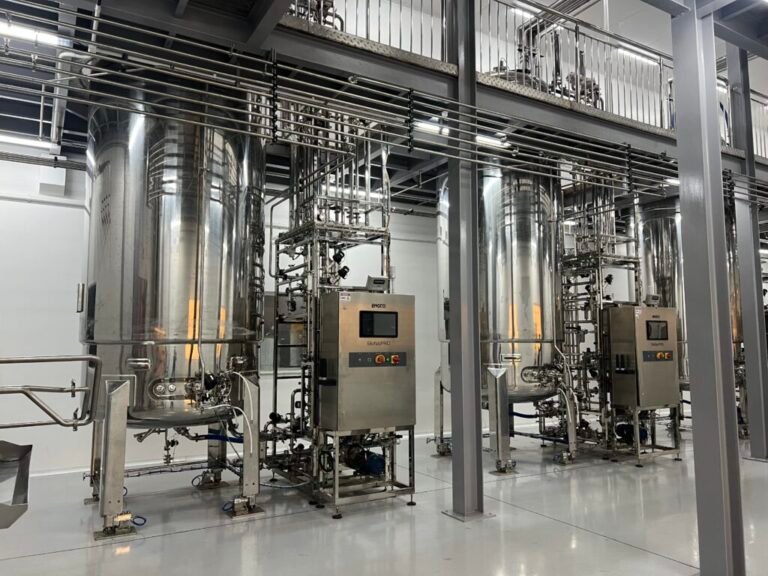
Pivot Bio—which pioneered the use of microbial nitrogen to help farmers reduce their reliance on synthetic fertilizer and improve yields—has brought out a flurry of new products and slashed prices by 30% without denting margins.
“Something we are proud of is that we are growing with new products, partners and distribution channels and we are doing it with 70% less capital intensity than 24 months ago,” CEO Chris Abbott told AgFunderNews.
And while farmers using Pivot Bio’s microbes can currently cut fertilizer use by about 20-25%, Abbott reckons that figure could get to 40-50% over the next five growing seasons as the firm further optimizes its wares.
He would not share revenues but said that the firm has recently opened up new distribution channels and hope to move into new markets: “We initially launched with the seed channel because seed treatment was such a huge home run product for us. But this is the first year we’ve gone to market with ag retail partners and we’ve added over 500 points of sale there. We’re also hoping to get approval to sell in Brazil any time now.”
The technology
Founded in 2011, Pivot Bio works with soil bacteria that naturally convert atmospheric nitrogen into ammonia via the enzyme nitrogenase. By editing the microbes’ genes to dramatically boost nitrogen fixation—and to prevent them from shutting down when synthetic fertilizer is present—Pivot Bio turns them into microscopic, super-productive ammonia factories.
The result: farmers can use far less synthetic nitrogen, a major emissions source that’s prone to losses through runoff after heavy rain and volatilization in high heat.
The microbes—which colonize plant roots and supply a steady stream of ammonia throughout the growing season—can be applied in-furrow, as a seed treatment, or now as a dry powder added directly to the planter box, says Abbott. “Our goal is to meet the grower however they want to use it.”
New products from Pivot Bio, which has operations in Minneapolis and St-Louis, include:
- PROVEN G3 – the third generation of its solution for corn.
- CERT-N – a new product tailored for cotton.
- RETAIN – a new product tailored for sorghum.
- New dry powder formulations of PROVEN-G3 and CERT-N combined with micronutrients so farmers can deliver Pivot Bio’s microbes directly in the planter box.
The business case
The business case varies from farmer to farmer and crop to crop, and comes from a combination of higher yields, reduced fertilizer use, and in some cases, direct payments from companies that will pay a premium for a less carbon intensive crop.
Over the last three growing seasons, for example, downstream buyers paid farmers in Pivot Bio’s N-OVATOR program $13 million for producing less carbon-intensive crops, said Abbott.
Some farmers that use Pivot Bio’s microbes are primarily focused on yield, so might choose to “produce a hell of a lot more with the same inputs” while others want to significantly cut back synthetic fertilizer use “and still inch their yield up,” he said.
In Pivot Bio’s large-scale farm trials across eight states in 2024, cotton treated with CERT-N replaced an average of 20% of farmers’ normal nitrogen program and saw an average yield gain of 50 pounds of lint per acre and a $35 boost in ROI, he claimed.
Early harvest results from corn in Texas, meanwhile, found that using PROVEN G3 on top of the standard nitrogen rate provided 154 bushels per acre, compared to 146.60 bushels per acre when using only the standard nitrogen rate, he added.
Put together, all this is pretty compelling at a time when farmers are facing soaring input costs, he said: “I was born in 1988 and in all the years since, grower margin has never been pressured more than it is right now.”
Nutrient use efficiency
While other players are looking to enter this market, he said, “We’re the only company with patents granted in the space. We also publish all of our data online from every customer and plot that submits it, good, bad, or indifferent.
“So take corn and cotton, which use different amounts of nitrogen, but across the range, Pivot Bio can deliver about 20 to 25% of what that plant needs. Today, we are delivering that on millions of acres, and as we look over the next five growing seasons, we’re hoping we’re in the 40 to 50% range of total nitrogen [need by the plant] fixed and excreted.”
He added: “If I’m a farmer applying anhydrous ammonia [a concentrated nitrogen fertilizer] and UAN [Urea Ammonium Nitrate, a blend of urea and ammonium nitrate], and Pivot Bio can give me 50% of my nitrogen [via microbes], Oh man, I might say, I’m done with anhydrous. It’s volatile. I lose 70% of it, it’s unsafe, or whatever. I’m going to just use the bio seed treatment and UAN.”
One way to think about ROI is around nutrient use efficiency, he said. “How many synthetic inputs have to be applied per bushel of yield? So our best customers are in that 0.4 to 0.6 pounds of synthetic nitrogen per bushel of yield, and typically they come to us in that 0.8 or 0.9 range.”
The highest performing source of nitrogen
Abbott added: “Our business today is focused really on three basic concepts. First, we have to be the highest performing source of nitrogen. Our microbes are glued to the root and by definition are not volatile with rain or heat. Second, we’re at or below the price of synthetic nitrogen, and three, we’re the most sustainable source of nitrogen.
“Sustainability is inherent to the technology, but we’ve gotten a lot better on quality, consistency and price in the last two years and our retention rate and grower satisfaction [levels] are fantastic.”
Looking ahead, he said, Pivot Bio sees opportunities to work closely with fertilizer companies to “bring solutions, not just our own products, but the right package, the right solution, for the customer.”

The post Can microbes supply half a crop’s nitrogen? Pivot Bio thinks so appeared first on AgFunderNews.