Source: Water Resources Research
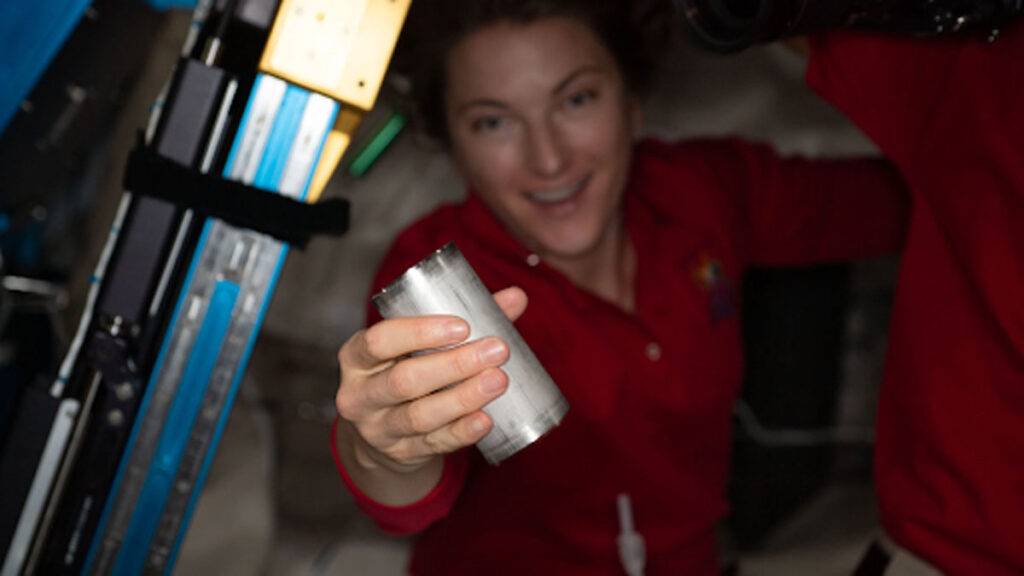
If humans want to live in space, whether on spacecraft or the surface of Mars, one of the first problems to solve is that of water for drinking, hygiene, and life-sustaining plants. Even bringing water to the International Space Station (ISS) in low Earth orbit costs on the order of tens of thousands of dollars. Thus, finding efficient, durable, and trustworthy ways to source and reuse water in space is a clear necessity for long-term habitation there.
Current systems, like the Environmental Control and Life Support System (ECLSS) on the ISS, offer a blueprint for closed-loop water reclamation, but they need improvements for future applications. Meanwhile, recent technological and scientific advances are pointing to new ways of finding, purifying, and managing water resources in demanding environments. In a new review, Olawade et al. provide an overview of the current state of extraterrestrial water management, as well as of the field’s prospects and challenges.
Water systems in space need to be closed loop, highly efficient, and durable, all while having low energy requirements, the authors say. Currently, the ECLSS is prohibitively energy intensive, and may not be efficient enough, for use on longer missions. Future suggested approaches for filtration and recycling include photocatalysis to purify water via light, bioreactors to filter urine and wastewater, ion-exchange systems to remove dissolved salts and heavy metals from extracted water, and ultraviolet or ozone disinfection to kill pathogens. Each comes with its own pros and cons: Microbial fuel cells in bioreactors could produce electricity, for example, but photocatalytic purification has low energy demands.
Sourcing water on places like the Moon or Mars would require either extracting water bound up in regolith or drilling into ice bodies. Sufficiently powering water reclamation systems is another concern, making energy-efficient systems a priority. Water system durability is also important, both to protect inhabitants and to reduce the need for onerous maintenance work.
Emerging technologies could meet many of these challenges. The authors point to advances in nanotechnology, which could be used to create highly tailored membranes for filtration that are more effective and resistant to fouling, and to the use of artificial intelligence (AI) to autonomously manage water systems, as two areas of promise. (Water Resources Research, https://doi.org/10.1029/2025WR041273, 2026)
—Nathaniel Scharping (@nathanielscharp), Science Writer

Citation: Scharping, N. (2026), A road map to truly sustainable water systems in space, Eos, 107, https://doi.org/10.1029/2026EO260023. Published on 9 February 2026.
Text © 2026. AGU. CC BY-NC-ND 3.0
Except where otherwise noted, images are subject to copyright. Any reuse without express permission from the copyright owner is prohibited.