Editors’ Highlights are summaries of recent papers by AGU’s journal editors.
Source: Journal of Geophysical Research: Solid Earth
Quartz is widely thought to control the mechanical strength of Earth’s continental crust, but measuring its strength at high pressure and temperature has long been challenging.
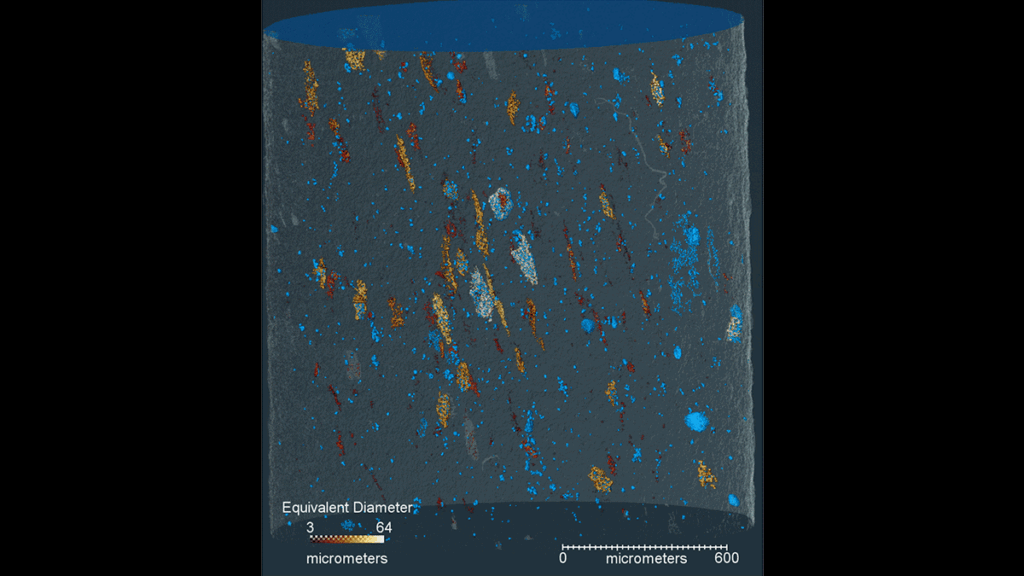
Medina et al. [2026] deform polycrystalline α-quartz at crustal pressure and temperature conditions while directly monitoring stress inside the sample using in situ synchrotron X-ray diffraction. Unlike traditional experiments that rely on external load measurements, this approach derives stress from lattice strain within the quartz itself, avoiding long-standing uncertainties related to friction corrections. The results show that quartz strength varies systematically with temperature, transitioning from lattice-resistance–controlled plasticity below 800 °C to dislocation creep at higher temperatures.
Remarkably, the new measurements are broadly consistent with classic deformation experiments despite the very different experimental techniques. The data also show little pressure dependence over the tested conditions, suggesting that temperature plays the dominant role in controlling quartz strength in much of the crust. These findings provide a more reliable experimental foundation for flow laws used to model crustal deformation, earthquakes, and mountain-building processes.
Citation: Medina, D. A. J., Kaboli, S., Patterson, B. M., & Burnley, P. C. (2026). Strength α-quartz: New results from high pressure in situ X-ray diffraction experiments. Journal of Geophysical Research: Solid Earth, 131, e2025JB032753. https://doi.org/10.1029/2025JB032753
—Jun Tsuchiya, Editor, JGR: Solid Earth
Text © 2026. The authors. CC BY-NC-ND 3.0
Except where otherwise noted, images are subject to copyright. Any reuse without express permission from the copyright owner is prohibited.