It’s not an easy time to be a documentary filmmaker.
It’s getting harder to sell political content—at exactly the time when that storytelling is arguably needed most. That’s one of the reasons that Alex Gibney, the documentarian behind films such as the Oscar-winning Taxi to the Dark Side, partnered with Wendy Schmidt, the philanthropist, earlier this year. Schmidt invested in a majority stake in Jigsaw Productions, Gibney’s company, in February.
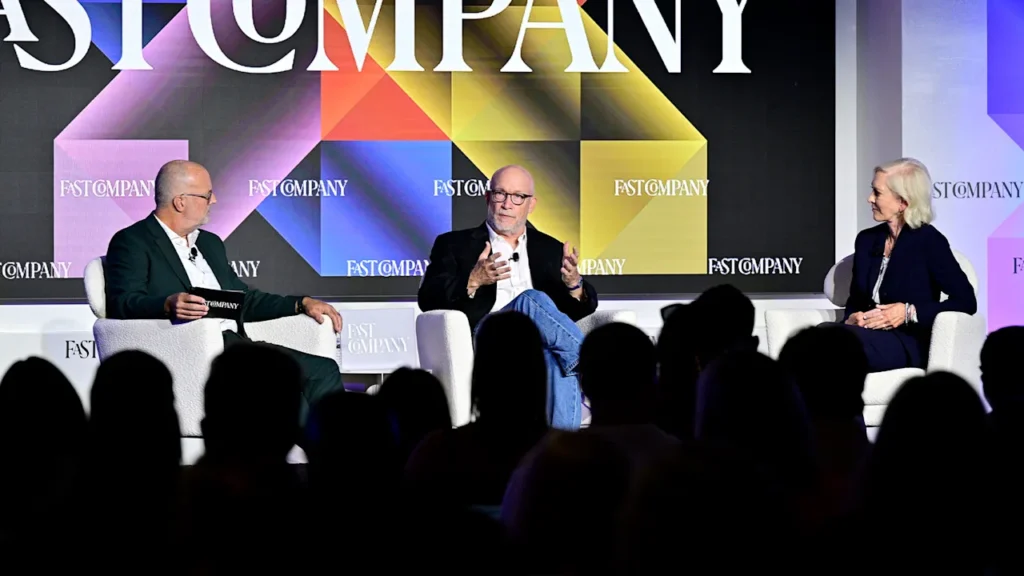
At this week’s Fast Company Innovation Festival, the partners talked about how they’re confronting the challenge of reaching audiences. “We believe that at this moment in time, with growing media consolidation, what’s ending up happening is, actually, that a wall is being built between independent creators and audiences who want to see that material,” Gibney said. “There is a kind of algorithmic twisting of content, in a way, that I think is interfering with that exchange between creators and viewers.”
Jigsaw Productions struggled to find a distributor for its 2024 film The Bibi Files, about the bribery and fraud trial of Israeli Prime Minister Benjamin Netanyahu. (Right now, it can be streamed on Jolt.film.) Other producers have faced the same challenge. No Other Land, a film about the Israeli-Palestinian conflict, won an Academy Award last year but couldn’t find a U.S. distributor.
Schmidt’s investment in the company is helping it continue its work as it focuses on how to get films in front of audiences. For Schmidt, the partnership was a natural fit. Before she was a billionaire philanthropist and the wife of former Google CEO Eric Schmidt, she was a journalist. She recognizes the power of storytelling to help audiences make sense of the world’s biggest challenges.
“We’ve been looking to invest in some kind of production company for a while to amplify the impact of the work we do in philanthropy,” Schmidt told the Innovation Festival audience. “There are so many issues that are really of critical importance to human life right now that are not represented well in any films. We have an opportunity to help educate people and to help bring voices into our public arena that are not heard from. And we’ve encountered these people for the last 20 years in our philanthropy, and there’s a way to give them a voice in film.”
Jigsaw will now work on more projects related to climate change and ocean health, issues that are priorities for Schmidt. She’s also helping the company brainstorm new approaches to distribution. There’s a need for more innovation in the industry, Gibney said, similar to the way Bookshop.org has helped independent local bookstores compete with Amazon.
Documentaries have a critical role to play now, Schmidt said. “Film, as Robert Redford made the observation many years ago, is one of the most direct ways to reach people—to reach their hearts, to help them make sense of the world they’re in, and then hopefully drive them to actions that can make them feel part of a solution instead of being part of a problem,” she said. “I think that’s the moment we’re in.”