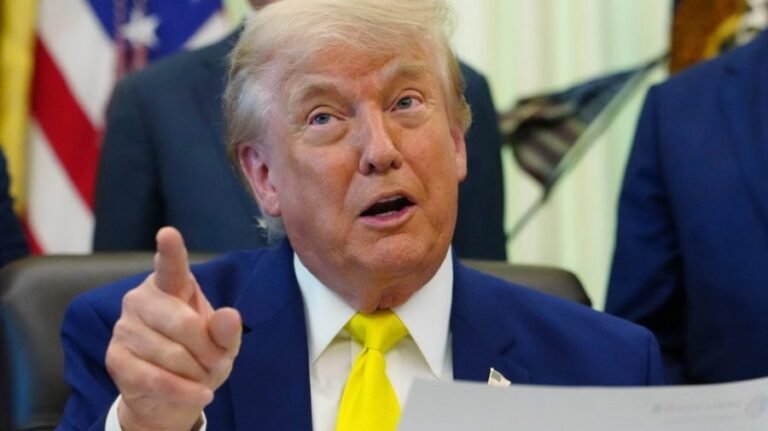
President Trump recently told his interviewers from The Atlantic magazine, “I run the country and the world.” There is certainly no denying that the president “runs” the United States, and is doing so more forcefully than any of his predecessors since World War II.
Running the world is quite another matter, however. The outcome in Canada’s parliamentary election this week turned to a significant extent on how Canadian voters felt about Trump’s desire to annex that country. Prime Minister Mark Carney, elected to a full-term, made resistance to Trump’s plan a central campaign theme.
And opposition to the president’s plans and intentions hardly ends with the Canadian election. Denmark is not prepared to cede Greenland, and has won the support not only of its Nordic partners, but other NATO members who are prepared backstop its efforts to resist American pressure.
Washington has hit the European Union with 20 percent tariffs. Rather than retaliating, the EU has chosen to hold its fire, especially as Hungary could block a united response. Nevertheless, if there is no progress in its own trade negotiations with Washington, especially if the Trump administration’s negotiators seek elimination of Value Added Tax and other non-tariff barriers, Brussels could retaliate by working around Hungary’s objections. It could create a “coalition of the willing” to resist American demands and retaliate with a variety of economic measures of its own.
Europe is not the only region where resistance to American policy continues to intensify. China has already indicated that it is prepared to engage in a trade war with the U.S. if it cannot reach a tariff agreement that it finds acceptable. Beijing simply will not acquiesce to an outcome that forces it to lose face and, in its view, to allow itself to be humiliated by a foreign power, as it did during the 19th century.
Moreover, China has cards of its own that it has yet to play, apart from having already imposed significant tariffs on American goods. At the end of 2024, Beijing held some $760 billion in American treasurys; it could flood the market, drive down prices and cause panic among other foreign and as well as domestic bondholders. As a result, China could trigger an even deeper recession than some economists currently are forecasting.
Japan could follow suit unless it too reaches what it would consider to be a satisfactory trade agreement with Washington that significantly reduces its 25 percent tariff. With $1.1 trillion in treasury notes, Japan is the largest foreign bondholder; like China, it too could tank America’s financial markets, though unlike China it would not do so except in extreme circumstances.
Some leading members of the administration, and especially Treasury Secretary Scott Bessent, are keenly aware of the dangers of provoking a tariff war simultaneously against so many powerful economies. Yet Washington faces challenges beyond Trump’s desire to add to U.S. territory and to obtain what he perceives to be a more level playing field with America’s trade partners.
To begin with, despite strenuous U.S. efforts, there is still no evidence that Vladimir Putin is willing to negotiate anything other than a Munich-style deal with Ukraine. For its part, Kyiv is prepared to go on fighting with or without American support, and regardless of whether or not the new mineral agreement yields additional American military assistance. The war could go on for years.
And while Europe cannot backfill all the military wherewithal that America has provided to Ukraine since the Russian invasion, the European allies are ready to do far more to ensure that Ukraine can fight as long as it wants to, even if the price of doing so will be exceedingly high. Moreover, the longer the war drags on, the better positioned Ukraine’s European supporters will be not only to furnish Kyiv with more locally developed weaponry, but to become increasingly independent of America’s defense industrial base.
The Middle East poses additional problems for Washington. Israel’s Benjamin Netanyahu, because of his reliance on his extreme right-wing coalition partners, continues to show no inclination to reach a ceasefire deal with Hamas, despite strenuous American efforts to convince him to do so.
More ominously for American interests, Israel has not ruled out a strike against Iran, with or without Washington’s support. Naturally, Netanyahu would like to drag America into a war with the ayatollahs; he has been trying to do so for more than a decade, without much success. Should Jerusalem perceive that an American agreement with Iran will result in little more than a reprise of Barak Obama’s 2015 Joint Comprehensive Plan of Action, the nuclear deal that Netanyahu could barely stomach, he may well order an attack, even if it only partially disables and delays Tehran’s nuclear program. And in so doing he might yet succeed in dragging Washington into a conflict it has long sought to avoid.
Former Secretary of Defense Jim Mattis once famously remarked that in a conflict or crisis, “the enemy gets a vote.” The same principle applies as much to America’s friends and partners as it does to its adversaries.
Washington may wish to “run the world,” but it is one thing to lead the world, which America still does, and another to “run” it. The “world” appears to have other ideas, with outcomes that could seriously harm the security and economic interests of the U.S.
Dov S. Zakheim is a senior adviser at the Center for Strategic and International Studies and vice chairman of the board for the Foreign Policy Research Institute. He was undersecretary of Defense (comptroller) and chief financial officer for the Department of Defense from 2001 to 2004 and a deputy undersecretary of Defense from 1985 to 1987.